
AgentGPT | Assemble, configure, and deploy autonomous AI Agents in your browser
AgentGPT is an open-source, browser-based autonomous AI agent platform that lets users create, configure, and run AI agents directly from a web interface. Built on top of large language models and frameworks like LangChain and OpenAI’s APIs, it was one of the earliest “no-install” ways to experiment with autonomous agents.
Key facts
- Type: Browser-based autonomous AI agent platform (open source)
- Creators/Org: Reworkd AI startup based in San Francisco
- Initial launch: April 2023, went viral shortly after
- Core stack: LangChain + OpenAI models (GPT-3.5/4) + Next.js/T3 stack
- Deployment model: Runs in the browser; cloud-hosted backend, no local install required
How AgentGPT works
AgentGPT’s interface asks the user for two main inputs: an agent name and a high-level goal (for example “ResearchGPT – create a market report on Nike” or “TravelGPT – plan a 7-day trip to Hawaii”). Once deployed, the agent autonomously decomposes the goal into sub-tasks, executes them in sequence (often using web search or APIs), and iteratively refines its plan based on intermediate results.
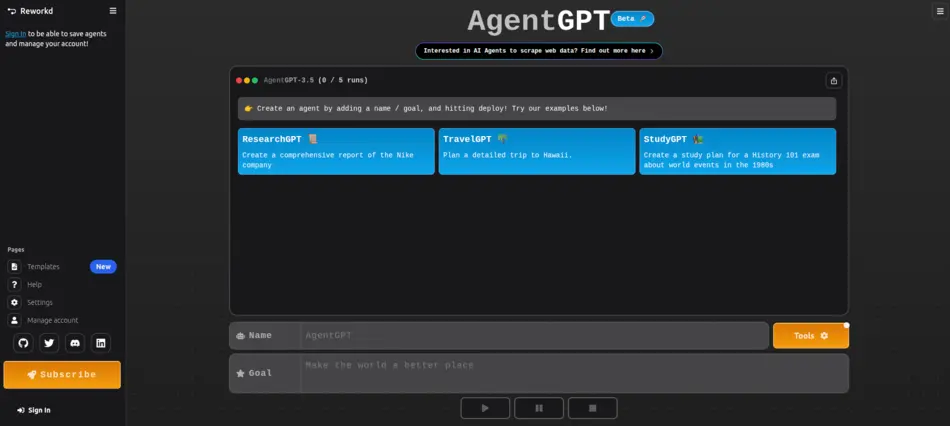
Behind the scenes it uses a loop similar to other agentic frameworks: think → plan tasks → act (call tools / web) → observe → update memory/plan, until a stopping condition such as max steps or success. Users see a running log of thoughts, actions, and results in the browser.
Features and capabilities
AgentGPT is aimed at non-developers who want to try autonomous agents without setting up a local environment. Key capabilities include:
- Creating multiple named agents with different objectives
- Automatic task decomposition and sub-task execution
- Browser-based experience with no CLI or Python required
- Integration with OpenAI models and LangChain tools for web search and simple APIs
Use cases highlighted in tutorials and blogs include research summaries, content drafting, simple growth/marketing experiments, and basic data gathering/analysis from the web.
Limitations and current status
Like many early agent platforms, AgentGPT can be unstable on long or complex tasks: it may loop, hallucinate, or hit API limits and cost ceilings, particularly when using GPT-4 heavily.
The original project saw explosive early adoption (100k+ daily users shortly after launch) but active development slowed around late 2023 after a 1.0.0 release. The code and templates remain available as an open-source starting point for building autonomous-agent-style experiences, but newer agent frameworks and commercial platforms have since emerged with more robust tooling and governance.