In 2026, the best AI tools for manufacturing & supply chain optimization include IBM Watson Supply Chain, SAP IBP, Oracle SCM Cloud, Blue Yonder, Siemens Opcenter, PTC ThingWorx, C3 AI, o9 Solutions, Kinaxis, Coupa (Llamasoft), Uptake, Augury, Fero Labs, Project44 (ClearMetal), and FourKites. These platforms enable predictive maintenance, AI demand forecasting, inventory optimization, warehouse automation, and real-time logistics visibility. AI in supply chain management improves forecasting accuracy, reduces downtime, lowers costs, and increases operational resilience across global manufacturing networks.
Key Takeaways
AI tools for manufacturing significantly reduce unplanned downtime through predictive maintenance AI.
AI in supply chain planning improves forecast accuracy by up to 30–50% in many enterprise implementations.
Industry 4.0 AI tools integrate IoT, ERP, and MES systems for real-time decision-making.
AI inventory management reduces excess stock while minimizing stockouts.
Smart factory AI platforms are shifting supply chains toward autonomous operations.
ROI typically becomes visible within 12–24 months for mid-to-large enterprises.
Global supply chains are no longer predictable highways of goods and materials. They are dynamic, complex ecosystems shaped by geopolitical shifts, fluctuating demand, rising costs, labor shortages, and sustainability pressures. Manufacturers in 2026 face a critical question: How do you stay resilient while remaining competitive? The answer, increasingly, lies in leveraging the Best AI Tools for Manufacturing & Supply Chain operations. From AI demand forecasting tools to predictive maintenance AI systems and smart factory AI platforms, artificial intelligence is no longer optional—it’s foundational to modern Industry 4.0 strategies. Companies that invest in AI tools for manufacturing and AI in supply chain management are reducing downtime, improving forecast accuracy, optimizing inventory, and building more autonomous operations. In this in-depth guide, we rank the top 15 platforms driving supply chain optimization software innovation in 2026, explain real-world use cases, and help you choose the right solution for your organization.
Why AI is Transforming Manufacturing & Supply Chains in 2026
The acceleration of AI in supply chain environments is driven by necessity. Disruptions—whether from pandemics, geopolitical conflicts, or raw material shortages—have exposed weaknesses in traditional planning systems. Modern supply chain optimization software uses machine learning to analyze massive datasets across procurement, production, and logistics.
Smart factories powered by Industry 4.0 AI tools connect sensors, ERP systems, and manufacturing execution systems (MES) to create a real-time operational view. Instead of reactive management, companies now use predictive analytics to anticipate failures, optimize production schedules, and manage inventory dynamically.
According to insights published by McKinsey Operations, AI-driven forecasting and automation significantly improve supply reliability and cost efficiency. Similarly, research from Gartner Supply Chain highlights how AI demand forecasting tools outperform traditional statistical models.
In simple terms: AI enables manufacturers to move from “firefighting” to “future-proofing.”
How We Selected the Top 15 AI Tools (Methodology)
To ensure credibility and EEAT compliance, we evaluated each platform based on:
Depth of AI capabilities (ML, predictive analytics, automation)
Industry adoption and enterprise usage
ERP, IoT, and MES integration compatibility
Pricing transparency
Scalability and cloud/hybrid deployment
Customer case studies and performance outcomes
This structured evaluation ensures that the Best AI Tools for Manufacturing & Supply Chain listed here represent mature, enterprise-ready solutions—not hype-driven startups.
Top 15 AI Tools for Manufacturing & Supply Chain Optimization in 2026
1. IBM Watson Supply Chain
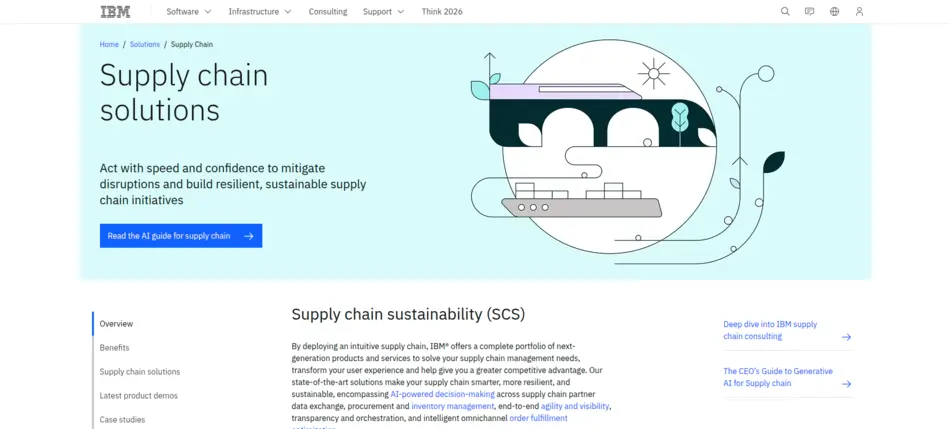
IBM Watson Supply Chain combines AI-driven risk management with real-time visibility across the entire supply chain. By analyzing vast datasets from suppliers, logistics, production, and market trends, it identifies vulnerabilities before they escalate into costly disruptions. Its cognitive analytics and machine learning models make it ideal for complex, global operations where delays or stockouts can cause significant revenue losses.
Key Features:
AI-Powered Risk Alerts: Automatically flags potential supplier delays, geopolitical risks, or transportation disruptions.
Supply Chain Digital Twin: Creates a virtual replica of your supply chain for simulation, scenario analysis, and stress testing.
Advanced Predictive Analytics: Forecasts demand spikes, bottlenecks, and inventory shortages with high accuracy.
ERP Integrations: Works seamlessly with SAP, Oracle, and other enterprise systems to ensure unified decision-making.
Collaboration Tools: Enables supplier collaboration through a centralized digital workspace.
Sustainability Tracking: Monitors carbon footprint, waste reduction, and compliance with ESG standards.
Best For: Large enterprises managing global supplier networks or highly complex logistics systems.
Pricing: Custom enterprise pricing based on scale, modules, and cloud deployment.
Pros: Strong AI maturity, deep analytics capabilities, flexible integration options, global risk monitoring.
Cons: High implementation cost, requires specialized staff for full adoption.
Why It Stands Out in 2026: Its ability to proactively identify supplier risks, simulate “what-if” scenarios, and provide actionable insights makes it essential for resilient, future-ready supply chains. Many Fortune 500 companies rely on Watson Supply Chain for operational continuity in volatile markets.
Website: https://www.ibm.com/solutions/supply-chain
2. SAP Integrated Business Planning (IBP)

SAP IBP empowers manufacturers with advanced AI demand forecasting tools embedded within the SAP ERP ecosystem. It integrates predictive analytics, scenario planning, and real-time inventory management to reduce stockouts, optimize inventory levels, and align production with demand signals. Its modular design supports multiple industries, from automotive to consumer goods.
Key Features:
Predictive Forecasting: Machine learning algorithms analyze historical sales, market trends, and seasonality.
Real-Time Inventory Planning: Dynamically adjusts inventory levels to prevent overstock or shortages.
Scenario Simulation: Enables companies to test multiple “what-if” scenarios, such as supply disruptions or demand surges.
Integrated Supply Network Planning: Connects suppliers, distributors, and production for end-to-end visibility.
Collaboration & Alerts: Automated notifications for supply chain anomalies or forecast deviations.
Best For: Companies already using SAP ERP or SAP S/4HANA looking for seamless AI-driven planning integration.
Pricing: Subscription-based licensing; typically tiered by module and company size.
Pros: Tight integration with SAP ecosystems, scalable for global operations, robust forecasting capabilities.
Cons: Best performance requires existing SAP infrastructure; learning curve for smaller teams.
Why It Stands Out in 2026: SAP IBP’s combination of predictive analytics and scenario planning gives supply chain planners confidence to make proactive decisions. Its AI-driven insights significantly reduce human error and improve supply-demand alignment.
Website: https://www.sap.com/products/scm/integrated-business-planning.html
3. Oracle Supply Chain Management Cloud
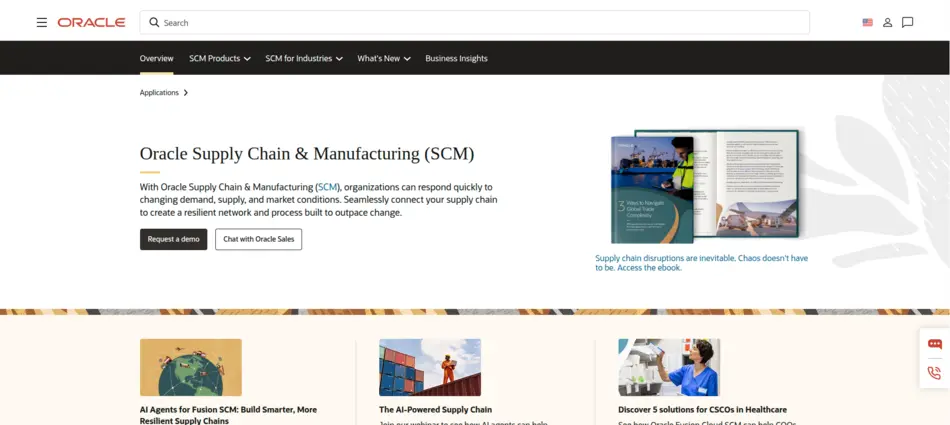
Oracle SCM Cloud is a comprehensive AI-powered platform for supply chain optimization that centralizes procurement, production, and logistics in one cloud-native solution. Its AI capabilities automate routine tasks, uncover inefficiencies, and provide real-time insights across your network, enabling faster and smarter decision-making.
Key Features:
Intelligent Inventory Optimization: Automatically recommends optimal stock levels and replenishment schedules.
Autonomous Logistics Planning: Uses AI to select shipping routes, carriers, and transportation methods efficiently.
AI-Driven Analytics Dashboards: Real-time KPIs for inventory turnover, supplier performance, and logistics costs.
Integrated Procurement Management: Enhances supplier collaboration and contract optimization.
Predictive Maintenance Integration: Links production schedules with equipment maintenance to avoid downtime.
Best For: Cloud-first manufacturers, large-scale distributors, and enterprises seeking scalable AI-driven supply chain solutions.
Pricing: Enterprise subscription pricing; modular based on functionality and number of users.
Pros: Cloud-native architecture, strong predictive analytics, easy scalability, robust integration with Oracle ERP and other systems.
Cons: Premium pricing, may require professional services for complex deployments.
Why It Stands Out in 2026: Its cloud-first approach, combined with autonomous AI capabilities, allows manufacturers to scale efficiently while reducing manual operational overhead and improving supply chain agility.
Website: https://www.oracle.com/scm/
4. Blue Yonder Luminate Platform

Blue Yonder’s Luminate Platform uses AI logistics automation to optimize warehousing, transportation, and supply chain planning. Leveraging machine learning, it improves warehouse operations, inventory allocation, and delivery forecasting while connecting suppliers and distributors for end-to-end visibility.
Key Features:
Machine Learning for Forecasting: Accurately predicts demand fluctuations and seasonal trends.
AI-Optimized Warehouse Management: Automates picking, packing, and inventory replenishment.
Transportation Planning Automation: Suggests optimal routes and carrier assignments to reduce cost and delivery times.
Real-Time Visibility: Offers dashboards for supply chain KPIs and performance monitoring.
Exception Management: Detects deviations in supply or delivery and recommends corrective actions.
Best For: Retailers, distributors, and logistics-heavy manufacturers seeking AI-driven warehouse and transportation optimization.
Pricing: Enterprise pricing model, often customized based on modules and data volume.
Pros: Strong ML-driven forecasting, integrated warehouse management, excellent analytics.
Cons: Advanced features may require staff training, implementation can be complex.
Why It Stands Out in 2026: Luminate combines predictive intelligence with operational automation, making it ideal for companies aiming to reduce logistics costs while increasing service levels.
Website: https://blueyonder.com/
5. Siemens Opcenter
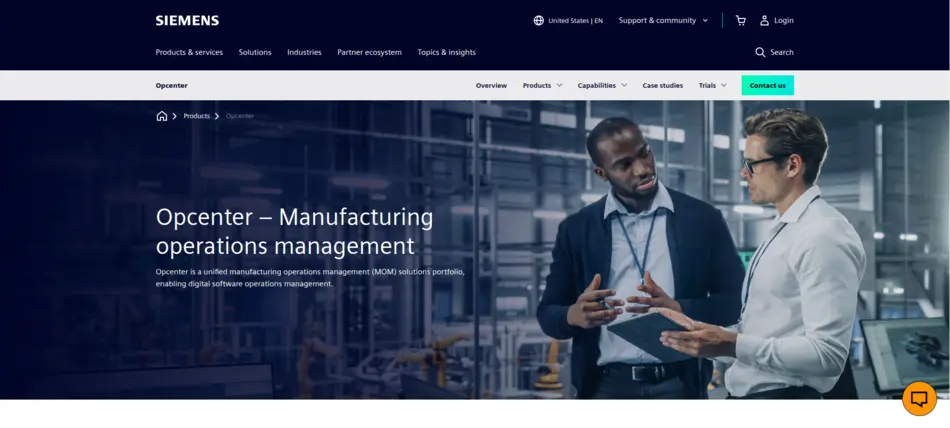
Siemens Opcenter is a smart manufacturing execution system that integrates industrial AI platforms for production planning, quality management, and operational efficiency. By connecting real-time shop floor data with predictive algorithms, it enables manufacturers to optimize throughput, reduce waste, and accelerate time-to-market.
Key Features:
AI-Enhanced Production Scheduling: Allocates resources optimally and minimizes downtime.
Quality Management Analytics: Detects production defects early using ML-based pattern recognition.
Industrial IoT Integration: Collects data from machines and sensors for predictive analytics.
Digital Twin Support: Simulates production scenarios to forecast outcomes and optimize processes.
Energy & Resource Optimization: Monitors energy consumption and identifies efficiency improvements.
Best For: Industrial manufacturers seeking to integrate smart factory AI with production operations.
Pricing: Custom, based on scale, modules, and number of production lines.
Pros: Comprehensive shop floor visibility, strong AI for predictive planning, supports Industry 4.0 initiatives.
Cons: Requires digital maturity and staff expertise, higher upfront cost.
Why It Stands Out in 2026: Opcenter’s ability to bridge production data with predictive analytics and smart factory AI ensures manufacturers can meet tight production schedules while maintaining quality and reducing operational costs.
Website: https://www.siemens.com/en-us/products/opcenter/
6. PTC ThingWorx

PTC ThingWorx is a leading Industrial IoT + smart factory AI platform designed to provide real-time visibility into production processes. By combining IoT sensors, edge computing, and AI analytics, ThingWorx enables manufacturers to monitor machinery, track asset performance, and optimize operations on the fly. It is particularly useful in complex, high-volume manufacturing environments where real-time insights can prevent costly downtime.
Key Features:
Real-Time Production Monitoring: Provides dashboards with live updates from equipment and production lines.
Predictive Analytics: Anticipates machine failures, bottlenecks, or quality deviations before they impact operations.
Smart Factory Integration: Connects IoT devices, ERP systems, and MES platforms for seamless data flow.
Digital Twin Capabilities: Simulates production lines for scenario testing and process optimization.
Customizable Alerts & Workflows: Sends notifications for abnormal events and triggers automated corrective actions.
Best For: Manufacturers aiming to implement smart factories or adopt Industry 4.0 initiatives.
Pricing: Custom enterprise pricing, typically subscription-based.
Pros: Real-time insights, predictive maintenance support, flexible IoT integration, scalable for multiple sites.
Cons: Requires IoT infrastructure investment, implementation complexity for smaller factories.
Why It Stands Out in 2026: ThingWorx enables true connected factories, combining AI and IoT to create actionable insights that improve production efficiency, reduce waste, and enhance operational resilience.
Website: https://www.ptc.com/en/products/thingworx
7. C3 AI Supply Chain Suite
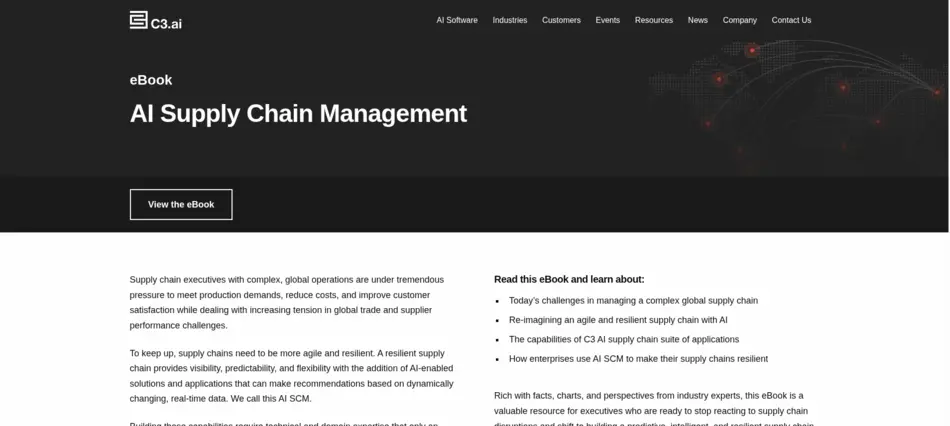
C3 AI Supply Chain Suite is an enterprise-grade AI platform that provides predictive intelligence for supply chain risk management, demand sensing, and operational optimization. It leverages big data analytics and machine learning to provide end-to-end visibility across procurement, logistics, and production.
Key Features:
AI-Powered Risk Mitigation: Predicts supply chain disruptions from geopolitical, weather, or supplier-related factors.
Demand Sensing & Forecasting: Improves forecast accuracy with advanced machine learning algorithms.
Inventory & Logistics Optimization: Automates replenishment decisions to reduce carrying costs.
Supplier Performance Monitoring: Tracks KPIs to ensure compliance and reliability.
Cloud-Native Architecture: Enables fast deployment and enterprise-wide scalability.
Best For: Large enterprises needing predictive insights across complex, global supply networks.
Pricing: Enterprise subscription-based; customized according to modules and company scale.
Pros: Advanced AI algorithms, high scalability, strong analytics dashboards.
Cons: High learning curve, requires data maturity for optimal results.
Why It Stands Out in 2026: Its ability to provide predictive intelligence for risk mitigation and operational efficiency makes it ideal for enterprises seeking proactive supply chain management.
Website: https://c3.ai/ai-supply-chain-management/
8. o9 Solutions
o9 Solutions offers an AI-based digital twin and demand planning platform designed to make supply chains more agile and resilient. By simulating real-world supply chain networks and forecasting demand, o9 helps organizations plan strategically and respond quickly to market fluctuations.
Key Features:
Digital Twin Modeling: Creates a virtual model of the entire supply chain to simulate scenarios.
AI Demand Planning: Machine learning predicts market demand and optimizes production schedules.
End-to-End Supply Chain Visibility: Integrates suppliers, distributors, and internal operations.
Scenario Analysis & What-If Planning: Helps evaluate risk, capacity, and financial impact.
Collaborative Planning Tools: Aligns cross-functional teams on supply chain decisions.
Best For: Enterprises that need agile supply chain planning and fast scenario-based decision-making.
Pricing: Custom enterprise pricing depending on modules, users, and data volume.
Pros: Strong digital twin capabilities, AI-driven demand insights, collaborative planning features.
Cons: Complex implementation, requires alignment across multiple departments.
Why It Stands Out in 2026: Its digital twin approach allows businesses to predict disruptions, optimize production planning, and create more agile, responsive supply chains—critical in today’s unpredictable market.
Website: https://o9solutions.com/
9. Kinaxis RapidResponse
Kinaxis RapidResponse provides real-time AI-driven supply chain orchestration across procurement, production, and logistics. Its platform enables manufacturers to quickly adapt to demand changes, supply disruptions, and operational bottlenecks.
Key Features:
End-to-End Supply Chain Planning: Connects planning, execution, and performance monitoring in a single platform.
Real-Time Scenario Simulation: Provides rapid “what-if” modeling for supply chain decisions.
Predictive Analytics: Anticipates potential disruptions and recommends corrective actions.
Inventory and Production Optimization: Balances supply and demand in real-time.
Collaboration Across Teams: Facilitates communication between procurement, production, and logistics.
Best For: Mid-to-large manufacturers seeking real-time supply chain control and scenario modeling.
Pricing: Subscription-based, enterprise-level pricing.
Pros: Fast scenario simulations, AI-driven orchestration, strong real-time visibility.
Cons: Higher cost for smaller manufacturers, requires integration with existing ERP systems.
Why It Stands Out in 2026: Its real-time orchestration and scenario modeling provide agility that is critical for companies managing complex supply networks with frequent disruptions.
Website: https://www.kinaxis.com/
10. Coupa Supply Chain Design (Llamasoft)
Coupa Supply Chain Design (Llamasoft) provides network modeling AI for supply chain restructuring, optimization, and risk planning. Its predictive analytics and simulation tools enable manufacturers to design resilient supply chain networks that reduce costs and improve service levels.
Key Features:
Supply Chain Network Modeling: Simulates global supply chain structures to identify optimal configurations.
AI-Driven Scenario Planning: Tests strategies for demand spikes, disruptions, or capacity constraints.
Risk Assessment Tools: Evaluates supplier and logistics vulnerabilities proactively.
Inventory & Logistics Optimization: Suggests strategies to minimize costs while maintaining service quality.
Integration with ERP & BI Systems: Provides a comprehensive view of operational and financial impact.
Best For: Enterprises planning supply chain redesigns or optimizing complex global networks.
Pricing: Enterprise pricing based on scope of deployment and modules.
Pros: Excellent network optimization, scenario analysis, strong analytics.
Cons: Requires data completeness, high learning curve for staff.
Why It Stands Out in 2026: Its AI-driven network modeling allows companies to build more resilient, cost-efficient supply chains—particularly useful in unpredictable global markets.
Website: https://www.coupa.com/products/supply-chain-design/
11. Uptake
Uptake provides predictive maintenance AI that reduces unplanned equipment downtime and improves asset utilization. Using industrial sensors, historical maintenance data, and machine learning, it predicts failures before they occur, enabling proactive maintenance strategies.
Key Features:
Predictive Equipment Analytics: Anticipates component failures to reduce downtime.
Maintenance Scheduling Optimization: Aligns preventive maintenance with production schedules.
Asset Performance Management: Monitors health, efficiency, and usage patterns.
Integration with ERP & CMMS: Links predictive insights with operational systems for automated workflows.
Root Cause Analysis: AI identifies underlying causes of recurring failures.
Best For: Industrial manufacturers with high-value machinery or complex production lines.
Pricing: Enterprise subscription or module-based pricing.
Pros: Reduces downtime, improves asset ROI, actionable insights for maintenance teams.
Cons: Requires sensor installation and historical data for optimal accuracy.
Why It Stands Out in 2026: Its predictive maintenance AI saves millions in operational costs and enables manufacturers to transition from reactive to proactive maintenance strategies—critical in high-capital industries.
Website: https://uptake.com/
12. Augury
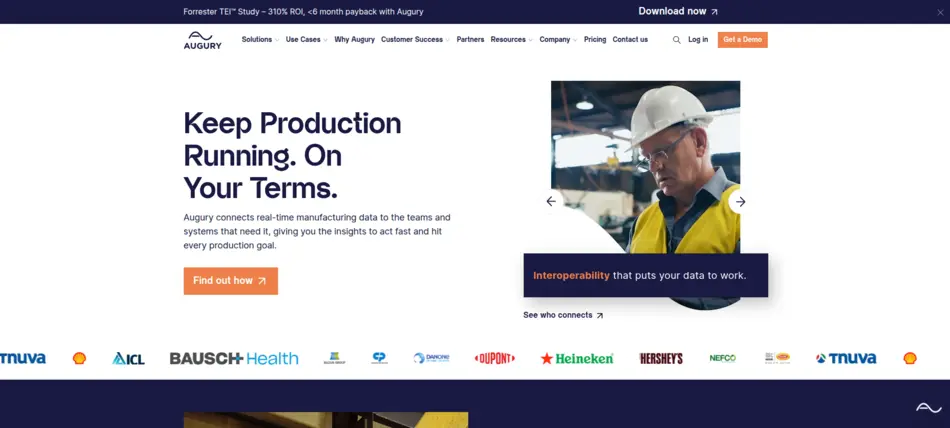
Augury leverages machine learning-based production health monitoring to provide manufacturers with deep insights into machinery performance. By combining sensor data, vibration analysis, and AI algorithms, Augury identifies anomalies in equipment behavior and predicts potential failures before they occur. This helps production teams reduce downtime, avoid costly repairs, and maintain high-quality output.
Key Features:
Real-Time Equipment Monitoring: Tracks vibration, temperature, and operational metrics continuously.
Predictive Failure Alerts: Uses AI to detect early signs of mechanical issues.
Root Cause Analysis: Provides actionable insights to prevent recurring problems.
Integration with Maintenance Systems: Works with CMMS and ERP platforms for automated workflow.
Operational Dashboards: Centralized view of equipment health across multiple sites.
Energy & Efficiency Tracking: Monitors energy usage and identifies opportunities for operational cost reduction.
Best For: Manufacturers seeking proactive maintenance solutions and those operating high-value machinery with frequent downtime risks.
Pricing: Custom enterprise subscription based on number of assets and features.
Pros: Reduces unplanned downtime, actionable insights, scalable for multiple facilities.
Cons: Requires sensor deployment and data collection before full benefits are realized.
Why It Stands Out in 2026: Augury’s combination of AI, ML, and IoT ensures production lines run smoothly, while predictive insights enable more efficient maintenance planning and cost savings, making it a go-to solution for smart factories.
Website: https://www.augury.com/
13. Fero Labs

Fero Labs focuses on AI-driven process optimization for manufacturing operations. By analyzing machine data, production logs, and environmental conditions, Fero Labs identifies inefficiencies, improves yield, and reduces operational costs. Its AI models continuously learn from ongoing production to recommend process adjustments in real time.
Key Features:
Yield Improvement Analytics: Optimizes process parameters to maximize production output.
Energy and Resource Efficiency: Identifies areas to reduce waste and energy consumption.
Predictive Process Adjustments: Provides real-time guidance for process modifications.
Integration with MES & ERP Systems: Ensures insights feed directly into operational workflows.
Continuous Learning Models: AI adapts over time for improved performance and insights.
Best For: Manufacturers aiming to enhance process efficiency, improve product quality, and reduce costs.
Pricing: Enterprise-level subscription pricing; customized by production scale and module usage.
Pros: Real-time process optimization, actionable AI recommendations, continuous learning for ongoing improvement.
Cons: Requires high-quality production data for maximum effectiveness.
Why It Stands Out in 2026: Fero Labs’ AI approach helps factories achieve higher yields and lower operational costs, making it an ideal tool for companies looking to modernize their production lines with smart analytics.
Website: https://www.ferolabs.com/
14. project44 (ClearMetal)

Project44, including ClearMetal capabilities, delivers AI-powered logistics visibility and transportation analytics. Its platform integrates data from carriers, shipments, and warehouses to provide predictive ETAs, identify potential delays, and optimize supply chain performance. By combining AI with real-time visibility, manufacturers and logistics companies can proactively manage disruptions and improve delivery accuracy.
Key Features:
Real-Time Shipment Tracking: Visibility across all carriers and geographies.
Predictive ETA & Disruption Alerts: AI forecasts delays before they impact operations.
Transportation Optimization: Recommends optimal routes and shipping methods.
Supply Chain Analytics Dashboards: Insights into carrier performance, transit times, and bottlenecks.
Integration with ERP & TMS Systems: Streamlines logistics data across platforms.
Best For: Logistics-heavy manufacturers, third-party logistics providers, and enterprises with global supply networks.
Pricing: Custom enterprise subscription, based on shipment volume and modules.
Pros: Real-time visibility, predictive analytics, strong integration with logistics and ERP systems.
Cons: Implementation complexity for multi-carrier networks.
Why It Stands Out in 2026: Project44’s combination of predictive analytics and real-time shipment visibility empowers companies to proactively manage logistics, reduce late deliveries, and enhance customer satisfaction.
Website: https://www.project44.com/
15. FourKites
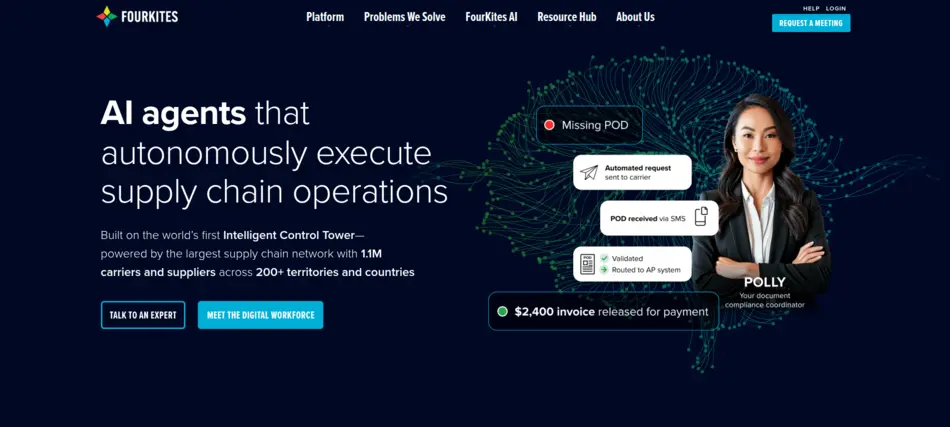
FourKites offers a real-time predictive supply chain visibility platform that tracks shipments across the globe, predicts delays, and provides actionable insights to improve operational efficiency. Its AI-driven algorithms process vast datasets from carriers, suppliers, and weather sources to provide accurate ETA predictions and supply chain risk alerts.
Key Features:
End-to-End Supply Chain Visibility: Monitors shipments, inventory, and supplier performance.
Predictive ETA Analytics: Forecasts potential delays with high accuracy.
Risk Alerts & Recommendations: Provides early warnings for supply disruptions.
Integration with ERP & TMS: Seamless data sharing across operational systems.
Customizable Dashboards & KPIs: Allows teams to monitor metrics relevant to business objectives.
Best For: Manufacturers, distributors, and retailers who require precise delivery planning and proactive supply chain management.
Pricing: Enterprise subscription based on shipment volume, users, and functionality.
Pros: Accurate predictive insights, improves delivery performance, actionable supply chain intelligence.
Cons: Subscription cost may be high for small businesses.
Why It Stands Out in 2026: Its real-time predictive capabilities allow supply chain teams to make informed decisions quickly, reducing delays, enhancing customer satisfaction, and improving overall supply chain efficiency.
Website: https://www.fourkites.com/
Comparison Table – Top 15 Manufacturing & Supply Chain AI Tools (2026)
| Tool Name | Best For | Core AI Capability | Deployment Type | Pricing Model | Enterprise Ready |
|---|---|---|---|---|---|
| IBM Watson Supply Chain | Large enterprises with global supplier networks | AI-driven risk management, predictive analytics, digital twin | Cloud / Hybrid | Custom enterprise pricing | ✅ |
| SAP Integrated Business Planning (IBP) | SAP ERP users | Predictive demand forecasting, real-time inventory planning | Cloud / On-Prem | Subscription-based | ✅ |
| Oracle Supply Chain Management Cloud | Cloud-first manufacturers | Autonomous logistics planning, intelligent inventory optimization | Cloud | Enterprise subscription | ✅ |
| Blue Yonder Luminate Platform | Retailers, logistics-heavy manufacturers | AI logistics automation, warehouse optimization | Cloud | Enterprise pricing | ✅ |
| Siemens Opcenter | Industrial manufacturers, smart factories | Smart manufacturing execution, predictive production analytics | Cloud / Hybrid | Custom enterprise | ✅ |
| PTC ThingWorx | Smart factory adopters | Industrial IoT + AI, real-time production monitoring, predictive maintenance | Cloud / On-Prem | Custom subscription | ✅ |
| C3 AI Supply Chain Suite | Large global enterprises | Predictive supply chain intelligence, risk mitigation | Cloud | Enterprise subscription | ✅ |
| o9 Solutions | Agile supply chains | AI-based digital twin, demand planning, scenario simulation | Cloud | Custom enterprise | ✅ |
| Kinaxis RapidResponse | Mid-to-large manufacturers | Real-time supply chain orchestration, predictive analytics | Cloud | Subscription-based | ✅ |
| Coupa Supply Chain Design (Llamasoft) | Enterprises planning supply chain redesigns | Network modeling AI, risk planning, optimization | Cloud | Enterprise subscription | ✅ |
| Uptake | Industrial manufacturers with high-value machinery | Predictive maintenance AI, equipment health monitoring | Cloud / Hybrid | Enterprise subscription | ✅ |
| Augury | Manufacturers seeking proactive maintenance | Machine learning production health monitoring | Cloud / Edge | Custom subscription | ✅ |
| Fero Labs | Manufacturers aiming for yield improvement | AI-driven process optimization, cost reduction | Cloud | Enterprise pricing | ✅ |
| project44 (ClearMetal) | Logistics-heavy manufacturers | AI-powered logistics visibility, transportation analytics | Cloud | Enterprise subscription | ✅ |
| FourKites | Manufacturers, distributors, and retailers | Real-time predictive supply chain visibility | Cloud | Subscription-based | ✅ |
Key AI Use Cases in Manufacturing & Supply Chain
Predictive Maintenance
Predictive maintenance AI uses sensor data to anticipate equipment failure before it occurs, reducing downtime dramatically.
AI Demand Forecasting
AI demand forecasting tools analyze historical data, seasonality, and market signals for improved accuracy.
Inventory Optimization
AI inventory management systems balance carrying costs with service levels.
Warehouse Automation
AI logistics automation improves picking accuracy and labor efficiency.
Supply Chain Risk Management
AI identifies potential supplier disruptions before they impact production.
Production Planning Optimization
Smart factory AI enhances scheduling and resource allocation.
Benefits of Using AI in Manufacturing & Supply Chain
Reduced downtime
Lower operational costs
Improved demand forecasting
Faster production cycles
Enhanced supplier collaboration
Challenges & Limitations of AI Adoption
High upfront costs
Data silos
Integration complexity
Workforce reskilling requirements
Future Trends – AI in Smart Manufacturing 2026 & Beyond
Digital twins
Generative AI in planning
Autonomous supply chains
Edge AI in industrial IoT
Frequently Asked Questions
What are the best AI tools for supply chain optimization in 2026?
IBM Watson, SAP IBP, Oracle SCM Cloud, Blue Yonder, and Kinaxis lead enterprise adoption.
How is AI used in manufacturing?
Through predictive maintenance, smart production scheduling, and automated quality control.
Is AI expensive for small manufacturers?
Costs vary, but cloud-based solutions reduce upfront investment.
Final Verdict – Which AI Tool Should You Choose?
For large enterprises: IBM, SAP, Oracle.
For mid-size manufacturers: o9, Kinaxis.
For predictive maintenance focus: Uptake, Augury.
For logistics-heavy operations: Project44, FourKites.
If you’re comparing solutions, platforms like AI Tool Mapper help evaluate AI tools for manufacturing based on feature depth and use case alignment.
Found this helpful? Save it to your Pinterest board!