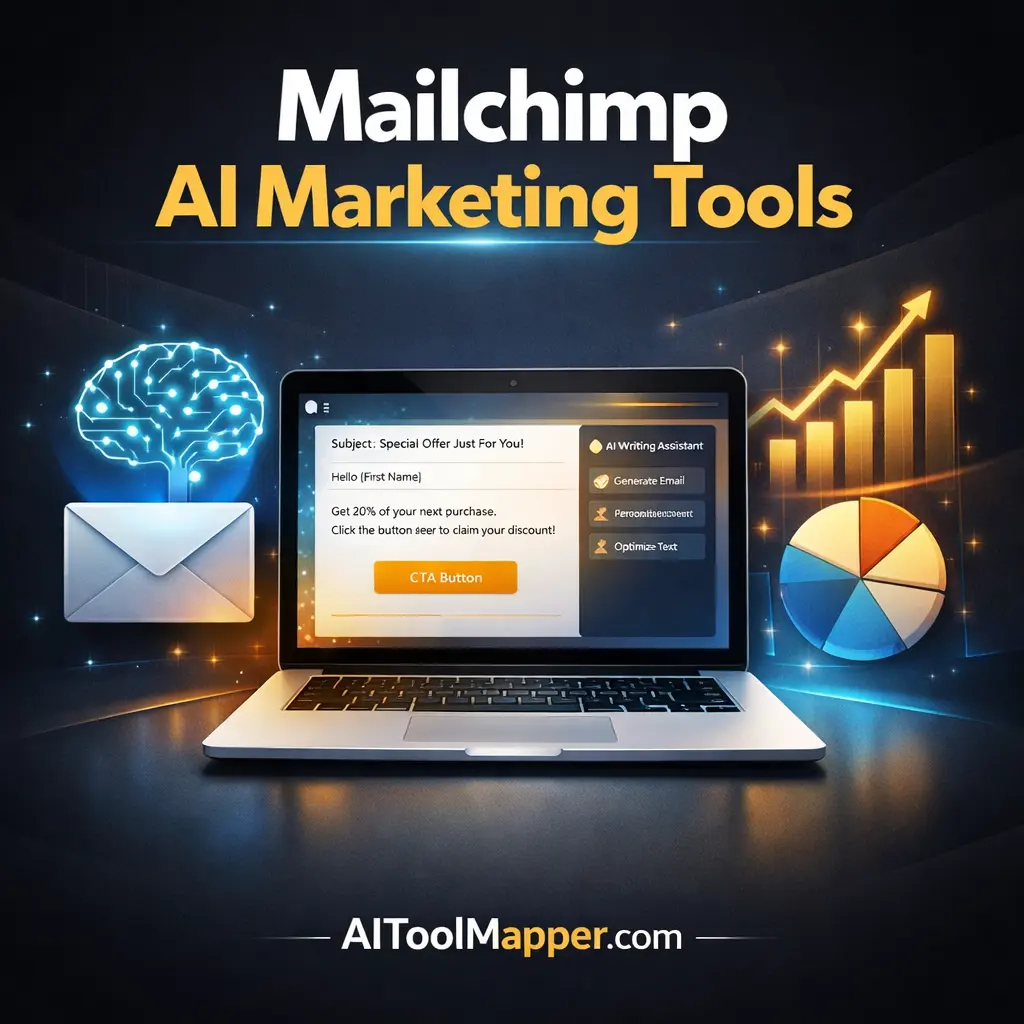
Mailchimp AI Marketing Tools are built-in artificial intelligence features designed to automate email marketing, generate content, optimize campaigns, and improve audience targeting. These tools use machine learning, predictive analytics, and behavioral data to help businesses send the right message to the right audience at the right time.
Key capabilities include AI email writing, predictive analytics, send-time optimization, automated audience segmentation, and AI-driven product recommendations. Businesses use these tools to increase email open rates, personalize campaigns, and scale marketing automation with minimal manual effort.
Platforms like Mailchimp integrate AI directly into their marketing automation system, making advanced AI marketing accessible even to small businesses and startups.
Key Takeaways
- Mailchimp AI Marketing Tools help automate email marketing campaigns using artificial intelligence.
- AI features include content generation, predictive analytics, and send-time optimization.
- Businesses can improve personalization and audience targeting with AI segmentation.
- AI-powered automation increases campaign efficiency and marketing ROI.
- Platforms like Mailchimp make advanced AI marketing accessible even for small businesses.
Getting Started with Mailchimp AI Marketing Tools
Artificial intelligence is transforming nearly every part of digital marketing. From predictive customer insights to automated campaign optimization, AI has become the secret weapon behind modern marketing strategies.
Email marketing—once a manual and time-consuming process—is now becoming smarter and more efficient thanks to AI-powered platforms.
One of the most widely used platforms leading this transformation is Mailchimp. Originally known for simple email newsletters, the platform has evolved into a full marketing automation ecosystem powered by intelligent algorithms.
Today, Mailchimp AI Marketing Tools help marketers:
- Write emails automatically
- Predict customer behavior
- Optimize send times
- Segment audiences intelligently
- Personalize campaigns at scale
Think of it like having a marketing assistant that never sleeps—constantly analyzing data, learning from customer interactions, and improving your campaigns.
And the best part?
You don’t need to be a data scientist to use it.
In this guide, we’ll explore how Mailchimp AI works, the tools it offers, practical use cases, and expert strategies to maximize its potential.
Whether you run a startup, eCommerce brand, SaaS company, or marketing agency, understanding Mailchimp AI marketing automation could dramatically improve your campaign performance.
What Are Mailchimp AI Marketing Tools?
Mailchimp AI Marketing Tools are intelligent features inside the Mailchimp platform that use artificial intelligence and machine learning to automate and optimize marketing campaigns.
These tools analyze large amounts of user data such as:
- customer behavior
- email engagement
- purchase history
- website interactions
Using this information, the AI system identifies patterns and predicts what customers are most likely to do next.
For example:
If a user frequently clicks product emails but hasn’t purchased yet, Mailchimp’s AI may recommend sending a personalized discount email.
Or if your subscribers usually open emails around 8 PM, AI will automatically schedule campaigns during that time.
How AI Works Inside Mailchimp
The platform combines several technologies:
Machine Learning Algorithms
Continuously learn from campaign performance and user behavior.
Predictive Analytics
Forecast future customer actions like purchase likelihood.
Generative AI
Write email copy, subject lines, and marketing content.
Behavioral Segmentation
Automatically group users based on engagement patterns.
Together, these capabilities turn Mailchimp from a simple email tool into a full AI-powered marketing platform.
Key AI Features in Mailchimp
Let’s break down the most powerful Mailchimp AI features marketers use today.
1. AI Email Content Generator
Creating engaging email content can take hours. AI dramatically reduces this time.
Mailchimp’s AI content generator helps marketers automatically create:
- marketing email copy
- subject lines
- product descriptions
- promotional messages
The tool analyzes your campaign goal, audience segment, and brand tone to generate optimized email content.
For example, if you’re launching a new product, the AI can instantly generate:
- a subject line optimized for high open rates
- engaging promotional text
- call-to-action suggestions
This feature functions similarly to modern generative AI writing systems.
It’s essentially a built-in AI email writer for marketing campaigns.
2. Predictive Analytics
Predictive analytics is one of the most powerful AI capabilities in Mailchimp.
It analyzes past behavior to forecast future actions.
The system can estimate:
- Customer Lifetime Value (CLV)
- Purchase probability
- Churn likelihood
For instance, if AI predicts that a user is highly likely to buy within the next week, marketers can send targeted offers to accelerate the conversion.
These predictive insights allow businesses to focus their marketing efforts where they matter most.
3. Send-Time Optimization
Timing can make or break an email campaign.
Send too early, and subscribers might miss it.
Send too late, and it gets buried under dozens of emails.
Mailchimp’s send-time optimization analyzes historical engagement data to determine when each subscriber is most likely to open emails.
Instead of sending emails at the same time for everyone, the AI schedules delivery individually for each subscriber.
This dramatically increases open rates and click-through rates.
4. AI Audience Segmentation
Traditional email segmentation requires manual work.
You must define segments like:
- active users
- new subscribers
- repeat buyers
Mailchimp’s AI automates this process.
Using behavioral data, the system automatically groups users into intelligent segments such as:
- high-value customers
- inactive subscribers
- frequent buyers
- potential churn users
This allows marketers to send hyper-personalized email campaigns without manual analysis.
5. AI Product Recommendations
For eCommerce businesses, this feature is a game changer.
Mailchimp AI analyzes:
- browsing history
- purchase patterns
- product interests
It then automatically suggests products to include in email campaigns.
This works similarly to recommendation systems used by companies like Amazon.
The result?
More relevant emails and higher conversion rates.
Benefits of Using Mailchimp AI Marketing Tools
Why are marketers rapidly adopting AI marketing platforms?
Because the results are measurable.
Let’s explore the main advantages.
Higher Email Open Rates
AI optimizes subject lines and send times.
When campaigns arrive exactly when users are most likely to read them, engagement increases significantly.
Marketers often report 20-30% higher open rates when using AI optimization.
Better Customer Personalization
Consumers expect personalized experiences.
Generic marketing emails no longer work.
Mailchimp AI enables personalization at scale by automatically tailoring content based on customer behavior.
Faster Campaign Creation
Without AI, creating campaigns requires:
- writing email copy
- designing layouts
- scheduling delivery
- segmenting audiences
AI automates most of these steps.
Marketers can launch campaigns in minutes instead of hours.
Improved Marketing ROI
Automation reduces manual work while improving campaign performance.
This means businesses spend less time and money while achieving better results.
In other words, AI makes marketing both faster and smarter.
How to Use Mailchimp AI Tools (Step-by-Step Guide)
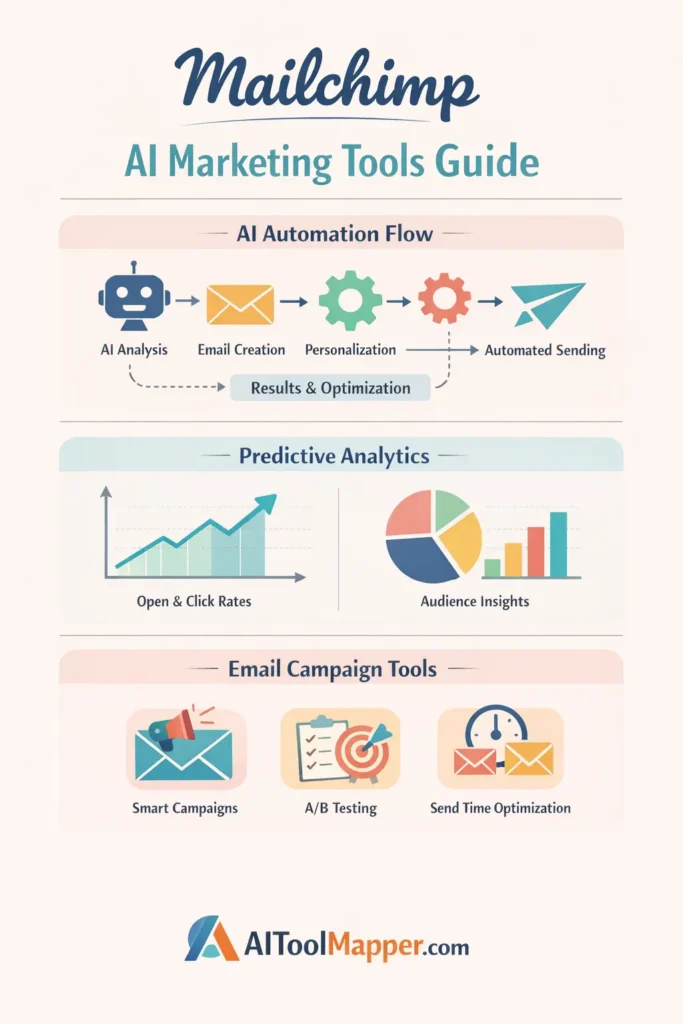
If you’re new to AI marketing, getting started with Mailchimp is surprisingly simple.
Here’s a practical walkthrough.
Step 1: Create a Mailchimp Account
Visit the official website of Mailchimp and sign up.
The platform offers a free plan for beginners.
Once registered, you’ll access the dashboard where all AI tools are available.
Step 2: Set Up Audience Data
Upload your contact list or connect your CRM.
Mailchimp can import data from:
- Shopify stores
- WordPress websites
- CRM platforms
The more data you provide, the better the AI predictions become.
Step 3: Use AI Content Assistant
When creating an email campaign, enable the AI content assistant.
Provide simple prompts like:
“Write a promotional email for a new product launch.”
Within seconds, the AI generates email content and subject line suggestions.
Step 4: Enable Automation Workflows
Automation workflows allow emails to trigger based on user actions.
Examples include:
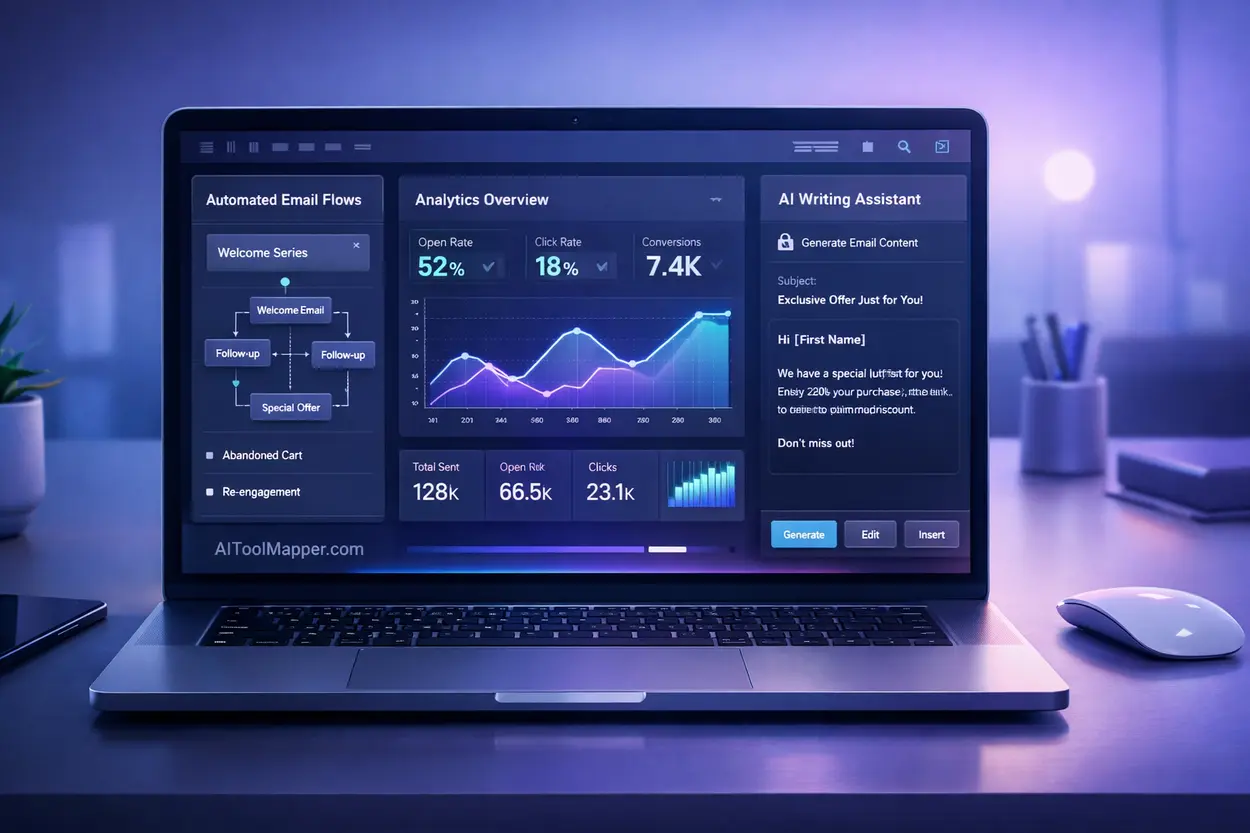
- welcome emails
- abandoned cart reminders
- lead nurturing sequences
AI optimizes these workflows over time.
Step 5: Analyze AI Campaign Insights
Once campaigns run, the platform generates analytics dashboards showing:
- open rates
- click-through rates
- conversion performance
Predictive insights also highlight which audiences are most likely to convert.
Mailchimp AI Marketing Tools for Different Businesses
AI marketing tools benefit businesses across industries.
Let’s examine how different organizations use them.
Small Businesses
Small businesses often have limited marketing resources.
AI automation allows them to compete with larger companies.
Common use cases include:
- automated welcome emails
- promotional newsletters
- local marketing campaigns
Mailchimp’s ease of use makes it ideal for entrepreneurs.
eCommerce Stores
For online stores, AI marketing is incredibly valuable.
Mailchimp helps eCommerce brands send:
- product recommendation emails
- abandoned cart reminders
- seasonal promotions
These automated campaigns can dramatically increase online sales.
SaaS Companies
SaaS businesses rely heavily on customer onboarding and retention.
AI marketing automation helps create personalized journeys such as:
- onboarding email sequences
- feature education campaigns
- subscription renewal reminders
These campaigns improve customer engagement and reduce churn.
Mailchimp AI vs Other AI Marketing Tools
Many marketing automation platforms now offer AI capabilities.
Two major competitors are:
- HubSpot
- ActiveCampaign
Here’s how they compare.
| Feature | Mailchimp | HubSpot | ActiveCampaign |
|---|---|---|---|
| AI Email Generator | ✓ | ✓ | ✓ |
| Predictive Analytics | ✓ | ✓ | ✓ |
| Automation Workflows | ✓ | ✓ | ✓ |
| Ease of Use | High | Medium | Medium |
| Pricing Accessibility | High | Lower | Medium |
Mailchimp tends to be easier for beginners, while HubSpot offers deeper enterprise integrations.
Mailchimp AI Pricing & Plans
Mailchimp provides several pricing tiers.
Free Plan
Best for beginners testing email marketing.
Includes:
- basic automation
- limited AI tools
- email campaigns
Essentials Plan
Adds advanced features such as:
- A/B testing
- improved automation
- branding customization
Standard Plan
This plan unlocks most AI capabilities including:
- predictive analytics
- send-time optimization
- audience segmentation
Premium Plan
Enterprise-level features including:
- advanced analytics
- large contact limits
- advanced automation workflows
Best Use Cases for Mailchimp AI Marketing Tools
AI marketing tools shine in real-world applications.
Here are some powerful examples.
AI Email Campaign Automation
Businesses can create campaigns that automatically trigger based on user behavior.
For instance:
A new subscriber automatically receives a welcome series explaining your product.
AI Lead Nurturing
Leads often need multiple touchpoints before converting.
AI identifies which content resonates most and sends personalized messages accordingly.
AI Customer Retention Campaigns
Predictive analytics can identify customers likely to churn.
Businesses can then launch targeted re-engagement campaigns to retain them.
Pros and Cons of Mailchimp AI Tools
Every platform has strengths and limitations.
Pros
- Easy to use
- Powerful automation features
- Built-in AI capabilities
- scalable for businesses
Cons
- advanced AI requires paid plans
- customization limited compared to enterprise platforms
Mailchimp AI Marketing Tips (Expert Strategies)
To get the most out of Mailchimp AI, follow these expert strategies.
Test AI-Generated Subject Lines
Run A/B tests between human-written and AI-generated subject lines.
Often the AI version performs surprisingly well.
Combine Segmentation with Automation
AI segmentation becomes even more powerful when combined with automation workflows.
This allows campaigns to adapt dynamically to user behavior.
Monitor Predictive Insights
Predictive analytics dashboards highlight valuable trends.
Marketers should review them regularly to refine targeting strategies.
Integrate with CRM Systems
Connecting Mailchimp with CRM tools enhances data accuracy and improves AI predictions.
Future of AI in Email Marketing
AI marketing is evolving rapidly.
Future developments will likely include:
- fully autonomous marketing campaigns
- predictive customer journeys
- advanced generative content creation
Platforms like Mailchimp are investing heavily in AI innovation.
Soon, marketers may only need to define campaign goals while AI handles everything else.
At AI Tool Mapper, we track emerging AI marketing technologies and tools that are shaping the next generation of digital marketing platforms.
FAQs
What AI tools does Mailchimp offer?
Mailchimp offers a range of AI-powered tools, including email content generation, predictive analytics, send-time optimization, audience segmentation, and product recommendations. These features analyze customer behavior and campaign performance data to improve personalization, automate workflows, and enhance overall marketing efficiency and results.
Does Mailchimp use generative AI?
Yes, Mailchimp uses generative AI to assist marketers in creating high-quality email content, subject lines, and promotional messaging. By analyzing campaign goals and audience insights, the AI generates tailored content that aligns with brand tone and improves engagement, saving time while maintaining consistency in marketing communication.
Can Mailchimp write marketing emails automatically?
Mailchimp includes an AI content assistant that can automatically generate marketing emails based on user prompts. Marketers simply input campaign details, and the AI produces relevant email copy, subject lines, and call-to-action suggestions, making it easier to create effective campaigns without manual writing effort.
Is Mailchimp AI free?
Mailchimp provides limited AI features within its free plan, allowing users to explore basic automation and content generation. However, advanced capabilities such as predictive analytics, detailed segmentation, and send-time optimization are typically available in paid plans like Standard and Premium, offering more robust AI-driven marketing tools.
How does Mailchimp AI improve email campaigns?
Mailchimp AI enhances email campaigns by analyzing subscriber behavior, optimizing delivery times, generating engaging content, and automatically segmenting audiences. These features work together to increase open rates, improve click-through performance, and deliver more personalized experiences, ultimately boosting conversion rates and marketing ROI.
Conclusion
Artificial intelligence is reshaping the future of digital marketing.
What once required entire marketing teams can now be automated with intelligent software.
Mailchimp’s AI marketing tools provide a powerful combination of:
- automation
- predictive analytics
- generative content creation
- personalized customer engagement
For businesses looking to scale their marketing without increasing workload, adopting AI-powered email marketing automation is no longer optional—it’s essential.
Whether you’re running a startup, online store, or SaaS product, Mailchimp AI can help you build smarter campaigns that deliver better results.