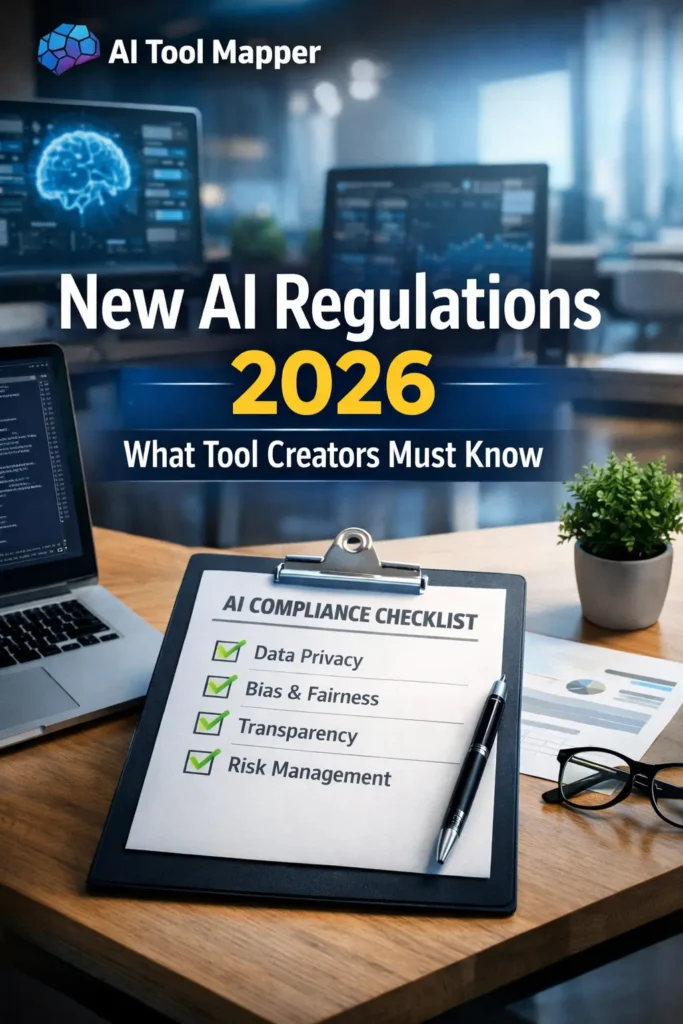

New AI regulations, including the EU AI Act, are reshaping how AI tools must operate. Learn the compliance requirements, risk categories, and practical steps for AI tool creators to ensure transparency, safety, and ethical standards in 2026.
Artificial Intelligence (AI) is no longer just a futuristic concept—it’s an integral part of our daily lives and businesses. From content generators to predictive analytics, AI tools are reshaping industries at an unprecedented pace. However, with this rapid growth comes significant responsibility. Governments around the world are introducing new AI regulations to ensure these technologies are safe, transparent, and ethical. For AI tool creators, this isn’t just a regulatory hoop to jump through—it’s a strategic necessity. Understanding AI legal compliance, navigating the EU AI Act, and preparing for the AI compliance requirements of 2026 can determine the success or failure of an AI product in the market. In this article, we explore what these regulations entail, why they matter, and how creators can ensure their tools remain compliant, ethical, and competitive.
What Are the New AI Regulations?
The surge of AI adoption has prompted lawmakers to rethink traditional tech regulations. Unlike previous laws that applied broadly to software, AI regulations are designed specifically for algorithms that make autonomous decisions, process personal data, or influence human behavior. These rules focus not only on data privacy and security but also on algorithm accountability, risk assessment, and ethical standards.
Traditional tech laws often treated AI like any other software, but the stakes are higher today. Autonomous decisions can impact lives, influence markets, or perpetuate biases. Therefore, regulators worldwide are stepping in with stricter rules to ensure responsible AI and transparent AI governance.
Key Regions Introducing AI Laws
European Union (EU) – The EU is at the forefront with the EU AI Act, a landmark regulation classifying AI systems by risk and imposing strict compliance standards.
United States (US) – While federal AI laws are evolving, multiple states, including California and New York, are introducing AI accountability frameworks and transparency requirements.
United Kingdom (UK) – Post-Brexit, the UK is aligning AI regulations with ethical standards, focusing on bias reduction, AI safety, and algorithm accountability.
Asia-Pacific (China, India, Singapore) – Regulatory approaches vary: China emphasizes AI ethics and social impact, India is drafting AI governance laws for data privacy and public safety, and Singapore promotes responsible AI adoption for businesses.
Understanding the EU AI Act
What is the EU AI Act?
The EU AI Act is the first comprehensive framework that categorizes AI systems based on risk levels and imposes legal requirements accordingly. It affects AI tools used both within the EU and internationally if they target EU users.
Who Does It Apply To?
Any developer, startup, or enterprise providing AI tools to EU citizens, even if based outside the EU, must comply. This includes cloud-based AI services, AI content generators, facial recognition systems, and more.
Why It Matters Even for Non-EU AI Tools
Global AI markets are interconnected. Non-compliance could lead to fines, bans, or reputational damage, making it imperative for all AI creators to align with AI compliance requirements proactively.
AI Risk Categories Explained
Minimal Risk AI – Tools with negligible impact on user rights, requiring basic transparency.
Limited Risk AI – AI that must meet disclosure standards, like chatbots providing automated advice.
High-Risk AI – Systems affecting safety, finance, or legal outcomes, such as AI hiring tools or healthcare AI. They require strict auditing, data records, and human oversight.
Prohibited AI Systems – AI applications banned outright, such as manipulative social scoring or subliminal influence tools.
Penalties for Non-Compliance
Non-compliance can lead to:
- Fines – Up to 6% of global annual turnover for serious breaches.
- Product Bans – Non-compliant AI tools may be removed from markets.
- Legal Consequences – Liability for damages caused by unregulated AI decisions.
How New AI Regulations Impact Tool Creators
AI creators, especially startups, face increased responsibilities:
- Product Design Changes – Algorithms must incorporate transparency, fairness, and safety.
- Data Handling Adjustments – Personal data must be anonymized, securely stored, and audited.
- Documentation & Compliance – Risk assessments, model explainability reports, and training data records become mandatory.
AI Tools Most Affected
- AI Content Generators – Must ensure factual accuracy and disclose AI usage.
- Facial Recognition Tools – Face strict privacy and ethical standards.
- AI Hiring & HR Tools – Require bias reduction and audit trails.
- Healthcare & Finance AI – High-risk systems needing rigorous compliance and monitoring.
Key Compliance Requirements for AI Tool Creators
- Transparency Obligations – Inform users when interacting with AI.
- Data Privacy & Security Standards – Encrypt, anonymize, and restrict access to sensitive data.
- Algorithm Accountability – Maintain clear documentation and explain decision-making logic.
- Human Oversight Requirements – Include human-in-the-loop for high-risk AI systems.
Documentation & Reporting
- Model Training Data Records – Track data sources and preprocessing steps.
- Risk Assessment Reports – Evaluate potential harms and mitigation strategies.
- Explainability Requirements – Ensure AI outputs are understandable by non-experts.
AI Governance & Ethical Responsibilities
AI governance ensures AI systems operate responsibly, transparently, and fairly. Adhering to Responsible AI guidelines includes:
- Bias Reduction & Fairness Checks – Regular audits to prevent discrimination.
- User Consent & Disclosure – Clear notifications about AI use.
- Ethical Decision-Making – Prioritize safety, fairness, and societal well-being.
Practical AI Compliance Checklist for Developers
- Identify AI risk category
- Audit training data
- Add AI disclosures
- Implement human-in-the-loop controls
- Maintain compliance documentation
- Monitor AI behavior post-launch
How AI Tool Marketplaces Like AI Tool Mapper Can Help
Platforms such as AI Tool Mapper promote compliant and ethical AI products. Listing tools on marketplaces increases trust, visibility, and long-term growth, while helping creators showcase adherence to AI compliance requirements.
Future of AI Regulations – What to Expect Next
- Stricter Global AI Laws – More countries adopting AI-specific legal frameworks.
- AI Audits Becoming Standard – Third-party compliance verification.
- Mandatory AI Labeling – Users informed about AI involvement in products.
- Increased Focus on Ethical AI – Governments emphasizing fairness, transparency, and accountability.
FAQs – New AI Regulations Explained
What are the new AI regulations?
They are laws designed to govern AI tools, ensuring transparency, safety, and ethical use, such as the EU AI Act.
Does the EU AI Act apply to my AI tool?
Yes, if your AI tool is offered to EU citizens, regardless of where your company is based.
What happens if an AI tool is non-compliant?
Fines, market bans, and legal liabilities are possible. Non-compliance can also damage brand reputation.
How can startups comply with AI laws affordably?
By auditing data, implementing transparency measures, and using compliance checklists or marketplaces like AI Tool Mapper.
Are free AI tools also regulated?
Yes. AI law applies to all tools regardless of price if they process data, impact decisions, or interact with users.
Conclusion
AI is transforming industries, but new AI regulations are shaping how tools can be developed and deployed responsibly. For creators, staying compliant with the EU AI Act, understanding risk categories, and adhering to AI governance standards isn’t just about legal safety—it’s about building trust and long-term success. Platforms like AI Tool Mapper help developers navigate this landscape while promoting responsible AI innovation. Proactively embracing compliance today ensures your AI tools are ethical, safe, and ready for the evolving 2026 regulatory environment.
Build responsible AI or list compliant tools on AI Tool Mapper today.
Found this helpful? Save it to your Pinterest board!