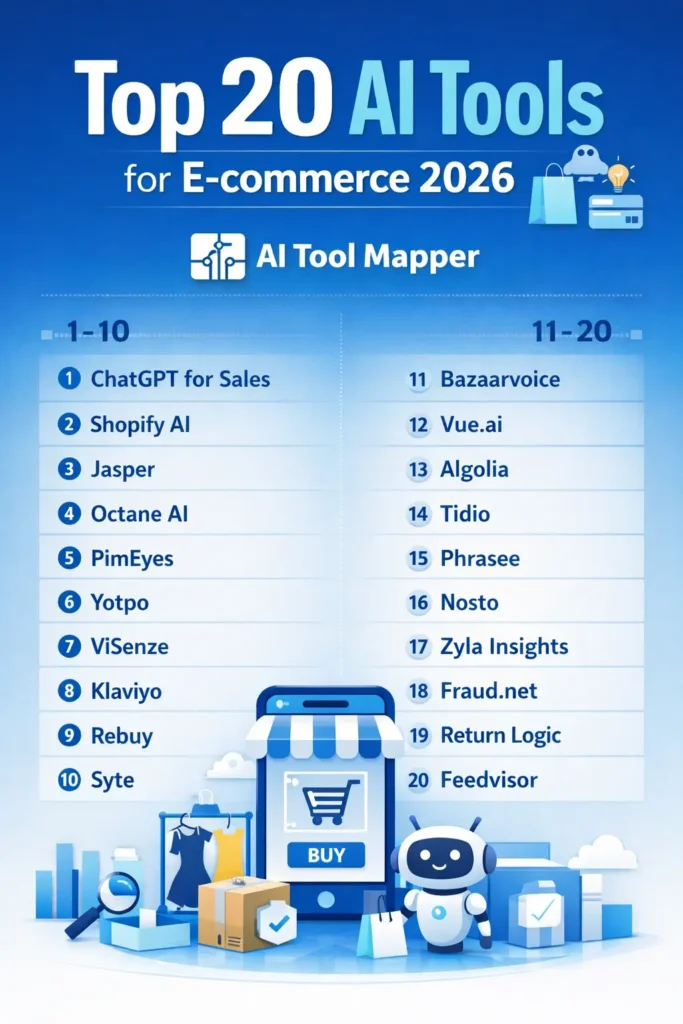
AI in e-commerce uses machine learning, automation, and predictive analytics to improve online shopping experiences, optimize pricing, personalize product recommendations, automate support, and prevent fraud. In 2026, leading AI tools like Shopify Magic, Salesforce Einstein, and Dynamic Yield are transforming digital retail by increasing conversions and operational efficiency.
E-commerce in 2026 isn’t just about having a beautiful website or running paid ads. It’s about intelligence. It’s about understanding customer behavior before the customer even realizes what they want. It’s about delivering hyper-personalized shopping journeys at scale while keeping operations lean and efficient. That’s where AI in e-commerce becomes not just helpful—but essential.
Today’s online stores generate massive volumes of behavioral, transactional, and engagement data. Without artificial intelligence, this data is noise. With the right AI tools, however, it becomes clarity—fueling smarter product recommendations, predictive inventory planning, automated customer service, fraud prevention, and dynamic pricing optimization.
If you’ve ever wondered how Amazon predicts your next purchase or how Shopify stores personalize product displays in real time, the answer lies in machine learning models trained to detect patterns humans can’t see. The result? Higher conversions. Better customer experience. Increased lifetime value.
In this 2026 guide, we’ll break down the Best AI Tools for E-commerce, ranked and reviewed. Whether you’re running a startup Shopify store or managing enterprise retail operations, this pillar guide will help you choose the right AI stack for long-term growth.
What is AI in E-commerce?
Artificial Intelligence in online retail refers to the use of machine learning in e-commerce, natural language processing, computer vision, and predictive analytics to automate and enhance digital store operations.
In simple terms, AI helps online stores:
Understand customer intent
Recommend relevant products
Forecast demand
Optimize pricing
Automate support
According to insights published by McKinsey & Company, AI-driven personalization can increase marketing ROI by 10–30%. That’s not a marginal improvement—it’s a competitive advantage.
How AI is Used in E-commerce (Snippet Ready)
AI is used in e-commerce for:
Product recommendations
Personalized search results
Chatbots and automated support
Inventory forecasting
Fraud detection
Dynamic pricing
In 2026, AI adoption is accelerating because consumers expect Amazon-level personalization everywhere.
Why AI is Essential for Online Stores in 2026
Customer expectations have changed dramatically. Shoppers expect relevance. Speed. Simplicity.
If your online store shows generic product listings, you’re losing revenue silently.
1. Rising Customer Expectations
Consumers now expect tailored shopping experiences powered by AI personalization tools.
2. Hyper-Personalization
Modern AI personalization for online shopping uses browsing history, purchase behavior, and contextual signals to display customized storefronts.
3. Automation for Efficiency
E-commerce automation software reduces manual workload in marketing, inventory, and customer service.
4. Data-Driven Decision Making
AI pricing optimization tools analyze competitor data and demand signals in real time.
5. Competitive Advantage
Brands using AI-driven e-commerce sales growth strategies consistently outperform competitors.
Key Benefits of AI in E-commerce
Personalized Shopping Experiences
AI product recommendation engines increase average order value by suggesting relevant cross-sells.
Smart Search & Visual Discovery
AI search solutions for online stores improve product discovery using semantic search and image recognition.
Automated Customer Support
AI chatbot for e-commerce reduces support tickets while improving response times.
Fraud Detection
AI-powered e-commerce automation monitors transaction anomalies to prevent fraud.
Inventory & Demand Forecasting
AI inventory forecasting predicts stock requirements using historical and seasonal data.
Top 20 AI Tools for E-commerce in 2026 (Ranked & Reviewed)
Below are the Best AI Tools for E-commerce transforming online stores today. These platforms help businesses automate operations, improve AI e-commerce customer experience, increase conversion rates, and deliver personalized shopping journeys at scale.
1. Shopify Magic

Shopify Magic is a powerful set of AI capabilities built directly into the Shopify ecosystem. Instead of installing third-party apps, merchants can use native AI features to automate everyday tasks such as writing product descriptions, generating email campaigns, managing customer interactions, and analyzing store performance.
What makes Shopify Magic especially attractive is how seamlessly it blends into existing workflows. Store owners don’t need technical expertise or machine learning knowledge. The AI works quietly in the background, learning from store data to improve content quality, optimize product listings, and support marketing automation.
For entrepreneurs and growing brands, this means less time spent on repetitive tasks and more time focusing on strategic growth.
Key Features
• AI-generated product descriptions and SEO-friendly copy
• AI email marketing suggestions for campaigns
• Automated FAQ generation for customer support
• Smart product tagging and catalog organization
• AI-assisted blog writing for store content
• Personalized shopping recommendations based on behavior
Best For
Small to mid-sized Shopify merchants looking for built-in AI tools for online stores without complex integrations.
Pricing
Included in Shopify plans.
Pros
• Native Shopify integration
• Easy to use with no technical setup
• Saves time on product content and marketing
• Helps improve SEO and product discoverability
Cons
• Limited functionality outside Shopify ecosystem
• Advanced analytics features are still evolving
Why It Stands Out
Unlike many third-party solutions, Shopify Magic delivers AI-powered e-commerce automation directly inside the platform merchants already use, making adoption extremely simple and cost-effective.
Website: https://www.shopify.com/magic
2. Salesforce Commerce Cloud (Einstein AI)
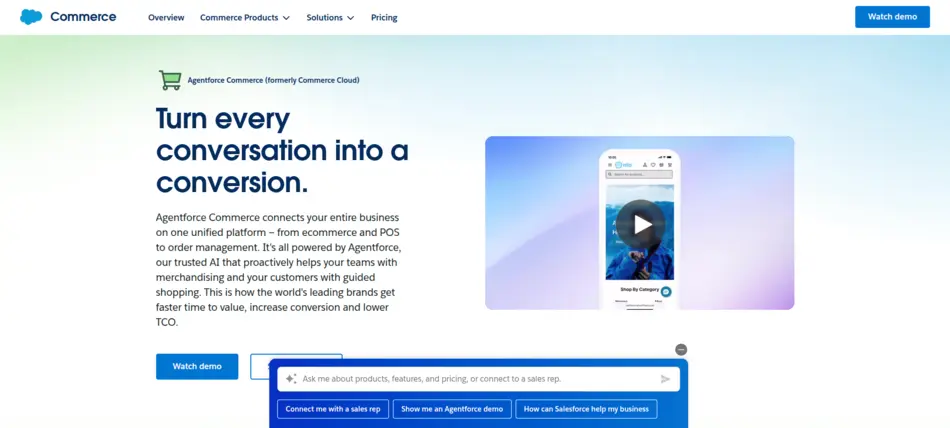
Salesforce Commerce Cloud integrates Einstein AI, a powerful artificial intelligence engine designed to optimize the entire customer journey across digital retail channels.
Large brands rely on Einstein AI to analyze millions of customer interactions, identify patterns in buying behavior, and automatically adjust product recommendations, pricing, and promotions. The system constantly learns from real-time data, enabling retailers to deliver highly personalized shopping experiences.
Because it integrates with the wider Salesforce ecosystem—including CRM, marketing automation, and analytics—it allows companies to unify customer data across channels. This creates a 360-degree customer profile that improves targeting accuracy and marketing efficiency.
Key Features
• Predictive product recommendations
• AI-driven search optimization
• Behavioral analytics and segmentation
• Personalized promotions and discounts
• Cross-channel marketing insights
• Customer lifetime value prediction
Best For
Enterprise retailers and large e-commerce operations managing large product catalogs and global customer bases.
Pricing
Custom enterprise pricing based on business size and requirements.
Pros
• Extremely powerful personalization capabilities
• Strong analytics and predictive insights
• Seamless integration with Salesforce CRM ecosystem
• Scalable for large global retailers
Cons
• Higher cost compared to SMB-focused tools
• Requires implementation expertise
Why It Stands Out
Einstein AI is widely recognized as one of the most advanced AI personalization tools in digital commerce, enabling enterprise brands to create deeply customized customer journeys.
Website: https://www.salesforce.com/commerce/
3. Adobe Commerce (Sensei AI)
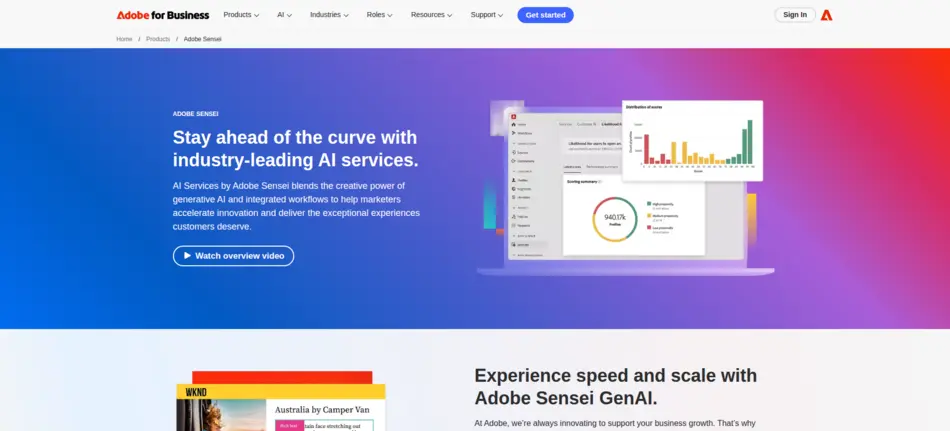
Adobe Commerce, powered by Adobe Sensei AI, combines digital content management with powerful commerce capabilities. It’s designed for brands that want to deliver immersive, personalized shopping experiences across websites, mobile apps, and digital marketplaces.
The platform uses AI to automate merchandising decisions, optimize product discovery, and personalize storefront experiences. For example, Adobe Sensei can analyze user behavior to automatically rearrange product listings, highlight trending items, and display targeted offers.
Because it integrates tightly with Adobe Experience Cloud tools, marketers can create consistent experiences across advertising, content, and commerce.
Key Features
• AI-powered product discovery and merchandising
• Smart category sorting and recommendations
• Customer segmentation based on behavioral data
• Automated A/B testing for storefront optimization
• Personalized content and product bundles
• Integrated analytics dashboards
Best For
Large-scale retail brands and enterprises that require advanced e-commerce personalization technology and content management capabilities.
Pricing
Enterprise pricing based on usage and business needs.
Pros
• Powerful integration with Adobe ecosystem
• Advanced AI merchandising automation
• Flexible customization options
• Excellent for omnichannel retail experiences
Cons
• Implementation can be complex
• Requires technical resources for customization
Why It Stands Out
Adobe Commerce uniquely blends content, data, and AI-powered merchandising, helping brands deliver highly engaging digital storefronts.
Website: https://business.adobe.com/products/sensei/adobe-sensei.html
4. Dynamic Yield

Dynamic Yield is a sophisticated AI-powered personalization platform that helps brands tailor every aspect of the customer journey. From homepage layouts to checkout offers, the platform uses behavioral data and machine learning to deliver personalized experiences in real time.
Major global brands use Dynamic Yield to run experimentation campaigns, personalize product recommendations, and optimize conversion funnels. Instead of relying on static design decisions, retailers can continuously test variations and allow AI to determine which experiences drive the best results.
Key Features
• Real-time behavioral personalization
• AI-powered product recommendation engine
• Customer journey experimentation tools
• Dynamic landing page optimization
• Automated A/B testing and segmentation
• Omnichannel personalization capabilities
Best For
Retailers focused on improving AI customer experience tools and optimizing conversion rates.
Pricing
Custom pricing depending on traffic volume and features.
Pros
• Highly advanced personalization capabilities
• Excellent experimentation and testing tools
• Scalable for large e-commerce platforms
Cons
• Can be expensive for smaller stores
• Requires data volume to maximize performance
Why It Stands Out
Dynamic Yield excels at real-time customer journey optimization, helping brands deliver individualized experiences that significantly boost conversions.
Website: https://www.dynamicyield.com/
5. Algolia AI Search

Algolia is one of the most powerful AI search solutions for online stores. Its lightning-fast search engine uses machine learning and natural language processing to understand customer queries and deliver relevant product results instantly.
For online stores with thousands or even millions of products, search performance can make or break conversions. Algolia solves this problem by enabling predictive search, typo tolerance, semantic query understanding, and advanced ranking algorithms.
When customers find what they’re looking for faster, they’re far more likely to complete a purchase.
Key Features
• AI-powered semantic search engine
• Predictive autocomplete suggestions
• Typo-tolerant search results
• Personalization based on user behavior
• Advanced analytics and search insights
• Voice and visual search capabilities
Best For
Online stores with large product catalogs and high traffic volumes.
Pricing
Tiered pricing based on search usage and queries.
Pros
• Extremely fast search performance
• Advanced machine learning ranking algorithms
• Easy integration with many platforms
Cons
• Pricing can scale with high traffic
• Requires configuration for optimal results
Why It Stands Out
Algolia delivers blazing-fast product discovery, which directly improves user experience and increases conversion rates.
Website: https://www.algolia.com/
6. Bloomreach
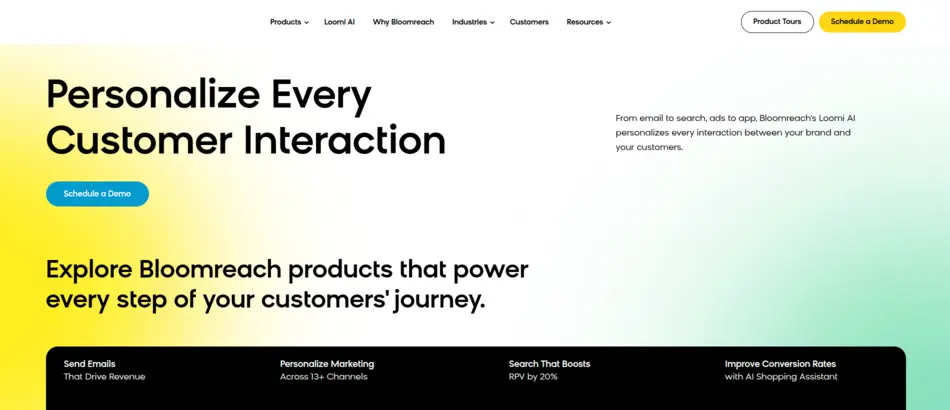
Bloomreach is a powerful digital experience platform that combines AI-driven marketing automation, personalization, and search capabilities to help e-commerce brands create highly relevant customer experiences.
The platform leverages machine learning to analyze massive datasets from browsing activity, purchase history, and behavioral signals. Based on this data, Bloomreach automatically generates personalized product recommendations, email campaigns, and dynamic content tailored to individual shoppers.
This level of intelligent automation helps brands deliver the right message to the right customer at the perfect moment in their shopping journey.
Key Features
• AI-powered personalization engine
• Predictive product recommendations
• AI-driven marketing automation
• Customer behavior analytics
• Smart product search and discovery
• Omnichannel campaign orchestration
Best For
Mid-sized and enterprise brands looking to scale AI personalization for online shopping across multiple marketing channels.
Pricing
Custom pricing depending on platform usage.
Pros
• Strong personalization capabilities
• Excellent marketing automation tools
• Data-driven campaign optimization
Cons
• May be complex for smaller businesses
• Requires onboarding for full optimization
Why It Stands Out
Bloomreach combines AI search, personalization, and marketing automation into one unified platform, making it a powerful growth engine for modern e-commerce brands.
Website: https://www.bloomreach.com/
7. Nosto
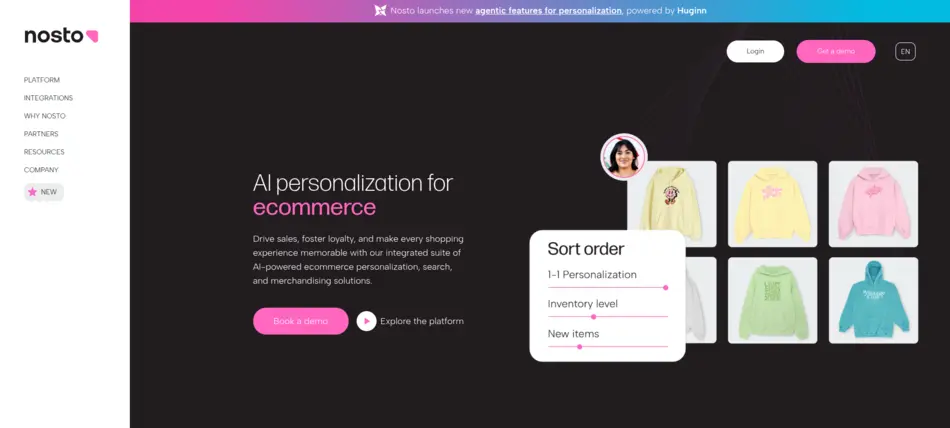
Nosto is one of the most widely used AI personalization tools for e-commerce, helping online retailers create tailored shopping experiences based on real-time customer behavior. The platform analyzes browsing patterns, purchase history, product interactions, and engagement signals to deliver highly relevant product recommendations and dynamic content.
Instead of presenting the same homepage or product suggestions to every visitor, Nosto allows retailers to customize product listings, promotional banners, and recommendations for each individual shopper. This behavior-driven approach significantly improves conversion rates and customer engagement.
For fashion, lifestyle, and beauty brands—where discovery and personalization play a critical role—Nosto provides a strong competitive advantage.
Key Features
• AI-powered product recommendation engine
• Personalized product bundles and upsell suggestions
• Behavioral segmentation of customers
• AI-powered search personalization
• Real-time personalization of category pages
• Dynamic email and marketing campaign integration
Best For
Retail brands that want advanced AI personalization for online shopping and improved product discovery.
Pricing
Free starter plan available, with premium plans based on traffic and features.
Pros
• Easy integration with major e-commerce platforms
• Powerful real-time personalization
• Strong analytics for measuring campaign performance
• Improves average order value through smart recommendations
Cons
• Advanced personalization requires sufficient traffic data
• Premium plans may be costly for small businesses
Why It Stands Out
Nosto excels at delivering behavior-driven product recommendations, enabling brands to create unique shopping journeys for every visitor.
Website: https://www.nosto.com/
8. Klevu

Klevu is a powerful AI search solution for online stores that focuses on improving product discovery through natural language processing (NLP) and machine learning. Traditional search engines often fail to understand how shoppers actually phrase their queries. Klevu solves this by interpreting intent, context, and semantic meaning.
The platform continuously learns from customer search behavior to improve search accuracy over time. For example, if customers frequently search for “summer sneakers,” Klevu’s AI understands the context and prioritizes relevant products.
Retailers that rely heavily on internal search—especially those with large catalogs—can significantly increase conversions by implementing intelligent search technology.
Key Features
• AI-powered semantic site search
• Natural language query understanding
• Smart autocomplete and predictive search
• Personalized product rankings
• Advanced search analytics and reporting
• AI-driven category merchandising
Best For
Online stores with medium to large product catalogs that need optimized AI search solutions for online stores.
Pricing
Subscription-based pricing depending on search volume and store size.
Pros
• Improves product discovery
• Learns from real-time user behavior
• Increases conversion rates from site search
• Works with multiple e-commerce platforms
Cons
• Initial configuration may require setup time
• Advanced features may increase costs
Why It Stands Out
Klevu’s AI-powered search engine uses machine learning in e-commerce to understand shopper intent, making it far more effective than traditional keyword-based search systems.
Website: https://www.klevu.com/
9. Clerk.io
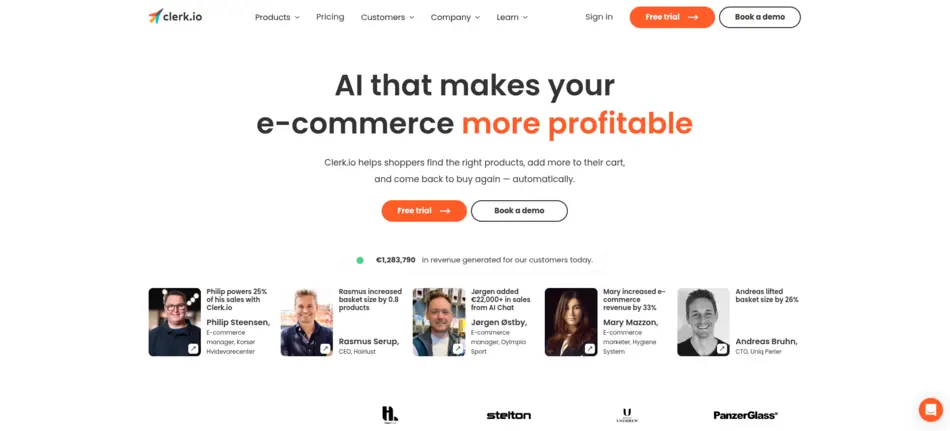
Clerk.io is a flexible AI-powered personalization and recommendation engine designed to improve product discovery and customer engagement. The platform analyzes customer behavior—including browsing patterns, purchase history, and interaction data—to generate intelligent product suggestions across various touchpoints.
Unlike many recommendation tools that focus only on product pages, Clerk.io integrates personalization into email marketing, search results, and category listings. This creates a more consistent and relevant shopping experience for users.
Many online retailers use Clerk.io to automate upselling and cross-selling strategies, which helps increase revenue without requiring manual merchandising.
Key Features
• Behavior-based product recommendations
• Personalized email marketing integration
• AI-powered search functionality
• Dynamic product recommendations on product pages
• Customer segmentation and targeting tools
• Automated cross-sell and upsell campaigns
Best For
Small to medium-sized businesses looking for affordable AI product recommendation engines.
Pricing
Tiered pricing based on store size and traffic.
Pros
• Easy to implement
• Affordable compared to enterprise tools
• Improves engagement and conversion rates
• Strong automation capabilities
Cons
• Limited advanced features for enterprise retailers
• Customization options may require developer assistance
Why It Stands Out
Clerk.io combines AI recommendations, search, and email personalization, making it a versatile growth tool for modern online stores.
Website: https://www.clerk.io/
10. ViSenze
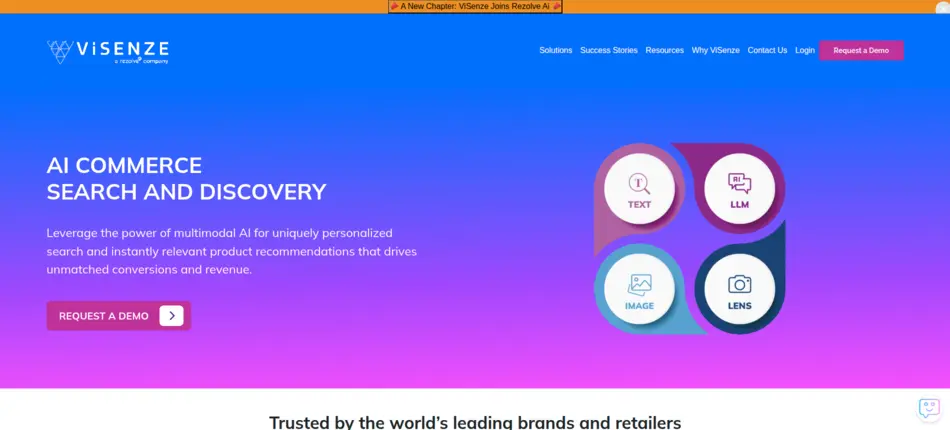
ViSenze is a leading platform for AI visual search and image recognition, helping shoppers discover products by uploading images instead of typing text queries. This technology is particularly useful in fashion, home décor, and lifestyle retail, where customers often search for visually similar products.
For example, a shopper who sees a dress on social media can upload the image to an online store powered by ViSenze. The AI system then scans the catalog and displays visually similar products available for purchase.
Visual search is becoming increasingly important as mobile commerce grows and customers rely more on images than text.
Key Features
• AI visual search engine
• Image recognition for product matching
• Smart tagging and product categorization
• Visual similarity recommendations
• Mobile-first shopping optimization
• AI-powered product discovery tools
Best For
Fashion, furniture, and lifestyle e-commerce brands with visually driven product catalogs.
Pricing
Custom pricing depending on usage and integration requirements.
Pros
• Enhances product discovery
• Ideal for image-based shopping behavior
• Improves mobile commerce experience
• Reduces friction in product searches
Cons
• Implementation requires image dataset optimization
• Best suited for visually focused industries
Why It Stands Out
ViSenze brings visual AI technology into e-commerce, enabling customers to search for products using images instead of keywords.
Website: https://www.visenze.com/
11. Tidio AI
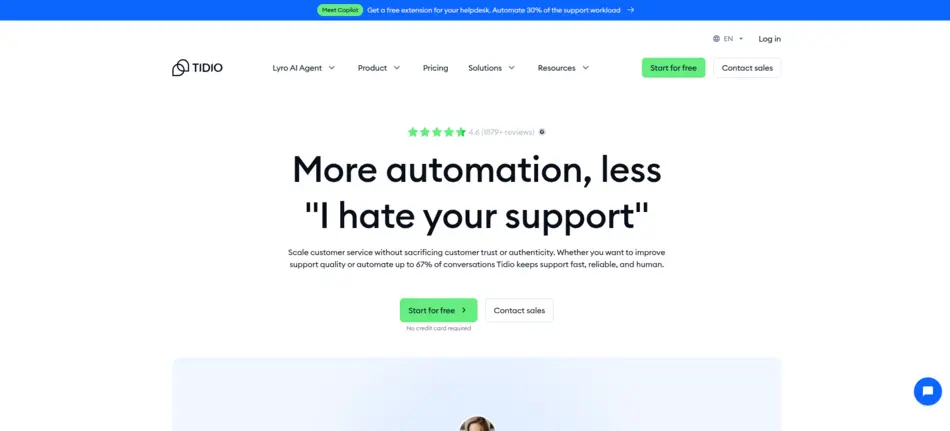
Tidio AI is a popular AI chatbot for e-commerce designed to automate customer service and improve response times. The platform combines live chat, chatbot automation, and AI-powered conversation tools to assist customers across multiple channels.
With Tidio’s AI assistant, online stores can answer common questions instantly, guide shoppers through the purchasing process, and resolve support issues without human intervention. This dramatically reduces customer support workload while improving the shopping experience.
Because it integrates with platforms like Shopify, WooCommerce, and BigCommerce, Tidio is accessible even for small businesses.
Key Features
• AI chatbot for customer support
• Automated responses to FAQs
• Live chat with human agents
• AI-powered conversation analytics
• Integration with social media messaging channels
• Automated cart recovery messaging
Best For
Small to mid-sized businesses needing affordable AI customer service tools for online shops.
Pricing
Free plan available, with premium automation features in paid tiers.
Pros
• Easy setup and integration
• Reduces customer support workload
• Improves response times
• Affordable for startups
Cons
• Advanced automation features require paid plans
• Complex queries may still require human agents
Why It Stands Out
Tidio offers a powerful yet accessible AI chatbot for e-commerce, helping stores deliver faster customer support without increasing operational costs.
Website: https://www.tidio.com/
12. Drift
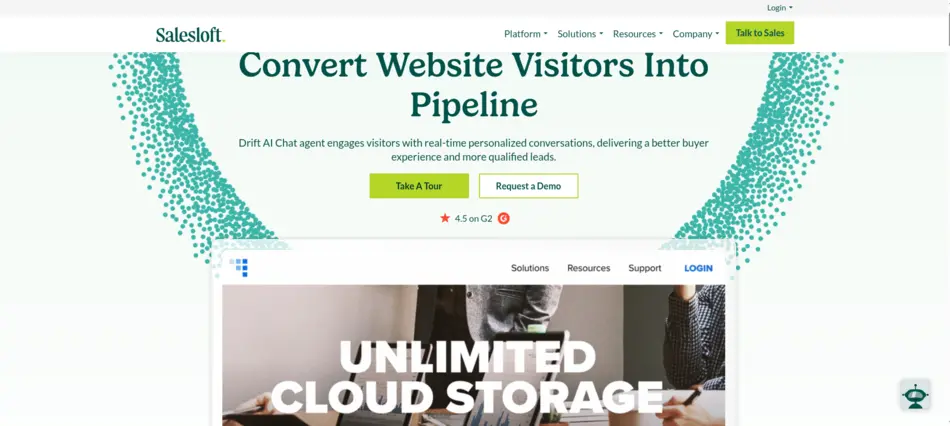
Drift focuses on conversational AI for sales and customer engagement, helping businesses convert website visitors into customers through real-time conversations. Instead of static forms or delayed email responses, Drift allows companies to interact with visitors instantly through AI-powered chat.
The platform uses machine learning to understand visitor intent, qualify leads, and route conversations to the right team or automated workflow. In e-commerce, this capability helps guide customers through product selection, answer questions instantly, and accelerate purchase decisions.
Conversational commerce is rapidly becoming a key part of digital retail strategy, especially for brands that prioritize customer engagement.
Key Features
• Conversational AI chatbot for websites
• Automated lead qualification
• Personalized product recommendations in chat
• Real-time visitor engagement tools
• Integration with CRM and marketing platforms
• Conversation analytics and performance insights
Best For
Brands focusing on AI-driven customer engagement and conversion optimization.
Pricing
Custom pricing based on usage and business requirements.
Pros
• Improves real-time customer engagement
• Helps convert visitors into buyers
• Strong analytics and performance insights
• Integrates with many marketing platforms
Cons
• Pricing may be higher than basic chatbot tools
• Requires conversation strategy planning
Why It Stands Out
Drift transforms traditional customer support into conversational commerce, helping businesses increase conversions through real-time interactions.
Website: https://www.salesloft.com/platform/drift
13. ManyChat

ManyChat is a powerful AI automation platform for social commerce, designed to help e-commerce brands manage customer conversations and marketing campaigns on platforms like Facebook Messenger, Instagram, and WhatsApp. As social media increasingly becomes a major shopping channel, tools like ManyChat allow businesses to automate conversations with potential buyers and guide them through the purchasing process.
The platform uses conversational automation to send personalized messages, product recommendations, and promotional offers directly through messaging apps. For example, if a customer comments on a product post or sends a message asking about availability, ManyChat can instantly respond with product details, links to the store, and even discount codes.
By combining AI chat automation with social media marketing, ManyChat helps online retailers convert social engagement into real sales.
Key Features
• Messenger and Instagram chatbot automation
• Automated responses to customer inquiries
• Social media marketing campaign automation
• Personalized product recommendations through chat
• Cart recovery and abandoned cart reminders
• Integration with e-commerce platforms like Shopify and WooCommerce
• Customer segmentation for targeted messaging campaigns
Best For
Brands that rely heavily on social commerce and Instagram or Messenger-based sales funnels.
Pricing
Free plan available with basic features. Advanced automation and marketing tools are available in paid plans.
Pros
• Excellent for social media-driven stores
• Automates customer engagement on messaging platforms
• Improves response speed and customer interaction
• Helps convert social media followers into customers
Cons
• Primarily focused on social channels rather than full website automation
• Advanced automation requires paid subscription
Why It Stands Out
ManyChat bridges the gap between social media engagement and e-commerce sales, enabling brands to automate conversations and convert social traffic into revenue.
Website: https://manychat.com/
14. Jasper AI
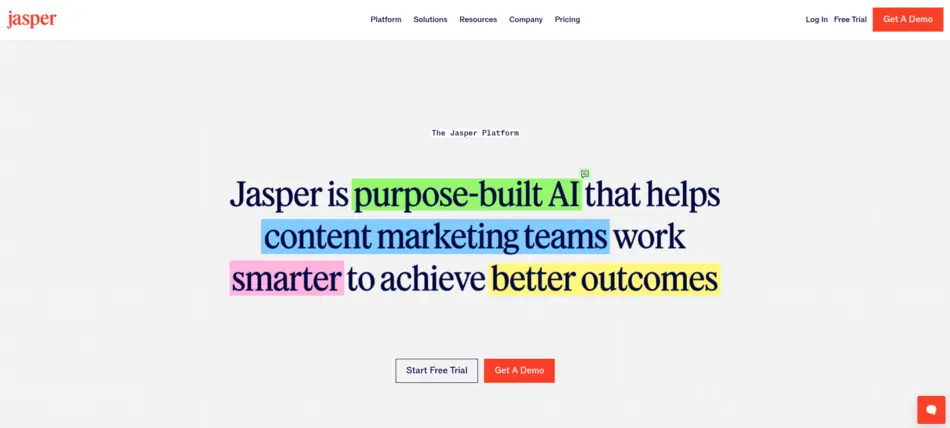
Jasper AI is a leading AI content generation platform that helps e-commerce businesses create high-quality marketing content at scale. From product descriptions to blog posts and advertising copy, Jasper enables online stores to generate engaging and SEO-friendly content quickly.
One of the biggest challenges in e-commerce is writing unique product descriptions for hundreds or thousands of products. Jasper solves this problem by using generative AI to create persuasive product copy that highlights key benefits and encourages conversions.
Beyond product pages, the platform can also generate email campaigns, social media captions, landing page content, and promotional messaging—making it a versatile content creation tool for digital retailers.
Key Features
• AI-generated product descriptions and product page content
• Automated blog writing for e-commerce SEO
• AI-powered marketing copy for ads and emails
• Content templates for product listings and promotions
• Brand voice customization for consistent messaging
• Multilingual content generation for global stores
Best For
E-commerce teams, marketers, and content creators who need scalable AI-generated product descriptions and marketing copy.
Pricing
Subscription-based pricing with multiple plans depending on usage and features.
Pros
• Speeds up product content creation
• Helps maintain consistent brand voice
• Useful for marketing campaigns and email content
• Supports multiple languages
Cons
• Generated content may require editing for accuracy
• Higher-tier plans needed for advanced features
Why It Stands Out
Jasper AI allows online retailers to scale content production without sacrificing quality, making it one of the most useful AI writing tools for e-commerce marketing.
Website: https://www.jasper.ai/
15. Surfer SEO AI
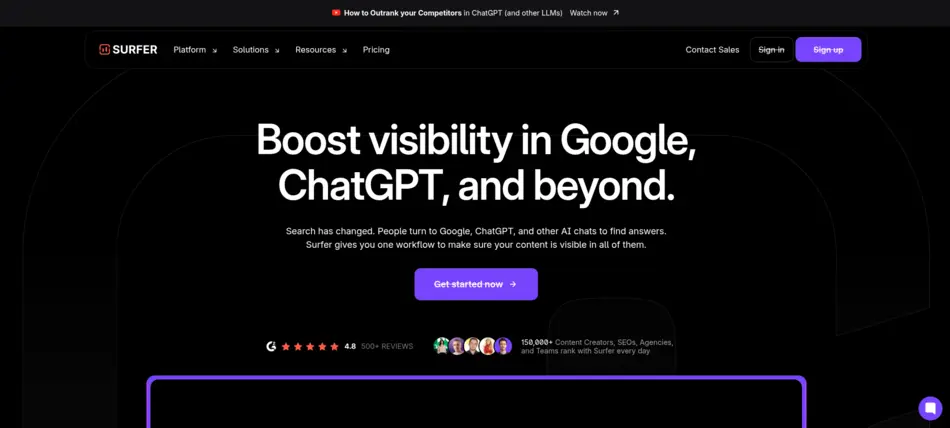
Surfer SEO AI is a powerful content optimization platform that helps e-commerce websites improve their search engine visibility. The tool analyzes top-ranking pages on search engines and provides data-driven recommendations for improving content structure, keyword usage, and overall SEO performance.
For e-commerce stores that rely heavily on organic traffic, optimized product pages and blog content are essential. Surfer SEO helps retailers create content that aligns with search engine algorithms by identifying relevant keywords, ideal content length, and semantic terms related to a topic.
By combining AI-driven insights with real-time SEO recommendations, Surfer SEO enables brands to build stronger search visibility and attract more qualified traffic.
Key Features
• AI-powered SEO content editor
• Keyword optimization suggestions
• Content scoring and ranking analysis
• NLP-based semantic keyword recommendations
• Competitor content analysis
• Integration with content writing tools
Best For
E-commerce businesses focusing on organic traffic growth and SEO-driven product discovery.
Pricing
Monthly subscription plans depending on content usage and feature access.
Pros
• Data-driven SEO recommendations
• Improves organic search rankings
• Helps optimize product pages and blogs
• Provides competitor insights
Cons
• Requires SEO knowledge for best results
• Content suggestions may require manual adjustments
Why It Stands Out
Surfer SEO combines AI insights with SEO analytics, helping e-commerce businesses create optimized content that performs well in search engines.
Website: https://surferseo.com/
16. Prisync
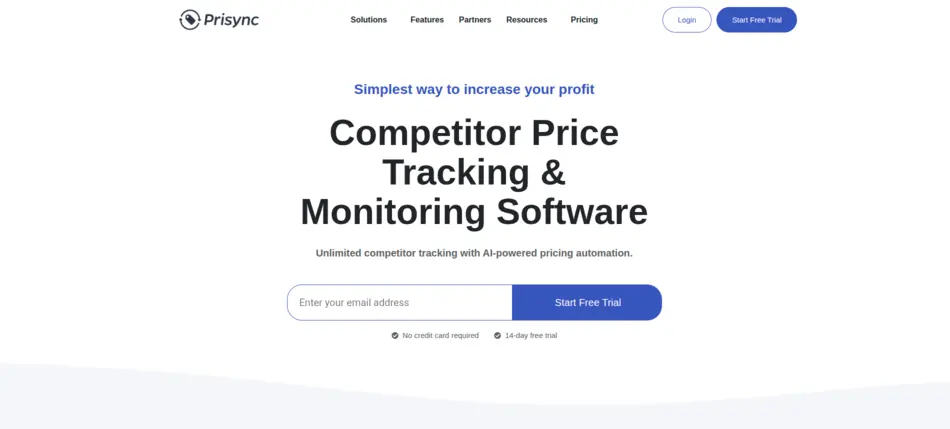
Prisync is a powerful AI pricing optimization tool designed to help e-commerce businesses track competitor pricing and automatically adjust their own prices to stay competitive. In highly competitive online markets, pricing strategy can directly influence conversion rates and revenue.
The platform continuously monitors competitor websites, marketplaces, and product listings to collect real-time pricing data. Using this information, retailers can analyze market trends, identify pricing opportunities, and adjust product prices dynamically.
Prisync’s automation capabilities make it especially valuable for stores with large product catalogs where manual price monitoring would be nearly impossible.
Key Features
• AI-powered competitor price tracking
• Dynamic pricing automation
• Real-time pricing alerts and notifications
• Market price trend analysis
• Product-level profit margin monitoring
• Integration with major e-commerce platforms
Best For
Retailers competing in price-sensitive markets where AI pricing optimization can improve conversion rates.
Pricing
Tiered subscription pricing based on the number of products monitored.
Pros
• Helps maintain competitive pricing strategy
• Automates price monitoring tasks
• Provides actionable pricing insights
• Supports dynamic pricing adjustments
Cons
• Requires strategic pricing planning to avoid margin loss
• Pricing automation may need careful configuration
Why It Stands Out
Prisync enables retailers to implement data-driven pricing strategies, ensuring products remain competitive while maintaining profitability.
Website: https://prisync.com/
17. Rebuy
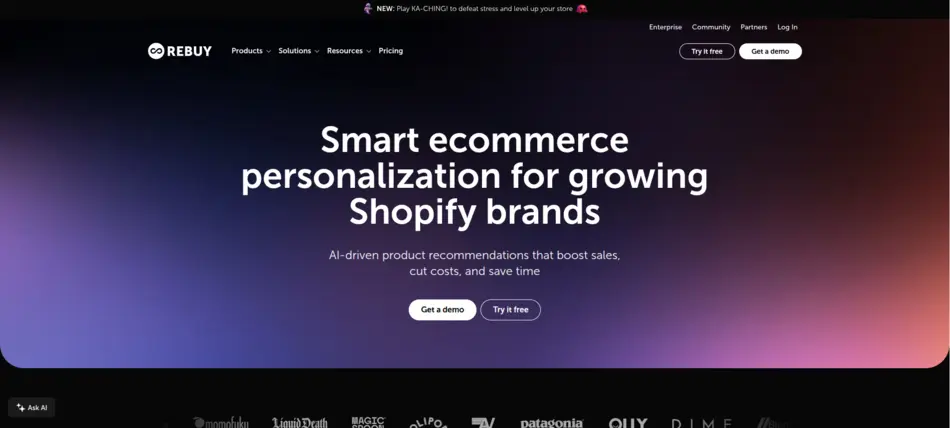
Rebuy is an advanced AI-powered upselling and cross-selling platform designed to maximize revenue opportunities throughout the customer journey. Instead of relying on static product recommendations, Rebuy uses machine learning to analyze customer behavior and suggest highly relevant products in real time.
The platform integrates with key points in the shopping experience—including product pages, cart pages, checkout, and post-purchase offers—to present personalized recommendations that increase average order value.
For example, if a customer adds a pair of running shoes to their cart, Rebuy might suggest complementary products like sports socks, fitness accessories, or related gear. These recommendations are powered by AI models trained on customer purchase data.
Key Features
• AI-powered upsell and cross-sell recommendations
• Personalized product bundles
• Smart cart recommendations
• Post-purchase product offers
• Customer segmentation and targeting
• Advanced analytics for conversion tracking
Best For
Shopify and other e-commerce platforms aiming to increase average order value through AI product recommendation engines.
Pricing
Subscription-based pricing depending on store revenue and feature access.
Pros
• Increases average order value
• Highly personalized product recommendations
• Easy integration with e-commerce platforms
• Strong analytics and performance tracking
Cons
• May require optimization to avoid overwhelming customers
• Best results achieved with sufficient customer data
Why It Stands Out
Rebuy transforms traditional upselling into AI-driven personalization, helping online stores increase revenue without increasing traffic.
Website: https://www.rebuyengine.com/
18. Syte

Syte is an advanced AI visual discovery and personalization platform designed to improve product discovery in online stores. Instead of relying solely on text-based search queries, Syte allows customers to find products by uploading images or clicking on visual elements within a website.
This technology is particularly valuable in industries like fashion, home décor, beauty, and lifestyle products where shoppers often know what they want visually but may struggle to describe it in words. By analyzing colors, shapes, patterns, and product attributes, Syte’s artificial intelligence identifies similar items within the catalog and presents them to the customer.
Retailers using visual discovery tools often see higher engagement rates because customers can explore product collections in a more intuitive and interactive way.
Key Features
• AI-powered visual search for product discovery
• “Shop the Look” functionality for outfit and style recommendations
• Image recognition and similarity matching
• Personalized product recommendations based on visual preferences
• Visual navigation within category pages
• Mobile-first visual shopping experiences
• AI tagging and automatic product attribute recognition
Best For
Fashion, home décor, and lifestyle brands that rely heavily on visual product discovery.
Pricing
Custom pricing depending on traffic, product catalog size, and integration requirements.
Pros
• Enhances product discovery through image recognition
• Ideal for visually driven e-commerce industries
• Improves customer engagement and browsing time
• Encourages product exploration and discovery
Cons
• Implementation requires optimized product image datasets
• Less impactful for stores with text-based product searches
Why It Stands Out
Syte enables visual commerce experiences, allowing shoppers to discover products through images rather than traditional search queries.
Website: https://www.syte.ai/
19. Forter

Forter is a leading AI fraud prevention platform designed specifically for e-commerce and digital commerce businesses. Online stores face increasing risks from payment fraud, account takeovers, and fraudulent transactions. Forter addresses these challenges by using machine learning models that analyze transaction patterns in real time.
Instead of relying on rigid rule-based systems that often block legitimate customers, Forter uses behavioral analysis and global fraud intelligence networks to detect suspicious activity more accurately. The system evaluates hundreds of signals—including device behavior, location data, transaction history, and user patterns—to determine whether a transaction is genuine.
This approach helps businesses reduce fraud losses while minimizing false declines that could harm legitimate customers.
Key Features
• AI-powered real-time fraud detection
• Machine learning analysis of transaction behavior
• Account takeover protection
• Payment fraud prevention across channels
• Global fraud intelligence network
• Chargeback protection and risk management
• Automated fraud decisioning without manual review
Best For
Medium to large online retailers seeking advanced AI fraud detection for e-commerce transactions.
Pricing
Custom pricing based on transaction volume and risk management requirements.
Pros
• Highly accurate fraud detection models
• Reduces false transaction declines
• Protects businesses from chargebacks
• Works across multiple payment channels
Cons
• Enterprise-level pricing may be high for smaller stores
• Implementation requires integration with payment systems
Why It Stands Out
Forter provides one of the most sophisticated AI-powered fraud prevention systems, helping retailers balance security with a smooth customer checkout experience.
Website: https://www.forter.com/
20. Vue.ai
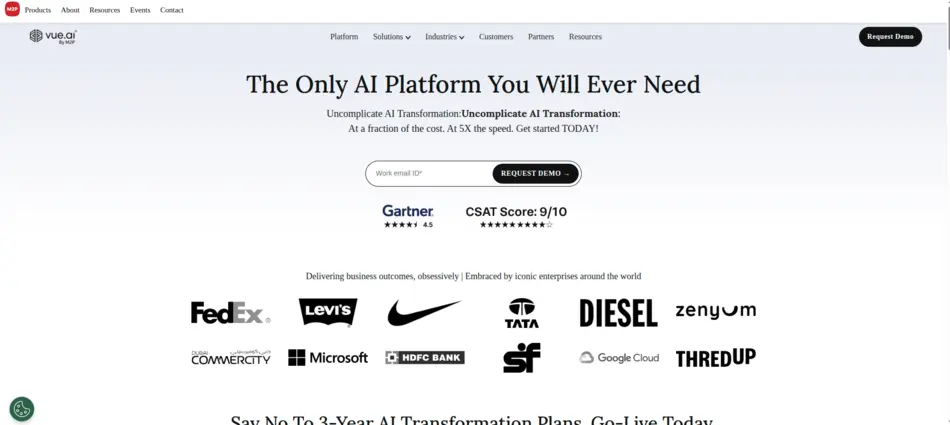
Vue.ai is a comprehensive AI-powered merchandising and retail automation platform built to help e-commerce brands manage product catalogs, optimize merchandising strategies, and deliver personalized shopping experiences.
The platform uses artificial intelligence to automate product tagging, catalog management, product recommendations, and digital merchandising. This is especially useful for large retailers with thousands of SKUs, where manual catalog management becomes extremely time-consuming.
Vue.ai also enables brands to create smarter merchandising strategies by analyzing customer behavior, identifying product trends, and automatically adjusting product placement across storefronts.
Key Features
• AI-powered product tagging and catalog management
• Automated merchandising recommendations
• Personalized product recommendations
• Visual product recognition and attribute tagging
• Smart product categorization and sorting
• Retail analytics and performance insights
• AI-powered styling and outfit recommendations
Best For
Large online retailers and fashion brands that require AI-powered store management systems and merchandising automation.
Pricing
Custom enterprise pricing depending on features and scale of implementation.
Pros
• Automates product catalog management
• Improves product discovery and merchandising
• Reduces manual operational workload
• Scales well for large product catalogs
Cons
• Enterprise-focused solution
• Setup and configuration may require technical support
Why It Stands Out
Vue.ai provides a full AI merchandising ecosystem, helping retailers automate catalog management, product discovery, and personalization at scale.
Website: https://vue.ai/
Comparison Table – Top 20 AI E-commerce Tools (2026)
The following comparison table summarizes the Best AI Tools for E-commerce based on category, core functionality, pricing structure, and ideal business size. This quick overview helps store owners and decision-makers compare tools before choosing the right AI software for online stores.
| Tool Name | Category | Key Use Case | Pricing Model | Free Trial | Ideal Business Size |
|---|---|---|---|---|---|
| Shopify Magic | AI Automation | Product descriptions, store automation | Included in Shopify plans | No | Small–Medium |
| Salesforce Commerce Cloud (Einstein AI) | Personalization & Analytics | Enterprise-level AI customer experience | Custom enterprise pricing | No | Enterprise |
| Adobe Commerce (Sensei AI) | AI Merchandising | Product discovery & personalization | Enterprise pricing | Limited demo | Enterprise |
| Dynamic Yield | Personalization | Customer journey optimization | Custom pricing | Yes | Mid–Enterprise |
| Algolia AI Search | AI Search | Product discovery & site search | Tiered pricing | Yes | All sizes |
| Bloomreach | Marketing & Personalization | AI marketing automation | Custom pricing | Demo available | Mid–Enterprise |
| Nosto | Personalization | Product recommendations | Tiered pricing | Yes | Small–Medium |
| Klevu | AI Search | Site search optimization | Subscription | Yes | Small–Medium |
| Clerk.io | Recommendations | Behavioral product suggestions | Tiered pricing | Yes | Small–Medium |
| ViSenze | Visual Search | Image-based product discovery | Custom pricing | Demo available | Mid–Enterprise |
| Tidio AI | AI Chatbot | Automated customer support | Freemium | Yes | Small–Medium |
| Drift | Conversational AI | Chat-based conversions | Custom pricing | Demo available | Mid–Enterprise |
| ManyChat | Social Commerce Automation | Messenger & Instagram automation | Freemium | Yes | Small–Medium |
| Jasper AI | AI Content | Product descriptions & marketing copy | Subscription | Yes | All sizes |
| Surfer SEO AI | SEO Optimization | SEO content optimization | Subscription | Limited | Small–Medium |
| Prisync | Pricing Intelligence | AI price monitoring | Tiered pricing | Yes | Small–Medium |
| Rebuy | Upselling AI | Cross-sell & upsell automation | Subscription | Yes | Small–Medium |
| Syte | Visual Discovery | Image-based shopping | Custom pricing | Demo available | Mid–Enterprise |
| Forter | Fraud Detection | Payment fraud prevention | Custom pricing | No | Enterprise |
| Vue.ai | AI Merchandising | Catalog automation & personalization | Custom enterprise pricing | Demo available | Enterprise |
How to Choose the Right AI Tool
Define business goals
Evaluate integration compatibility
Assess scalability
Review ROI projections
Ensure compliance & security
You can explore more curated solutions inside our AI tools directory at AI Tool Mapper, where we categorize platforms by industry and use case.
Emerging AI Trends in E-commerce (2026 & Beyond)
Generative AI product descriptions
AI video commerce
Voice shopping assistants
Predictive dynamic pricing
Autonomous customer service agents
According to research from Gartner, generative AI will influence over 30% of digital commerce interactions by 2026.
Common Challenges of AI Implementation
Data silos
Integration complexity
Over-automation
Privacy compliance (GDPR, CCPA)
High initial investment
Smart implementation strategy reduces these risks significantly.
FAQs – AI in E-commerce
What is the best AI tool for e-commerce?
It depends on business size. Shopify Magic works well for SMBs, while Salesforce Einstein suits enterprises.
How does AI improve customer experience?
Through personalization, faster search, and automated support.
Is AI expensive?
Many AI tools for online stores offer tiered pricing, making them accessible.
Can AI increase sales?
Yes. AI-driven e-commerce sales growth improves conversion rates and AOV.
How to start?
Begin with AI chatbot and AI product recommendation engine.
Key Takeaways
AI in e-commerce is essential in 2026
Personalization drives revenue growth
Automation improves efficiency
AI tools fit businesses of all sizes
Smart AI stack selection improves ROI
Final Thoughts
The future of digital commerce belongs to intelligent stores. AI is no longer optional—it’s foundational. Whether you adopt AI personalization tools, AI customer experience tools, or AI inventory forecasting systems, the key is strategic implementation.
Start small. Measure ROI. Scale intelligently.
The brands winning in 2026 aren’t necessarily bigger—they’re smarter.
Found this helpful? Save it to your Pinterest board!