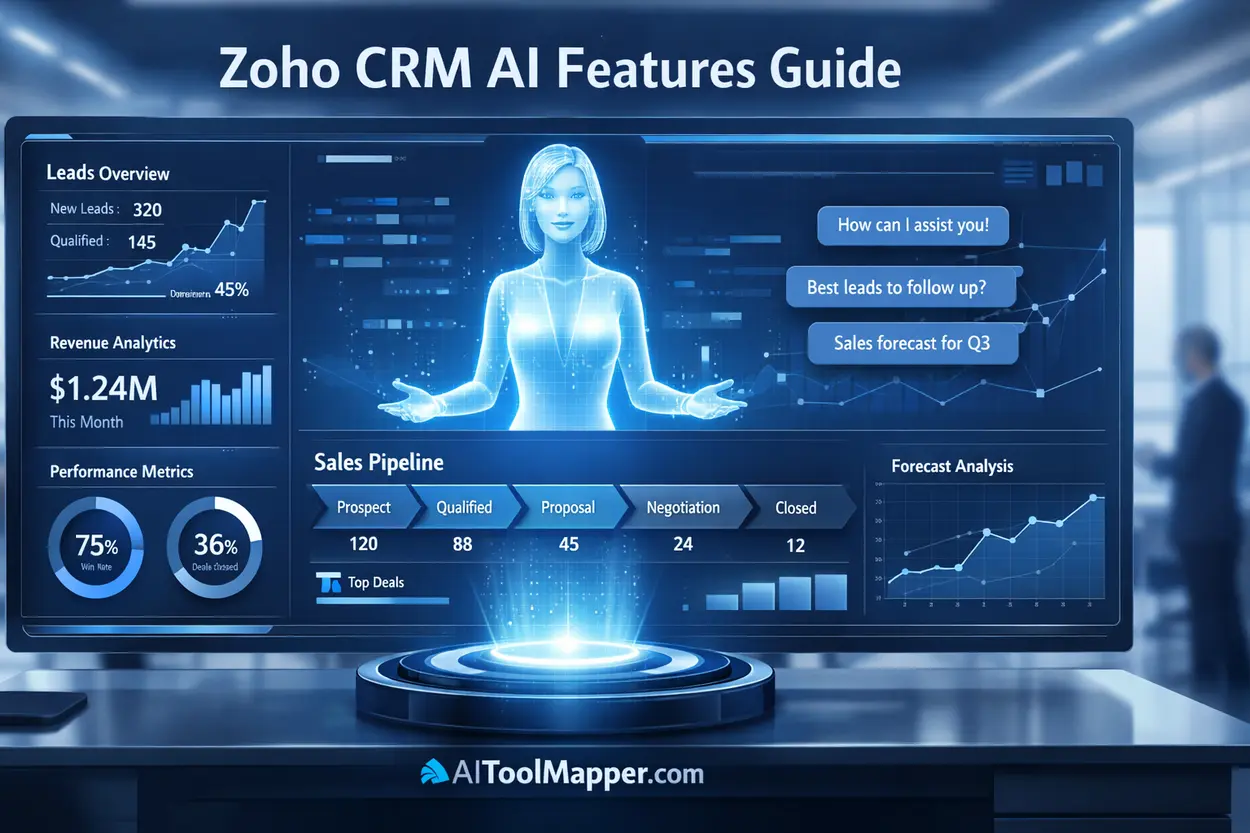
Zoho CRM is an AI-powered customer relationship management platform designed to help businesses automate sales, analyze customer data, and improve productivity. Its built-in AI assistant Zia provides predictive insights such as lead scoring, deal prediction, workflow automation suggestions, and sales forecasting.
Companies can access Zoho CRM through a web login dashboard, mobile apps for Android and iOS, and simple sign-up options. With flexible pricing plans and powerful AI automation tools, Zoho CRM helps teams manage leads, track sales pipelines, and deliver better customer experiences.
Key Takeaways
- Zoho CRM AI features include predictive analytics, automation tools, and intelligent sales insights.
- The built-in AI assistant Zia analyzes customer data and recommends actions for sales teams.
- Businesses can use AI agents to automate customer interactions and lead management.
- Zoho CRM provides multiple pricing plans, including a free version for small teams.
- The platform is accessible through CRM Zoho login, mobile apps, and browser dashboards.
- Automation tools help businesses streamline workflows, improve forecasting, and boost productivity.
Zoho CRM AI Tools & Features Guide
Running a business today means managing thousands of tiny interactions—emails, customer inquiries, sales calls, and follow-ups. Without the right tools, it’s easy for opportunities to slip through the cracks. That’s where modern CRM platforms step in. But not just any CRM—AI-powered systems are changing the way businesses understand and engage with customers.
One platform that stands out in this space is Zoho Corporation’s powerful CRM solution. The Zoho CRM AI features combine automation, predictive analytics, and intelligent recommendations to help businesses make smarter decisions. Instead of manually tracking every lead or analyzing spreadsheets, companies can rely on built-in AI tools to identify opportunities, automate repetitive tasks, and provide real-time insights.
At the center of this innovation is Zia, Zoho’s AI assistant. Zia can analyze sales patterns, predict which leads are likely to convert, monitor email sentiment, and even suggest the best time to contact a customer. Combined with AI agents, workflow automation, and mobile CRM capabilities, Zoho CRM becomes much more than a contact database—it becomes a smart business partner.
In this comprehensive guide, we’ll explore everything you need to know about Zoho CRM’s AI capabilities. From Zia AI and intelligent automation to pricing plans, login processes, mobile apps, and sign-up steps, this article walks you through how businesses can use Zoho’s AI-powered CRM to streamline sales and improve customer relationships.
If you’re evaluating CRM platforms or looking to upgrade your current system, understanding how AI works inside Zoho CRM could help you unlock new levels of productivity.
What is Zoho CRM?
Customer relationship management software is designed to organize and optimize interactions between businesses and customers. Zoho CRM takes this concept further by integrating AI-driven analytics and automation tools directly into the platform.
Developed by Zoho Corporation, Zoho CRM is used by thousands of organizations around the world to manage leads, track deals, automate workflows, and analyze customer data. The platform integrates sales, marketing, and support operations in one centralized system.
Unlike traditional CRM systems that require heavy manual work, Zoho CRM relies on machine learning and intelligent automation to reduce repetitive tasks and guide teams toward better decisions.
Businesses can manage contacts, monitor sales pipelines, track customer communication, and automate processes—all while AI analyzes patterns in the background.
For many organizations, Zoho CRM becomes the central nervous system of sales operations, helping teams stay organized and focused on closing deals.
Overview of Zoho CRM Platform
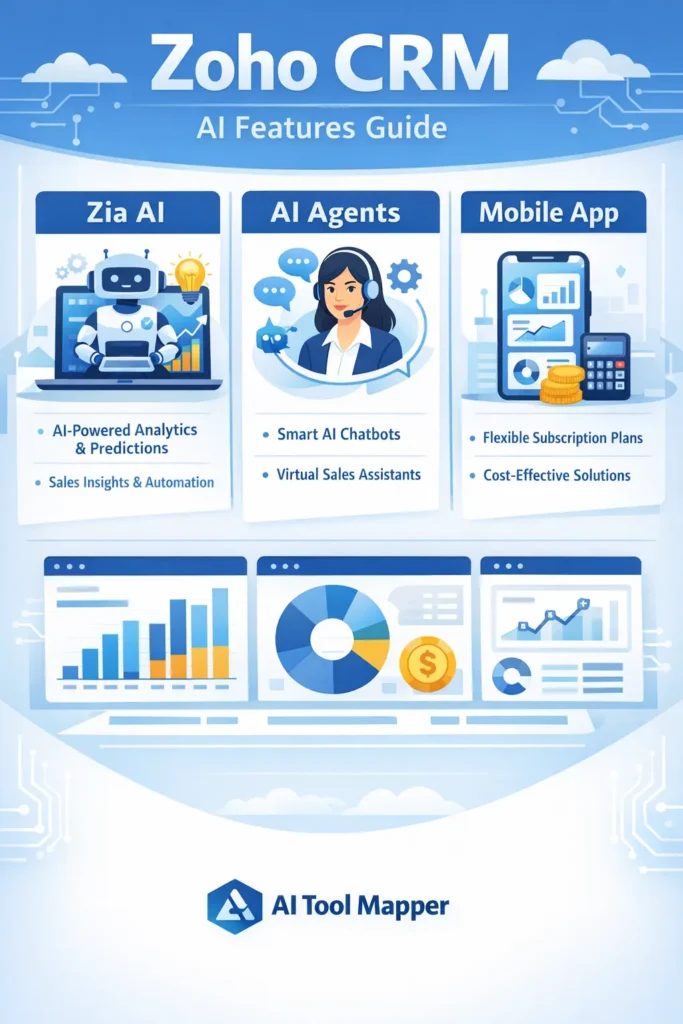
The Zoho CRM platform is designed to provide an end-to-end solution for managing customer relationships. It combines tools for sales tracking, marketing automation, analytics, customer support, and AI insights.
Users can create pipelines, track leads, manage accounts, and monitor deals through customizable dashboards. The platform also supports integrations with email services, marketing software, and productivity tools.
According to insights published by Gartner, CRM platforms that incorporate AI are becoming essential for businesses aiming to improve decision-making and operational efficiency.
Zoho CRM’s AI ecosystem helps teams identify patterns in customer behavior. For instance, the system may detect when certain types of leads convert more frequently or when follow-up timing influences deal success.
With these insights, businesses can refine their strategies and improve sales outcomes.
Why Businesses Use CRM Software
Imagine running a sales team without a CRM system. Every lead, conversation, and deal would have to be tracked manually. Important information would be scattered across spreadsheets, emails, and messaging apps.
CRM software solves this problem by creating a centralized database of customer interactions.
Businesses use CRM systems for several reasons:
- Organizing customer data
- Tracking sales pipelines
- Managing communication history
- Automating repetitive tasks
- Improving collaboration across teams
When AI is added to the mix, the CRM becomes much more powerful. Tools like predictive analytics and automation can identify opportunities that humans might miss.
This is why platforms like Zoho CRM are gaining popularity among small businesses, startups, and enterprise sales teams alike.
Key Benefits of Zoho CRM
Zoho CRM offers a range of advantages that make it appealing to organizations across industries.
One major benefit is automation. Businesses can automate repetitive processes such as lead assignment, follow-up emails, and workflow triggers. This reduces manual effort and allows teams to focus on strategic activities.
Another advantage is AI-powered insights. Zia analyzes large volumes of data and highlights patterns that help teams make better decisions.
The platform is also known for its affordable pricing and scalability. Companies can start with a free plan and upgrade as their needs grow.
Finally, Zoho CRM integrates with a wide range of business tools. This makes it easier to connect marketing campaigns, email communication, and analytics systems within a single platform.
Zoho CRM AI Features Explained
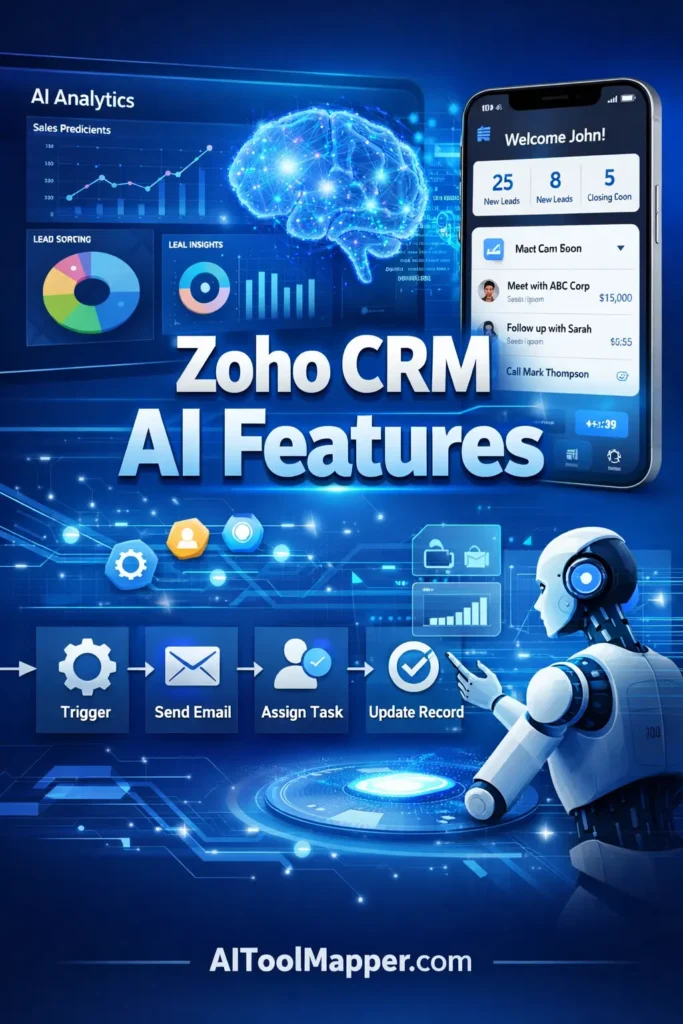
Artificial intelligence is transforming how businesses manage customers. Instead of relying solely on historical data, AI can analyze patterns and predict future outcomes.
The Zoho CRM AI features are designed to help organizations make smarter decisions by combining automation with predictive intelligence.
From lead scoring and sales forecasting to customer sentiment analysis, AI tools inside Zoho CRM allow businesses to understand their customers more deeply.
Let’s explore the key AI capabilities that make Zoho CRM stand out.
AI-Powered Sales Insights
Sales teams often struggle to determine which leads deserve attention. Some prospects show interest but never convert, while others are ready to buy but go unnoticed.
AI-powered insights solve this problem by analyzing behavioral patterns.
Zoho CRM uses machine learning to evaluate customer interactions such as emails, website visits, and previous purchases. Based on this data, the system predicts which leads are most likely to convert.
These insights allow sales representatives to focus on high-value opportunities instead of chasing every lead.
For example, the AI might recommend contacting a prospect within a certain timeframe because previous deals with similar characteristics closed successfully during that window.
Smart Automation for Customer Management
Automation is one of the most valuable features of modern CRM platforms. With Zoho CRM, businesses can automate a wide range of processes, including:
- Lead assignment
- Follow-up reminders
- Email responses
- Task creation
Instead of manually updating records, the system triggers actions automatically when specific conditions are met.
For instance, when a new lead enters the system, the CRM can automatically assign it to the appropriate sales representative based on location or industry.
Automation ensures consistency and saves time, making it easier for teams to manage large volumes of customer interactions.
AI Analytics and Reporting
Data is only valuable if it leads to actionable insights. Zoho CRM includes advanced analytics tools that transform raw data into meaningful reports.
AI analyzes sales performance, customer engagement metrics, and marketing results to identify trends and opportunities.
Businesses can visualize this information through dashboards that display metrics such as:
- conversion rates
- revenue forecasts
- lead sources
- campaign performance
These insights help organizations adjust strategies quickly and respond to changing market conditions.
Predictive Sales Forecasting
Predicting future sales performance is essential for planning and resource allocation.
Zoho CRM’s predictive forecasting tools analyze historical sales data and identify patterns that influence deal outcomes.
Using machine learning algorithms, the system can estimate:
- expected revenue
- probability of closing deals
- future pipeline performance
This allows managers to make informed decisions about hiring, marketing budgets, and production planning.
Predictive forecasting reduces uncertainty and provides a clearer picture of where the business is heading.
Zoho CRM Zia: The Built-In AI Assistant
The heart of Zoho CRM’s AI ecosystem is Zia, an intelligent assistant that continuously analyzes CRM data and provides recommendations.
Zia acts like a virtual analyst working in the background. It monitors sales activity, evaluates customer behavior, and alerts teams when something important happens.
Many businesses consider Zia one of the most valuable Zoho CRM AI features because it turns complex data into actionable insights.
What is Zia AI?
Zia is the AI assistant built into Zoho CRM. It uses machine learning and natural language processing to analyze business data and provide recommendations.
Sales teams can ask Zia questions such as:
- Which leads are most likely to convert?
- What deals are at risk of failing?
- When should we contact this customer?
Zia processes CRM data and generates answers instantly.
This conversational approach makes data analysis more accessible for teams that may not have technical expertise.
Zia AI Capabilities
Zia includes a variety of powerful features designed to improve sales performance.
Lead Prediction
Zia analyzes historical conversion data and assigns scores to incoming leads. High-scoring leads are more likely to become customers.
This helps sales teams prioritize their efforts and focus on prospects with the greatest potential.
Deal Prediction
The AI also evaluates active deals in the pipeline and predicts their likelihood of closing. If a deal appears risky, the system may recommend follow-up actions.
Email Sentiment Analysis
Zia can analyze email conversations and determine whether the tone is positive, neutral, or negative. This helps teams detect potential issues early.
Voice Assistant Features
Using voice commands, users can interact with Zia to retrieve data, create tasks, or update records without manually navigating the interface.
How Zia Helps Sales Teams Close More Deals
Sales success often depends on timing and insights. Zia helps teams by identifying the right moment to engage with prospects.
For example, the AI may detect that a customer frequently opens marketing emails but hasn’t responded yet. It might recommend sending a personalized message or scheduling a call.
By analyzing patterns across thousands of interactions, Zia enables teams to work smarter rather than harder.
Zoho CRM AI Agents
AI agents represent another layer of automation within Zoho CRM.
Unlike traditional automation rules, AI agents can perform complex tasks and interact with customers in more intelligent ways.
These agents help businesses automate workflows while maintaining a personalized customer experience.
What Are AI Agents in Zoho CRM?
AI agents are intelligent automation tools that can perform tasks on behalf of users.
For example, an AI agent may automatically assign leads, schedule follow-ups, or trigger marketing campaigns based on customer behavior.
These agents use data and machine learning to adapt their actions over time.
How AI Agents Automate Sales Processes
AI agents streamline several key processes within the sales cycle.
They can monitor customer activity and trigger workflows when specific events occur. For instance, if a lead visits the pricing page multiple times, the system might notify a sales representative.
This proactive approach ensures that opportunities are not missed.
Benefits of AI Agents for Customer Engagement
AI agents improve customer engagement by providing timely responses and personalized interactions.
Instead of waiting for manual follow-ups, customers receive relevant communication based on their behavior.
This leads to faster response times and higher satisfaction.
Businesses that adopt AI automation often see improvements in conversion rates and customer retention.
Zoho CRM Pricing Plans
Pricing is one of the most important factors when choosing CRM software. Zoho CRM offers multiple plans designed for different types of businesses.
From startups to enterprise organizations, companies can choose a plan that matches their needs and budget.
Zoho CRM Free Plan
The free plan is designed for small teams that need basic CRM functionality.
It includes contact management, lead tracking, and limited automation features.
This plan is ideal for startups or businesses exploring CRM software for the first time.
Standard Plan
The Standard plan introduces additional features such as workflow automation and advanced reporting.
Small teams that require more structured sales processes often choose this option.
Professional Plan
The Professional plan includes advanced capabilities like sales forecasting, inventory management, and deeper automation.
Growing businesses typically benefit from these features.
Enterprise Plan
The Enterprise plan unlocks many of the Zoho CRM AI features, including advanced analytics and AI insights.
Large organizations that require sophisticated automation often choose this tier.
Ultimate Plan
The Ultimate plan provides the most comprehensive set of tools, including advanced BI analytics and extended AI capabilities.
This option is designed for enterprises with complex sales operations.
Pricing Comparison Table
| Plan | Key Features | Best For |
|---|---|---|
| Free | Basic CRM tools | Startups |
| Standard | Automation tools | Small teams |
| Professional | Advanced CRM features | Growing businesses |
| Enterprise | AI capabilities | Large companies |
| Ultimate | Advanced analytics | Enterprises |
Zoho CRM Login Guide
Accessing Zoho CRM is simple once an account is created.
Users can log in through the official Zoho website and access their dashboards instantly.
How to Access CRM Zoho Login
To access the platform:
- Visit the Zoho CRM website
- Click the Login button
- Enter your email and password
After logging in, users can access dashboards, reports, and automation tools.
Troubleshooting Login Issues
If login problems occur, users should verify credentials, reset passwords, or clear browser cache.
Zoho also offers support resources to help resolve technical issues quickly.
Security and Account Protection
Security is critical for CRM platforms because they store sensitive customer information.
Zoho CRM supports multi-factor authentication, IP restrictions, and encryption to protect data.
These measures ensure that businesses can manage customer information securely.
Zoho CRM Sign Up Process
Creating a Zoho CRM account is straightforward and takes only a few minutes.
Creating a Free Zoho CRM Account
Users can sign up by visiting the Zoho CRM website and selecting the free trial option.
After entering basic details such as name, email address, and company information, the account is created.
The platform offers a trial period so businesses can explore features before upgrading.
Setting Up Your First CRM Dashboard
Once the account is created, users can customize their dashboard by adding widgets, pipelines, and reports.
This allows teams to track metrics that matter most to their business.
Connecting Sales and Marketing Tools
Zoho CRM integrates with marketing platforms, email systems, and analytics tools.
Connecting these systems ensures that customer data flows seamlessly across the organization.
Zoho CRM Mobile App Features
Modern businesses require flexibility, and Zoho CRM provides mobile apps that allow teams to manage customer relationships from anywhere.
Zoho CRM App for Android and iOS
The Zoho CRM mobile app is available for both Android and iOS devices.
Sales representatives can access contacts, track deals, and update records directly from their smartphones.
This is particularly useful for field sales teams.
Managing Leads and Contacts on Mobile
Users can create leads, update contact details, and log calls directly through the mobile interface.
This ensures that CRM data remains accurate even when teams are on the move.
Mobile Notifications and AI Alerts
Zia can send alerts to mobile devices when important events occur.
For example, sales representatives may receive notifications about new leads or deals that require attention.
Zoho CRM Automation Tools
Automation tools reduce manual work and improve efficiency.
Workflow Automation
Workflow automation allows businesses to create rules that trigger actions automatically.
For example, when a lead fills out a form, the system can automatically send a welcome email.
Lead Scoring and Assignment
Zoho CRM assigns scores to leads based on behavior and engagement.
High-scoring leads are prioritized for follow-up.
Sales Pipeline Automation
Automation can also manage sales pipelines by updating deal stages and assigning tasks.
This ensures that every opportunity moves through the process efficiently.
Zoho CRM Integrations
Integration capabilities allow Zoho CRM to connect with other tools used by businesses.
Email and Communication Tools
Zoho CRM integrates with popular email platforms to track communication with customers.
This helps teams maintain complete records of conversations.
Marketing Automation Platforms
Marketing tools can be connected to track campaign performance and generate leads automatically.
Integration with Business Applications
The platform also supports integrations with accounting, analytics, and productivity tools.
These connections help businesses streamline operations.
Zoho CRM Pros and Cons
Pros
- Powerful AI capabilities
- Affordable pricing plans
- Flexible automation tools
- Mobile-friendly interface
Cons
- Some advanced features require higher plans
- Initial setup may take time for beginners
Zoho CRM vs Other CRM Platforms
Zoho CRM vs HubSpot
HubSpot offers a popular CRM platform with strong marketing tools.
However, Zoho CRM provides deeper customization and more affordable pricing for growing businesses.
Zoho CRM vs Salesforce
Salesforce is widely recognized as an enterprise CRM leader.
While Salesforce offers powerful capabilities, Zoho CRM is often preferred by small and medium businesses due to its lower cost and simpler setup.
Which CRM Is Best for Small Businesses?
For small businesses, Zoho CRM provides a balance between affordability and advanced features.
Its AI capabilities and automation tools make it a strong option for teams that want powerful functionality without enterprise-level costs.
Best Use Cases for Zoho CRM
Zoho CRM can be applied across many industries.
Small Businesses
Startups use Zoho CRM to organize customer data and automate sales processes.
Sales Teams
Sales professionals rely on predictive insights to prioritize leads and close deals faster.
Marketing Automation
Marketing teams integrate CRM data with campaigns to improve targeting.
Customer Support Management
Support teams track customer issues and interactions within the CRM platform.
Tips to Get the Most from Zoho CRM AI
To maximize the value of Zoho CRM’s AI capabilities, businesses should adopt best practices.
First, ensure that CRM data is accurate and updated regularly. AI models rely on quality data to generate reliable predictions.
Second, automate repetitive tasks wherever possible. Workflow automation can dramatically reduce administrative work.
Third, monitor analytics dashboards frequently. AI insights often reveal trends that can guide strategic decisions.
Platforms like AI Tool Mapper often highlight AI-powered business tools that simplify operations, and Zoho CRM is consistently listed among the most effective solutions for intelligent customer management.
Frequently Asked Questions
What is Zoho CRM Zia AI?
Zia is the built-in AI assistant in Zoho CRM that helps businesses analyze data and improve decision-making. It offers features like lead scoring, deal prediction, email sentiment analysis, and workflow suggestions. Sales teams use Zia to identify high-potential opportunities, automate tasks, and gain actionable insights that improve productivity and conversion rates.
Is Zoho CRM free?
Yes, Zoho CRM offers a free plan suitable for small teams that need basic CRM functionality like contact management and lead tracking. Businesses can upgrade to paid plans for advanced features such as automation, analytics, and AI-powered tools, making it flexible for startups as well as growing organizations.
Can I use Zoho CRM on mobile?
Yes, Zoho CRM provides mobile apps for both Android and iOS devices. These apps allow users to manage leads, track deals, update records, and receive AI-driven alerts on the go. This makes it especially useful for remote teams and field sales professionals who need real-time access to customer data.
How do I sign up for Zoho CRM?
To sign up for Zoho CRM, visit the official website and choose the free trial or sign-up option. Enter your basic details like name, email, and company information, then verify your account. Once registered, you can access the dashboard and begin setting up your CRM workflows.
What are Zoho CRM AI features?
Zoho CRM includes AI-powered tools like Zia for predictive analytics, workflow automation, lead scoring, and sales forecasting. These features help businesses automate repetitive tasks, analyze customer behavior, and improve decision-making, ultimately boosting sales performance and operational efficiency.
What is Zoho CRM used for?
Zoho CRM is used to manage customer relationships, track sales pipelines, automate workflows, and analyze business performance. It helps organizations centralize customer data, improve communication, and streamline sales processes, making it an essential tool for businesses of all sizes.
How does Zoho CRM help sales teams?
Zoho CRM helps sales teams by providing tools for lead management, deal tracking, automation, and AI insights. Features like lead scoring and predictive analytics allow teams to focus on high-value opportunities, improve follow-ups, and close deals more efficiently.
Does Zoho CRM offer automation tools?
Yes, Zoho CRM includes powerful automation tools such as workflow automation, task assignment, and email triggers. These tools reduce manual work, ensure consistent processes, and help businesses manage large volumes of leads and customer interactions effectively.
Is Zoho CRM good for small businesses?
Yes, Zoho CRM is highly suitable for small businesses due to its affordable pricing and scalable features. The free plan allows startups to get started easily, while advanced plans provide automation and AI tools that support growth as the business expands.
What integrations does Zoho CRM support?
Zoho CRM supports integrations with email platforms, marketing tools, analytics software, and business applications. These integrations allow businesses to connect their CRM with other systems, ensuring seamless data flow and improving overall productivity across teams.
Conclusion
The modern sales environment is increasingly driven by data, automation, and intelligent insights. Businesses that rely solely on manual processes often struggle to keep up with growing customer expectations.
Zoho CRM addresses this challenge by integrating AI-powered tools directly into the CRM platform. Features such as Zia AI, predictive analytics, automation workflows, and mobile CRM access help teams work more efficiently while delivering better customer experiences.
From startups exploring their first CRM to enterprises seeking advanced analytics, Zoho CRM offers flexible pricing plans and scalable functionality.
As AI continues to reshape business operations, platforms like Zoho CRM demonstrate how intelligent automation can transform the way companies manage relationships, track opportunities, and drive growth.