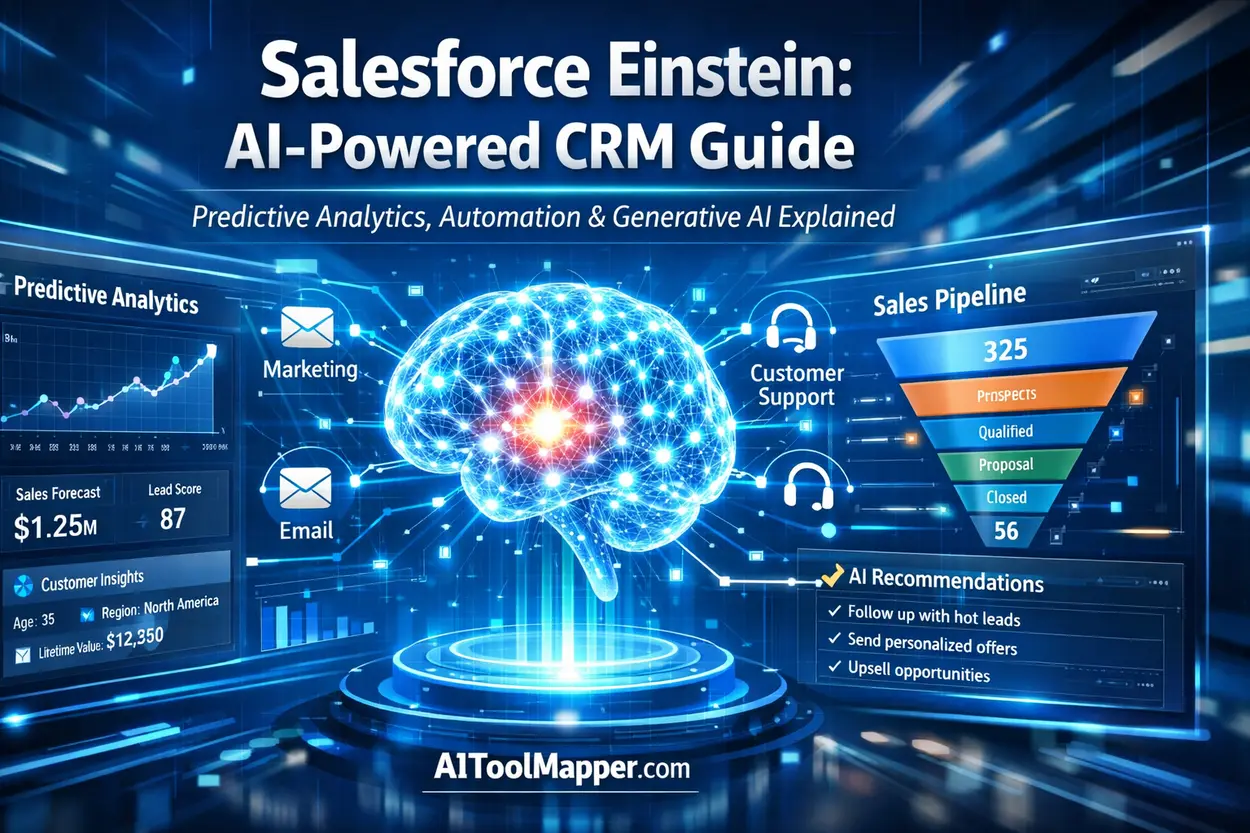
Salesforce Einstein is the artificial intelligence layer built directly into the Salesforce ecosystem. It combines machine learning, predictive analytics, automation, and generative AI to help businesses analyze customer data, forecast sales outcomes, automate repetitive tasks, and personalize marketing campaigns.
With features like lead scoring, opportunity insights, AI-powered analytics, and conversational bots, Salesforce Einstein AI CRM allows organizations to make smarter decisions based on real-time data. It integrates with major Salesforce products such as Salesforce Sales Cloud, Salesforce Marketing Cloud, and Salesforce Service Cloud.
Businesses use Salesforce Einstein analytics and automation to improve forecasting, increase sales productivity, deliver personalized customer experiences, and automate service operations. As AI adoption grows, Einstein represents one of the most advanced AI-driven CRM technologies available today.
Key Takeaways
- Salesforce Einstein adds powerful AI capabilities to the Salesforce CRM ecosystem.
- It uses machine learning, predictive analytics, and automation to generate intelligent business insights.
- Features like lead scoring, opportunity insights, and Einstein Bots improve productivity and customer experience.
- Einstein integrates with Salesforce Sales Cloud, Marketing Cloud, and Service Cloud.
- Generative AI innovations like Einstein GPT represent the future of CRM automation.
What You Need to Know About Salesforce Einstein
Artificial intelligence has rapidly transformed how companies interact with customers. Just a decade ago, most CRM systems were little more than digital spreadsheets—tools for storing contacts, tracking deals, and managing communication history. Today, modern CRMs can predict customer behavior, automate workflows, and generate insights before a human even asks the question.
This is where Salesforce Einstein enters the picture.
Salesforce Einstein is an AI-powered layer embedded across the Salesforce ecosystem. It analyzes massive amounts of CRM data using machine learning algorithms and predictive analytics to help businesses make smarter decisions. Instead of relying purely on historical reports, companies can now anticipate outcomes—such as which leads will convert, which deals are at risk, and which customers may churn.
Think of it like having a data scientist working inside your CRM 24/7.
The platform uses intelligent automation to reduce manual work while delivering deep insights about customers, sales pipelines, and marketing performance. For example, a sales manager might receive an alert that a high-value deal is likely to stall based on patterns in historical data. Meanwhile, marketers can automatically personalize campaigns using AI-driven segmentation.
Even more interesting is how Einstein integrates seamlessly across Salesforce tools. Whether teams use Sales Cloud, Marketing Cloud, or Service Cloud, Einstein adds predictive intelligence to everyday workflows.
In simple terms:
Salesforce Einstein transforms CRM data into actionable intelligence.
As AI adoption accelerates, tools like Einstein are becoming essential for businesses that want to remain competitive in a data-driven economy. From predictive analytics CRM capabilities to generative AI content creation, the platform represents a major step forward in intelligent customer relationship management.
What Is Salesforce Einstein?
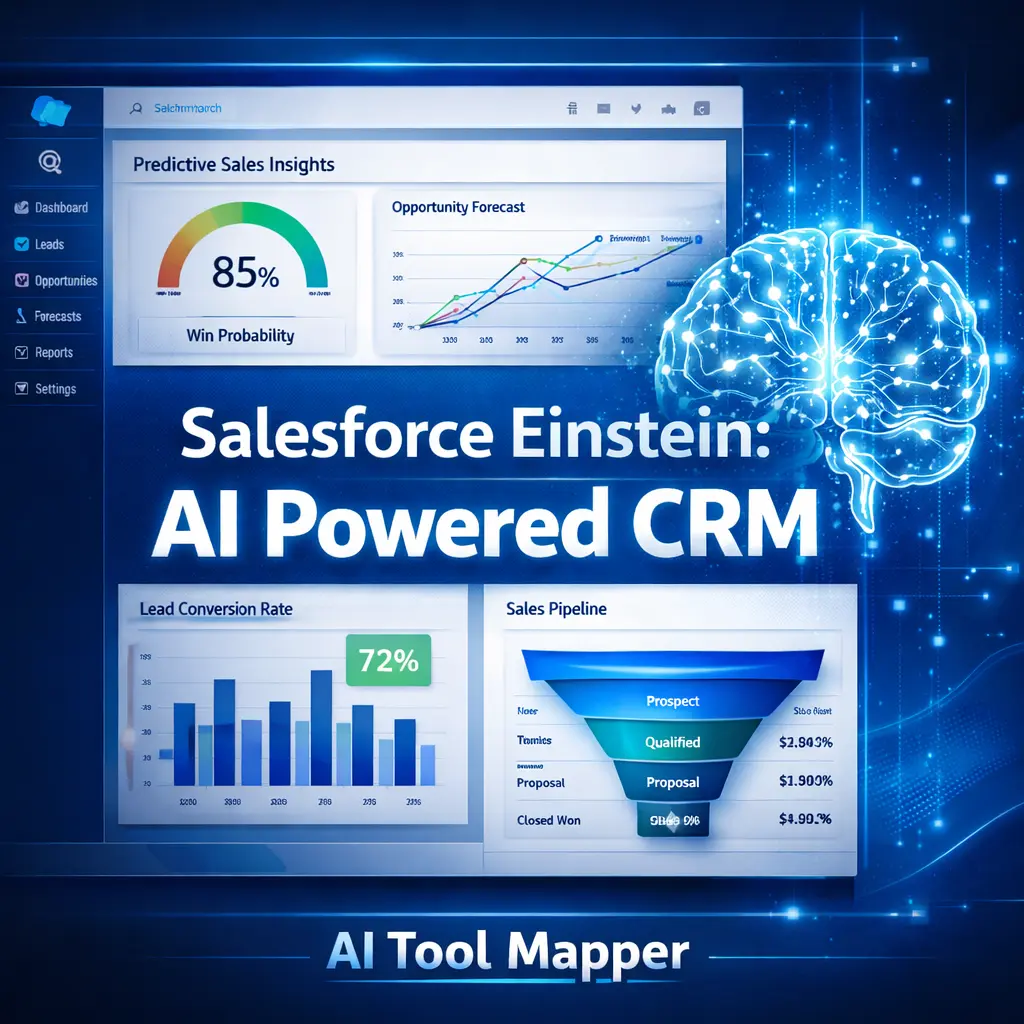
At its core, Salesforce Einstein AI is a built-in artificial intelligence platform designed to enhance the functionality of the Salesforce CRM ecosystem.
Instead of operating as a standalone AI tool, Einstein acts as an intelligent layer embedded directly into Salesforce applications. This design allows businesses to access machine learning insights without requiring advanced technical expertise or data science teams.
The primary goal of Salesforce Einstein is simple: turn raw CRM data into meaningful insights and automated actions.
Here’s how the platform accomplishes that goal.
First, Einstein collects data from multiple sources within the Salesforce ecosystem. This includes customer interactions, sales activities, email communications, marketing campaigns, and support tickets.
Next, machine learning models analyze this information to identify patterns. Over time, these algorithms learn which behaviors correlate with successful outcomes—such as closing deals, converting leads, or retaining customers.
Once these patterns are identified, Einstein generates predictive insights.
For instance:
- Which leads are most likely to convert
- Which deals may stall in the pipeline
- Which customers might need support soon
- Which marketing campaigns will generate higher ROI
The system then delivers these insights directly inside the CRM interface through dashboards, alerts, and recommendations.
This approach effectively turns Salesforce into an AI-driven business intelligence platform.
Another key capability is CRM automation with AI. Einstein can automate routine processes like lead scoring, activity logging, and service responses. As a result, teams spend less time on manual tasks and more time focusing on strategic work.
In short, Salesforce Einstein transforms CRM systems from passive databases into intelligent decision-making engines.
Key Features of Salesforce Einstein
Salesforce Einstein includes a wide range of AI tools designed to improve sales, marketing, and customer service operations. These features rely on machine learning models that analyze CRM data to provide predictions, insights, and automation.
Let’s explore the most important capabilities.
Einstein Lead Scoring
Lead prioritization has always been one of the biggest challenges for sales teams. With hundreds or even thousands of potential prospects in a CRM system, identifying which leads deserve attention can be difficult.
Salesforce Einstein Lead Scoring solves this problem using predictive analytics.
Instead of relying on manual evaluation or generic scoring models, Einstein analyzes historical CRM data to determine which characteristics are most associated with successful conversions. The AI then assigns each lead a probability score representing the likelihood of becoming a customer.
For example, the system may identify patterns such as:
- Leads from certain industries convert more often
- Specific job titles are more likely to respond to sales outreach
- Certain marketing campaigns generate higher-quality leads
Using these insights, the AI automatically ranks leads from highest to lowest conversion potential.
The benefits are significant.
Sales representatives can focus their time on high-value prospects instead of wasting effort on low-quality leads. Over time, this improves both conversion rates and overall sales productivity.
Einstein Opportunity Insights
Managing a sales pipeline can sometimes feel like navigating through uncertainty. Deals that seem promising suddenly disappear, while unexpected opportunities close quickly.
Salesforce Einstein Opportunity Insights helps reduce that uncertainty by predicting deal outcomes.
This AI-powered feature continuously analyzes data related to sales opportunities, including communication frequency, deal size, engagement history, and similar past deals.
If the system detects potential risks, it alerts sales representatives. For example, Einstein may flag an opportunity if there has been no communication with the prospect for several weeks.
Conversely, the AI may highlight deals with strong momentum and high likelihood of closing.
These predictive insights help teams:
- Identify risks early
- prioritize active opportunities
- forecast revenue more accurately
In many organizations, this capability significantly improves pipeline visibility.
Einstein Activity Capture
One of the most common frustrations in CRM usage is manual data entry. Sales representatives often spend hours updating records with emails, meetings, and call notes.
Einstein Activity Capture eliminates much of that manual work.
The tool automatically logs emails, meetings, and calendar events directly into the Salesforce CRM. It synchronizes communication data and associates it with the relevant leads, contacts, and opportunities.
This automation provides several advantages.
First, it ensures that CRM records remain accurate and up to date. Second, it reduces administrative workload for sales teams. Finally, the captured data provides additional input for Einstein’s machine learning models, improving prediction accuracy over time.
Einstein Bots
Customer service teams often face high volumes of repetitive support requests. Questions about account status, order updates, or basic troubleshooting can overwhelm human agents.
Einstein Bots offer a scalable solution.
These AI-powered chatbots can interact with customers through messaging platforms and websites, providing instant responses to common inquiries. The bots use natural language processing to understand customer questions and deliver relevant answers.
When a request becomes too complex, the bot seamlessly transfers the conversation to a human support agent.
Organizations that implement Einstein Bots often experience:
- reduced support response times
- lower operational costs
- improved customer satisfaction
The technology essentially acts as a 24/7 digital support assistant.
Einstein Analytics
Data analysis is one of the most powerful features of the Salesforce Einstein platform.
Einstein Analytics provides advanced dashboards and predictive analytics tools that help businesses understand trends, identify opportunities, and forecast outcomes.
Unlike traditional reporting tools, Einstein Analytics goes beyond simple historical data. The platform applies machine learning algorithms to detect hidden patterns and generate future predictions.
For example, businesses can analyze:
- sales performance trends
- customer behavior patterns
- marketing campaign effectiveness
- service performance metrics
These insights help decision-makers plan strategies based on data rather than assumptions.
Salesforce Einstein Products
Salesforce Einstein powers multiple AI capabilities across the Salesforce ecosystem. Each major Salesforce product integrates Einstein features tailored to specific business functions.
Einstein for Sales Cloud
Within Salesforce Sales Cloud, Einstein focuses on improving sales productivity and forecasting accuracy.
Sales teams benefit from predictive lead scoring, opportunity insights, and AI-generated recommendations for next steps. The system analyzes historical deal data to predict which opportunities are most likely to close successfully.
This intelligence allows sales representatives to focus their efforts where they matter most.
Over time, organizations using Einstein for Sales Cloud often see improved win rates and more reliable revenue forecasts.
Einstein for Marketing Cloud
In Salesforce Marketing Cloud, Einstein enhances marketing automation with predictive intelligence.
The AI analyzes customer behavior across channels—email, web, social media, and mobile interactions—to identify patterns in engagement and purchasing behavior.
Marketers can then create highly personalized campaigns based on these insights.
For instance, Einstein may recommend the optimal time to send an email or predict which customers are most likely to respond to a promotion.
This approach increases campaign performance while improving customer experiences.
Einstein for Service Cloud
Customer service operations also benefit from AI-powered automation through Salesforce Service Cloud.
Einstein helps support teams classify service tickets, prioritize urgent issues, and recommend solutions based on past cases.
The AI analyzes support history to identify the most effective responses for specific problems. Agents receive suggested solutions directly within their workflows.
Combined with Einstein Bots, these features dramatically reduce response times and improve service efficiency.
Einstein GPT
The newest evolution of Salesforce AI is Einstein GPT.
Einstein GPT brings generative AI capabilities directly into the CRM environment. It can generate sales emails, marketing copy, service responses, and even automated reports based on CRM data.
For example, a sales representative could ask Einstein GPT to draft a follow-up email summarizing a recent meeting with a prospect. The AI uses customer information stored in the CRM to create a personalized message.
This capability represents the next generation of generative AI for sales and marketing teams.
How Salesforce Einstein Works
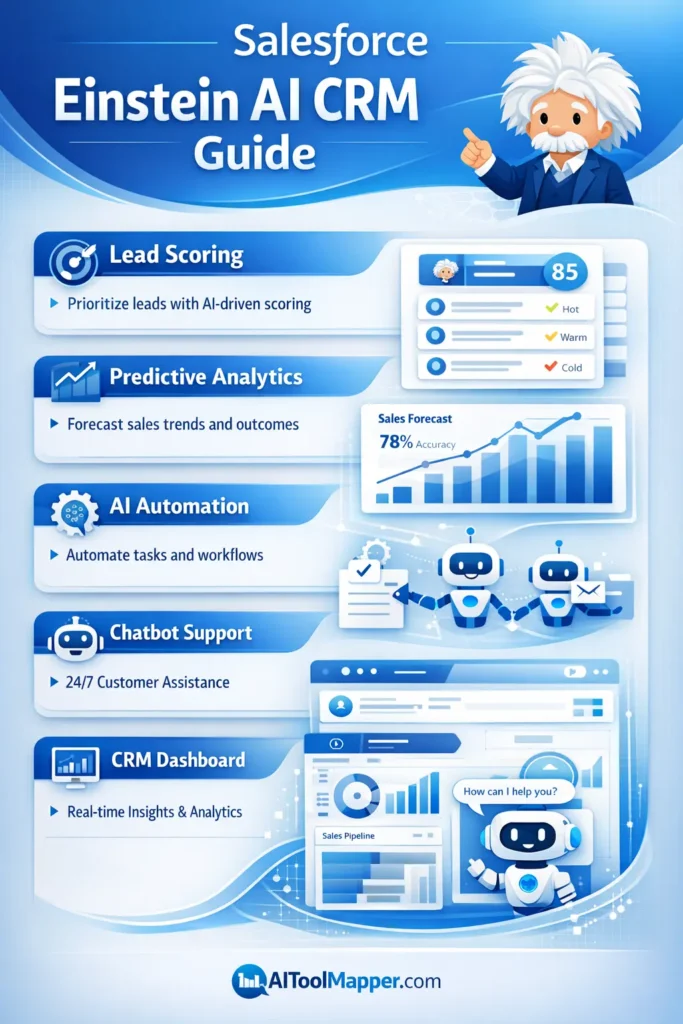
Understanding how Salesforce Einstein works requires looking at the underlying AI process. Although the technology involves complex machine learning algorithms, the workflow can be explained through a simple step-by-step model.
Step 1: Data Collection
Everything begins with data.
Einstein gathers information from across the Salesforce CRM environment. This includes customer records, sales interactions, marketing campaign results, service tickets, and communication history.
Because Salesforce platforms already store large amounts of business data, Einstein has a rich dataset to analyze.
Step 2: Machine Learning Model Training
Once the data is collected, machine learning models analyze historical patterns.
These algorithms evaluate thousands of variables to determine relationships between actions and outcomes. For example, they may identify factors that influence deal success or customer engagement.
The models continuously improve as more data becomes available.
Step 3: Pattern Recognition
After training, Einstein identifies patterns that humans might overlook.
For example:
- Which marketing channels drive the most conversions
- Which sales behaviors lead to successful deals
- Which customers are most likely to churn
These insights form the foundation for predictive analytics.
Step 4: Predictive Insights Generation
Using the patterns identified during analysis, Einstein generates predictions.
Examples include:
- conversion probability for leads
- revenue forecasts for pipelines
- customer churn risk scores
These predictions help teams make better decisions.
Step 5: Automated Recommendations
Finally, Einstein delivers recommendations directly within the CRM interface.
Instead of forcing users to analyze complex reports, the AI highlights actionable insights. Sales representatives may receive suggestions for next steps, while marketers receive campaign optimization recommendations.
This approach transforms Salesforce into an intelligent predictive analytics platform.
Benefits of Salesforce Einstein for Businesses
Adopting AI-powered CRM technology can dramatically improve operational efficiency. Salesforce Einstein offers several key benefits for organizations of all sizes.
Improved Sales Forecasting
Accurate forecasting is essential for strategic planning.
Traditional forecasting methods rely on historical data and manual judgment, which often leads to inaccuracies.
Salesforce Einstein uses predictive analytics to evaluate pipeline data, deal history, and engagement patterns. The system then generates forecasts based on statistical models rather than guesswork.
As a result, leadership teams gain more reliable revenue projections.
Increased Sales Productivity
Sales representatives often spend significant time on administrative tasks.
Einstein automates many of these activities, including lead scoring, activity logging, and opportunity analysis. With less time spent on data entry, sales teams can focus on building relationships and closing deals.
Automation also ensures that CRM data remains accurate and consistent.
Better Customer Insights
Understanding customer behavior is critical for business growth.
Salesforce Einstein analyzes customer interactions across multiple channels to generate intelligent insights. Businesses can identify buying patterns, engagement trends, and potential risks.
These insights help companies develop stronger relationships with their customers.
Personalized Marketing
Modern consumers expect personalized experiences.
Einstein enables marketers to segment audiences based on predictive analytics and behavioral data. Campaigns can be tailored to individual preferences and engagement history.
This level of personalization improves conversion rates and customer satisfaction.
Faster Customer Support
Customer service teams benefit from AI-powered automation and intelligent recommendations.
Einstein Bots handle routine inquiries, while AI-assisted case management helps agents resolve complex issues quickly.
The result is faster response times and improved service quality.
Salesforce Einstein Use Cases
Salesforce Einstein can be applied across many industries and business functions.
Sales Teams
Sales organizations use Einstein for:
- predictive lead scoring
- opportunity insights
- pipeline forecasting
- automated activity tracking
These features help sales representatives prioritize opportunities and close deals more efficiently.
Marketing Teams
Marketing professionals use Einstein to optimize campaigns.
The AI analyzes engagement data to recommend audience segments, content strategies, and optimal messaging times. This improves campaign performance and reduces wasted advertising spend.
Customer Service
Customer service departments rely on Einstein for automated case classification, chatbot support, and intelligent knowledge recommendations.
These tools help support agents resolve issues faster and improve customer satisfaction.
E-commerce Businesses
Online retailers benefit from Einstein’s predictive analytics capabilities.
AI can analyze browsing behavior, purchase history, and engagement data to generate product recommendations and personalize customer journeys.
This increases both sales and customer loyalty.
Salesforce Einstein vs Traditional CRM
| Feature | Traditional CRM | Einstein AI CRM |
|---|---|---|
| Data Insights | Manual analysis | AI-powered insights |
| Lead Prioritization | Sales rep judgment | Predictive scoring |
| Automation | Limited workflows | Advanced AI automation |
| Forecasting | Historical trends | Predictive modeling |
| Customer Insights | Basic reports | Intelligent analytics |
The difference is clear.
While traditional CRMs store information, Salesforce Einstein transforms data into actionable intelligence.
Salesforce Einstein Pricing and Availability
Salesforce Einstein features are included across several Salesforce products, although availability varies depending on the specific plan.
Basic AI capabilities may be included in certain CRM packages, while advanced analytics and generative AI tools often require additional licensing or enterprise-level subscriptions.
Pricing typically depends on:
- the Salesforce product used
- number of users
- advanced AI features enabled
Organizations considering Einstein should consult official Salesforce documentation or sales representatives for the most current pricing details.
Salesforce Einstein Pros and Cons
Pros
- Advanced AI capabilities
- Deep integration with the Salesforce ecosystem
- Powerful predictive analytics tools
- Automation that improves productivity
- Scalable enterprise-grade infrastructure
Cons
- Steeper learning curve for new users
- Higher cost compared with basic CRM platforms
- Requires high-quality data for optimal performance
Despite these challenges, many organizations consider Einstein one of the most powerful AI CRM solutions available.
Salesforce Einstein Alternatives
While Salesforce Einstein dominates the enterprise CRM market, several competitors offer AI-powered CRM capabilities.
HubSpot CRM
HubSpot offers AI-powered marketing automation, predictive lead scoring, and customer insights within a user-friendly interface.
Zoho CRM
Zoho CRM includes AI capabilities through its Zia assistant, which provides predictive insights and workflow automation.
Microsoft Dynamics 365
Microsoft’s CRM solution integrates AI through Azure services and offers advanced analytics and automation.
Each platform offers unique strengths, but Salesforce Einstein remains one of the most comprehensive AI CRM solutions.
How to Get Started with Salesforce Einstein
Implementing Salesforce Einstein involves several steps.
First, businesses must enable Einstein features within their Salesforce account. Administrators can configure AI settings and select which modules to activate.
Next, organizations should connect relevant data sources. The accuracy of Einstein predictions depends heavily on data quality and completeness.
After data integration, the AI models begin training on historical CRM information. Over time, the system generates increasingly accurate predictions.
Finally, teams should monitor AI insights and adjust workflows accordingly.
Platforms like AI Tool Mapper, an AI tools directory and resource hub, often highlight CRM AI solutions like Salesforce Einstein to help businesses discover and compare emerging technologies.
Future of AI in CRM
Artificial intelligence is rapidly reshaping the CRM landscape.
As generative AI technology evolves, CRM systems will become even more intelligent and proactive. Instead of simply analyzing past interactions, future systems will anticipate customer needs before they arise.
Salesforce continues to lead innovation in this space.
With technologies like Einstein GPT, businesses can generate content, automate communication, and analyze data within a single platform.
The result is a new generation of CRM systems capable of delivering fully AI-driven customer experiences.
FAQs
What is Salesforce Einstein used for?
Salesforce Einstein is used to bring AI-powered intelligence into CRM systems. It helps businesses analyze customer data, automate repetitive workflows, and generate predictive insights. With features like lead scoring and opportunity forecasting, it enables smarter sales decisions, improved marketing campaigns, and enhanced customer experiences across the CRM ecosystem.
Is Salesforce Einstein free?
Salesforce Einstein is not entirely free. While some basic AI features may be included in standard Salesforce plans, advanced capabilities such as predictive analytics, automation tools, and generative AI features like Einstein GPT usually require additional licensing or premium subscriptions depending on the product tier.
Does Salesforce Einstein use machine learning?
Yes, Salesforce Einstein heavily relies on machine learning algorithms to process CRM data. It identifies patterns in customer behavior, sales activities, and engagement history to generate predictions. These insights help businesses forecast outcomes, prioritize leads, and improve decision-making using data-driven intelligence.
What is Einstein GPT?
Einstein GPT is a generative AI tool within the Salesforce ecosystem that creates content such as emails, marketing messages, and service responses. It uses CRM data and natural language processing to generate personalized and context-aware outputs, helping teams save time and improve communication efficiency.
Who should use Salesforce Einstein?
Salesforce Einstein is designed for sales teams, marketing professionals, customer service agents, and enterprises using Salesforce CRM. It is particularly beneficial for organizations looking to automate processes, gain predictive insights, and deliver personalized customer experiences using AI-driven technology.
How does Salesforce Einstein improve sales performance?
Salesforce Einstein improves sales performance by providing predictive lead scoring, opportunity insights, and automated activity tracking. It helps sales teams focus on high-value prospects, identify risks in deals, and optimize engagement strategies. This leads to higher conversion rates and more efficient sales processes.
What are the key features of Salesforce Einstein?
Key features of Salesforce Einstein include lead scoring, opportunity insights, activity capture, AI chatbots (Einstein Bots), and advanced analytics dashboards. These tools work together to automate workflows, deliver predictive insights, and enhance decision-making across sales, marketing, and customer service operations.
Can Salesforce Einstein integrate with other tools?
Yes, Salesforce Einstein integrates seamlessly with other Salesforce products and third-party applications. It works with tools like Sales Cloud, Marketing Cloud, and Service Cloud, while also supporting integrations through APIs. This allows businesses to unify data and apply AI insights across multiple platforms.
What industries benefit most from Salesforce Einstein?
Salesforce Einstein is widely used across industries such as retail, finance, healthcare, e-commerce, and technology. Any organization that manages customer relationships and data can benefit from its predictive analytics, automation capabilities, and personalized customer engagement features.
Is Salesforce Einstein suitable for small businesses?
Yes, Salesforce Einstein can be suitable for small businesses, especially those already using Salesforce CRM. While advanced features may require higher-tier plans, smaller teams can still benefit from automation, lead scoring, and AI insights to improve efficiency and growth.
What is the difference between Salesforce Einstein and traditional CRM?
Traditional CRM systems mainly store and organize customer data, while Salesforce Einstein adds AI capabilities to analyze and act on that data. It provides predictive insights, automation, and intelligent recommendations, helping businesses move from reactive data management to proactive decision-making.