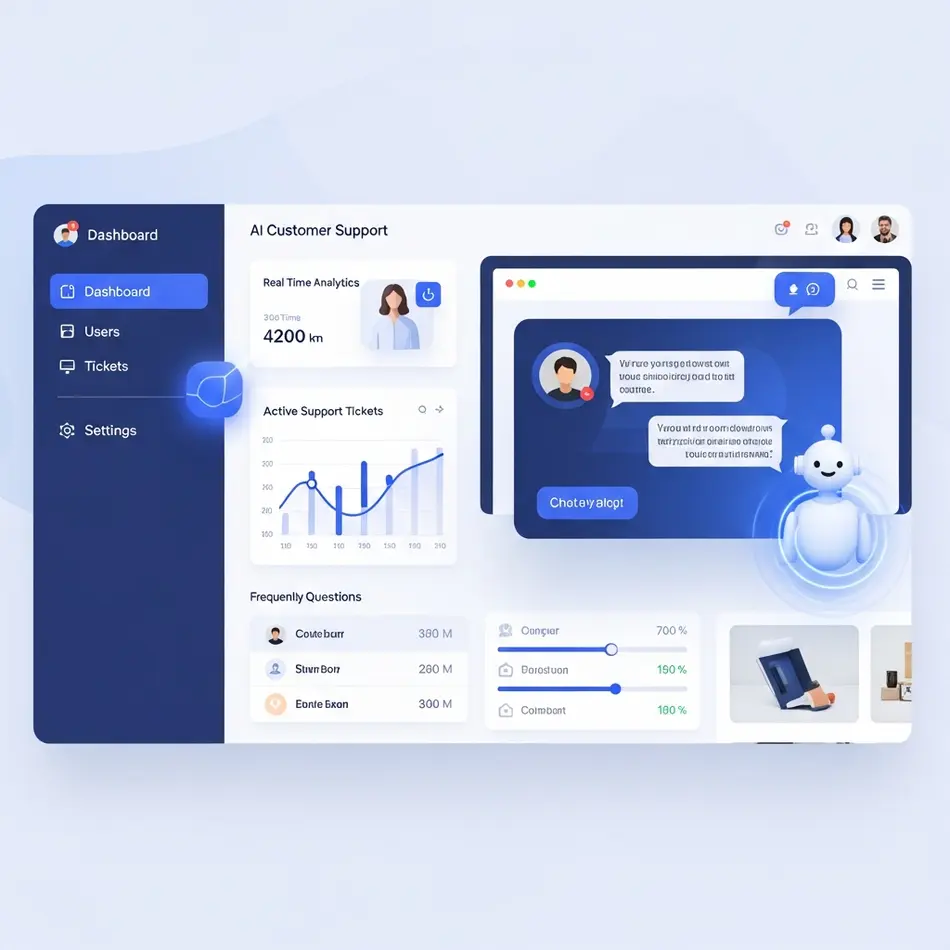
AI chatbots for customer support help businesses deliver faster, 24/7 assistance while reducing operational costs. This guide explains how to set up an AI customer service chatbot step by step, compares AI vs rule-based bots, highlights key features, and reviews the best AI chatbot tools for 2026. You’ll also learn real-world use cases, common mistakes to avoid, and whether AI chatbots can replace human agents.
Key Takeaways
- AI chatbots improve speed, availability, and efficiency
- Hybrid models outperform pure automation
- Training data quality determines chatbot success
- AI + human support delivers the best experience
- Continuous optimization is essential
Why Customer Support Is Breaking — and How AI Fixes It
Customer expectations have changed dramatically. People don’t want to wait hours for a reply or scroll endlessly through help pages. They want answers now. Meanwhile, businesses are dealing with rising support costs, agent burnout, and growing ticket volumes. It’s a tough equation to balance.
This is where AI chatbots for customer support quietly change the game. Instead of replacing humans, modern AI chatbots handle repetitive questions, guide users instantly, and free support teams to focus on real problems. When set up correctly, they feel less like bots and more like helpful digital assistants.
In this guide, you’ll learn how to set up an AI chatbot, choose the right tools, integrate it with your CRM, and avoid common mistakes. Whether you run an e-commerce store, SaaS product, or service business, this walkthrough will help you automate customer service with AI—without sacrificing trust or experience.
What Is an AI Chatbot for Customer Support?
An AI chatbot for customer support is a conversational system designed to understand customer queries and respond intelligently—without relying on rigid scripts. Unlike traditional bots, AI chatbots use Natural Language Processing (NLP) and machine learning to understand intent, context, and even tone.
Instead of matching exact keywords, AI chatbots analyze how people actually speak. That’s why users can type “Where’s my order?” or “I haven’t received my package yet” and get the same accurate response. Over time, these bots improve as they learn from real conversations.
The biggest distinction lies in AI vs rule-based chatbot for support. Rule-based bots follow predefined paths and fail when queries fall outside scripts. AI chatbots adapt, learn, and escalate intelligently when needed. According to insights shared by Gartner, conversational AI is now a core pillar of modern customer experience strategies.
Benefits of Using AI Chatbots for Customer Support
24/7 Customer Support Availability
Customers don’t follow business hours. AI chatbots don’t sleep, don’t take breaks, and don’t miss messages. A 24/7 support AI chatbot ensures that even midnight queries receive immediate responses. This alone dramatically improves satisfaction, especially for global audiences.
Faster Response Time & Reduced Workload
AI chatbots instantly handle FAQs, order status checks, password resets, and appointment scheduling. This reduces ticket volume and gives human agents space to solve complex issues. Brands featured in Zendesk’s CX reports consistently highlight speed as the top driver of loyalty.
Cost Savings for Businesses
Hiring and training support agents is expensive. AI chatbots scale instantly without increasing headcount. Over time, businesses see significant reductions in per-ticket costs while maintaining quality.
Better Customer Experience & Engagement
AI chatbots personalize responses, remember context, and guide users smoothly. When combined with live agent handover, they create a seamless support journey rather than a frustrating dead end.
Types of AI Chatbots Used in Customer Support
Not all chatbots are built the same. Choosing the right type is a critical part of customer support AI chatbot setup.
Rule-Based Chatbots
Best for very simple flows like contact forms or basic FAQs. Limited flexibility, low intelligence.
AI-Powered Chatbots
These bots understand language, context, and intent. Ideal for growing businesses handling diverse customer questions.
Hybrid Chatbots
A blend of rules and AI. They handle predictable tasks with scripts and complex queries with AI logic. This is the most practical choice for most companies today.
Step-by-Step Guide: How to Set Up AI Chatbots for Customer Support
Step 1 – Identify Customer Support Goals
Before choosing tools, define what success looks like. Do you want to reduce tickets, improve response time, generate leads, or all three? Review FAQs, customer emails, and live chat transcripts to identify patterns.
Step 2 – Choose the Right AI Chatbot Platform
Look for platforms offering strong NLP, CRM integration, scalability, and transparent pricing. Avoid tools that lock you into rigid flows. Many businesses explore platforms listed on AI Tool Mapper to compare features objectively.
Step 3 – Design Chatbot Conversation Flow
Start simple. Create a welcoming greeting, map top intents, and design fallback responses that guide users instead of frustrating them. A good bot knows when to say “Let me connect you to a human.”
Step 4 – Train Your AI Chatbot with Real Queries
Use historical tickets, chat logs, and customer emails. Real language beats hypothetical examples. The more authentic the data, the smarter the chatbot becomes.
Step 5 – Integrate Chatbot with Website & CRM
Deploy the bot on your website, WhatsApp, Facebook Messenger, or in-app chat. Chatbot integration with CRM ensures conversation history, tickets, and user data sync seamlessly.
Step 6 – Test, Optimize & Launch
Test internally first. Monitor unanswered queries, adjust flows, and track engagement. Optimization is ongoing, not a one-time task.
Best AI Chatbots for Customer Support in 2026
ChatGPT-Powered Support Bots
Highly flexible, conversational, and excellent for intent detection when implemented responsibly.
Intercom AI
Strong automation, deep CRM integration, and proven enterprise reliability.
Tidio AI
Popular with small and medium businesses for its ease of use and affordability.
Drift
Sales-focused chatbot with strong conversational intelligence for B2B.
Zendesk AI
Ideal for large support teams needing ticket automation and analytics.
AI Chatbot Features You Must Have for Customer Service
Any serious chatbot should include NLP, multilingual support, live agent handover, analytics, and CRM integration. Without reporting, you can’t improve. Without escalation, trust breaks. These features separate gimmicks from real chatbot customer support tools.
Common Mistakes to Avoid When Setting Up AI Chatbots
Over-automation without human backup is the fastest way to lose trust. Poor training data leads to nonsense responses. Ignoring analytics prevents improvement. Treat your chatbot as a living system, not a one-time install.
AI Chatbots vs Human Support – Can Bots Replace Humans?
AI chatbots excel at speed, consistency, and scale. Humans excel at empathy, judgment, and nuance. The future isn’t replacement—it’s collaboration. The best support teams use AI as the first line and humans as specialists.
Use Cases of AI Chatbots in Customer Support
From order tracking in e-commerce to onboarding in SaaS, appointment booking in healthcare, and balance queries in banking—AI chatbots adapt across industries when configured thoughtfully.
FAQs – AI Chatbots for Customer Support
1. What is the best AI chatbot for customer support?
The best AI chatbot depends on your business size, budget, and support needs. Popular options like Zendesk AI, Intercom, and ChatGPT-powered bots offer automation, personalization, and integrations. Small businesses may prefer simple tools, while enterprises benefit from advanced AI with CRM and analytics capabilities.
2. How much does it cost to set up an AI chatbot?
AI chatbot costs vary widely based on features and scale. Basic plans may start free or at $10–$50 per month, while advanced solutions with automation, integrations, and AI training can cost hundreds or even thousands monthly. Custom enterprise setups typically require higher investment and ongoing maintenance.
3. Can AI chatbots fully replace human support agents?
AI chatbots cannot fully replace human agents, especially for complex or emotional customer issues. However, they significantly reduce workload by handling repetitive queries, FAQs, and initial interactions. This allows human agents to focus on high-value tasks, improving overall efficiency and customer satisfaction.
4. Are AI chatbots safe for customer data?
AI chatbots are generally safe when built with proper security protocols like encryption, access control, and compliance with regulations such as GDPR. Businesses must ensure data is stored and processed securely, and choose trusted platforms that prioritize privacy, transparency, and responsible AI usage.
5. How do AI chatbots improve customer support?
AI chatbots improve customer support by providing instant responses, 24/7 availability, and consistent service. They can handle multiple queries simultaneously, reduce wait times, and guide users through common issues. This leads to faster resolutions, improved user experience, and reduced operational costs for businesses.
6. Can AI chatbots handle multiple languages?
Yes, many modern AI chatbots support multiple languages using natural language processing (NLP). This allows businesses to serve global audiences without hiring multilingual staff. Advanced bots can detect the user’s language automatically and respond accurately, enhancing customer experience across different regions.
7. How long does it take to implement an AI chatbot?
Implementation time depends on complexity. Basic chatbots can be set up within a few hours using no-code platforms, while advanced AI chatbots with integrations, custom workflows, and training may take several weeks. Proper testing and optimization are essential before full deployment.
8. What industries benefit the most from AI chatbots?
Industries like eCommerce, healthcare, banking, SaaS, and customer service benefit greatly from AI chatbots. They handle high volumes of customer interactions, automate repetitive tasks, and provide quick assistance. Any business that deals with frequent customer queries can significantly improve efficiency using chatbots.
9. Do AI chatbots require coding skills?
Not necessarily. Many chatbot platforms offer no-code or low-code builders with drag-and-drop interfaces, making them accessible to beginners. However, advanced customization, API integrations, and AI training may require technical knowledge or developer support for optimal performance.
10. How do you measure the success of an AI chatbot?
Success can be measured using metrics like response time, resolution rate, customer satisfaction (CSAT), and engagement levels. Businesses also track cost savings and reduction in support tickets. Continuous monitoring and optimization help improve chatbot performance and ensure it meets customer expectations effectively.
Final Thoughts – Is AI Chatbot Setup Worth It?
If customer support matters to your business—and it should—then AI chatbots are no longer optional. They reduce costs, improve response times, and scale effortlessly. The key lies in thoughtful setup, ongoing training, and ethical use.
Businesses that adopt AI responsibly today will define customer experience tomorrow.
👉 Explore the best AI chatbot tools on AI Tool Mapper.