
Enterprise AI solutions are transforming modern businesses by automating workflows, improving decision-making, and enhancing customer experiences. From platforms like Microsoft Azure AI and Google Cloud AI to tools like UiPath and Salesforce, organizations are leveraging AI across operations, marketing, HR, and finance. This guide explores top enterprise AI platforms, real-world use cases, and how to choose the right solution for scalable growth.
How Enterprise AI Is Transforming Businesses
Imagine running a business where repetitive tasks handle themselves, customer queries are resolved instantly, and data predicts your next big move. That’s not futuristic anymore—it’s happening now with enterprise AI solutions.
From startups to global corporations, companies are rapidly embracing AI-driven technologies to boost productivity, reduce operational costs, and gain a competitive edge. Whether it’s automating workflows, personalizing marketing campaigns, or detecting fraud, AI is quietly reshaping how businesses operate behind the scenes.
In this in-depth guide, you’ll discover:
- The meaning and importance of enterprise AI
- The top 15 enterprise AI platforms dominating 2026
- Real-world enterprise AI use cases
- How to choose the right AI solution for your business
Let’s dive in.
🔍 What Are Enterprise AI Solutions?
At its core, enterprise AI solutions refer to advanced AI-powered tools and platforms designed to solve complex business problems at scale. Unlike traditional software, these systems learn from data, adapt over time, and make intelligent decisions.
Key Components:
- Machine Learning (ML): Learns patterns from data
- Natural Language Processing (NLP): Understands human language
- Automation: Reduces manual tasks
- Predictive Analytics: Forecasts trends and outcomes
👉 Traditional software follows rules. AI-powered systems create rules based on data.
🚀 Why Businesses Are Investing in Enterprise AI
✅ Key Benefits of Enterprise AI Solutions
- Increased Efficiency: Automate repetitive tasks
- Better Decision-Making: Data-driven insights
- Cost Reduction: Lower operational expenses
- Enhanced Customer Experience: Personalization at scale
📈 Enterprise AI Adoption Trends in 2026
- Rise of generative AI tools like OpenAI
- AI-first business strategies
- Integration with cloud giants like Amazon Web Services
🏆 Top 15 Enterprise AI Solutions in 2026
1. Microsoft Azure AI
Microsoft offers one of the most comprehensive enterprise AI platforms, designed for scalability, flexibility, and deep integration with business ecosystems.
🔑 Key Features:
- Azure Machine Learning: Build, train, and deploy ML models with drag-and-drop simplicity or advanced coding
- Cognitive Services: Pre-built APIs for vision, speech, language, and decision-making
- AI-powered Analytics: Integrates with Power BI for real-time insights
- Azure OpenAI Integration: Access to advanced generative AI capabilities
- Enterprise-grade Security: Compliance with global standards
💼 How Businesses Use It:
- Automating customer support through AI chatbots and virtual assistants
- Predictive maintenance in manufacturing
- Fraud detection in financial services
- Intelligent document processing
👉 Many enterprises use Azure AI to create end-to-end AI solutions for businesses, from data ingestion to deployment.
2. Google Cloud AI
Google is known for its cutting-edge AI research and developer-friendly tools, making it a top choice among enterprise AI companies.
🔑 Key Features:
- Vertex AI: Unified platform for ML model development and deployment
- AutoML: Build custom models without deep technical expertise
- Vision AI & Video AI: Advanced image and video analysis
- Natural Language AI: Sentiment analysis, entity recognition, translation
- BigQuery AI: AI-powered data analytics at scale
💼 How Businesses Use It:
- Image recognition for retail inventory and quality control
- NLP-driven chatbots and sentiment analysis
- Real-time data analytics for decision-making
- AI-powered recommendation engines
👉 Google Cloud AI excels in AI platforms for business automation, especially when handling large-scale data.
3. AWS AI
Amazon provides a vast ecosystem of AI services, making it one of the most widely adopted enterprise AI software platforms globally.
🔑 Key Features:
- Amazon SageMaker: Build and deploy ML models quickly
- AI Services (Rekognition, Comprehend, Lex): Ready-to-use AI tools
- Personalize: Recommendation engine for eCommerce and media
- Forecast: Time-series forecasting
- Scalable Infrastructure: Pay-as-you-go pricing
💼 How Businesses Use It:
- Fraud detection in banking and fintech
- Personalized product recommendations in eCommerce
- Voice assistants and chatbots
- Demand forecasting in supply chain
👉 AWS AI is ideal for companies needing highly scalable AI tools for enterprises.
4. IBM Watson
IBM has long been a pioneer in AI, focusing on deep analytics and industry-specific solutions.
🔑 Key Features:
- Watson Assistant: AI chatbots for customer service
- Watson Discovery: Extract insights from unstructured data
- Watson Health: AI for medical data analysis
- Explainable AI: Transparent decision-making models
- Industry-specific Solutions: Tailored for healthcare, finance, and legal
💼 How Businesses Use It:
- Healthcare diagnostics and patient data analysis
- Financial risk assessment and compliance monitoring
- Customer service automation with intelligent chatbots
- Legal document analysis
👉 IBM Watson is a strong choice for enterprise artificial intelligence tools requiring deep domain expertise.
5. Salesforce Einstein
Built by Salesforce, Einstein brings AI directly into CRM workflows, making it essential for sales and marketing teams.
🔑 Key Features:
- Predictive Lead Scoring: Identify high-value prospects
- AI-powered CRM Automation: Automate repetitive sales tasks
- Customer Insights: Behavioral analysis and personalization
- Einstein GPT: Generative AI for content and emails
- Sales Forecasting: Accurate revenue predictions
💼 How Businesses Use It:
- Sales forecasting and pipeline management
- Personalized marketing campaigns
- Automated email responses and content generation
- Customer behavior analysis
👉 Salesforce Einstein is one of the best AI solutions for businesses focused on revenue growth and customer engagement.
6. SAP AI
SAP integrates artificial intelligence directly into its ERP (Enterprise Resource Planning) ecosystem, making it a powerful choice for large organizations managing complex operations.
🔑 Key Features:
- AI-powered ERP automation (finance, procurement, supply chain)
- Intelligent robotic process automation (RPA)
- Predictive analytics for demand forecasting
- AI-driven business insights via SAP Business Technology Platform
💼 How Businesses Use It:
Companies use SAP AI to automate repetitive back-office processes like invoice matching, procurement approvals, and inventory management. For example, a manufacturing company can predict supply chain disruptions before they happen and adjust operations in real time.
👉 The biggest advantage? SAP doesn’t just add AI—it embeds intelligence into core business workflows, making operations smarter without needing separate tools.
7. Oracle AI
Oracle Corporation offers a comprehensive suite of AI-driven applications and databases, particularly strong in data management and enterprise analytics.
🔑 Key Features:
- AI-powered autonomous database (self-patching, self-optimizing)
- Embedded AI in Oracle Cloud applications
- Advanced analytics and business intelligence tools
- Natural language query for data insights
💼 How Businesses Use It:
Organizations rely on Oracle AI for automating database management, detecting anomalies, and generating real-time insights from massive datasets. For instance, financial institutions use Oracle AI to identify unusual transaction patterns and reduce fraud risks.
👉 Oracle stands out because it reduces the need for manual database administration—saving both time and cost.
8. OpenAI Enterprise Solutions
OpenAI is leading the generative AI revolution by offering enterprise-grade AI models that can understand, generate, and automate human-like tasks.
🔑 Key Features:
- Advanced language models (for text, code, and automation)
- API integrations for enterprise workflows
- Custom AI assistants and copilots
- Secure and scalable enterprise deployment
💼 Use Cases:
✍️ Content Creation
Businesses use OpenAI tools to generate blog posts, marketing copy, emails, product descriptions, and even technical documentation—saving hours of manual effort.
⚙️ Automation Workflows
AI-powered assistants can automate repetitive tasks such as responding to customer queries, summarizing reports, generating insights, and even writing code snippets for developers.
👉 In many organizations, OpenAI acts as a digital co-worker, boosting productivity across departments like marketing, customer support, and development.
9. DataRobot
DataRobot specializes in automated machine learning (AutoML), enabling businesses to build and deploy AI models without deep technical expertise.
🔑 Key Features:
- End-to-end AutoML platform
- Model deployment and monitoring
- Explainable AI (XAI) for transparency
- Pre-built templates for faster implementation
💼 How Businesses Use It:
Companies use DataRobot to quickly build predictive models for use cases like customer churn prediction, sales forecasting, and risk analysis. Even non-technical teams can create models using its user-friendly interface.
👉 This makes DataRobot ideal for organizations that want fast AI adoption without hiring large data science teams.
10. H2O.ai
H2O.ai is a well-known platform focused on predictive analytics and open-source AI innovation.
🔑 Key Features:
- Open-source machine learning platform
- AutoML capabilities
- AI explainability tools
- Scalable deployment for enterprise environments
💼 How Businesses Use It:
H2O.ai is widely used in industries like banking, insurance, and healthcare to build predictive models. For example, banks use it for credit scoring, while healthcare providers use it to predict patient outcomes.
👉 Its open-source nature makes it highly flexible and cost-effective, especially for organizations that want custom AI solutions with full control.
11. UiPath AI
UiPath is a global leader in robotic process automation (RPA), helping enterprises automate repetitive and rule-based tasks with precision.
UiPath combines AI with automation to create intelligent workflows that mimic human actions. It goes beyond basic automation by integrating machine learning and decision-making capabilities into business processes.
🔑 Key Features
- AI-powered document understanding
- Process mining and task discovery
- Intelligent automation workflows
- Integration with enterprise applications (ERP, CRM, etc.)
💼 How Businesses Use It:
- Automating invoice processing and financial operations
- Streamlining HR onboarding and payroll tasks
- Enhancing customer service with AI chatbots
- Reducing manual errors in data entry
👉 Many enterprises use UiPath as a core enterprise AI automation tool to improve efficiency and reduce operational costs significantly.
12. C3.ai
C3.ai is designed specifically for building and deploying large-scale enterprise AI applications across industries.
C3.ai offers a comprehensive platform that enables organizations to develop AI-driven applications quickly without building everything from scratch.
🔑 Key Features
- Pre-built AI models for industries
- Scalable architecture for enterprise needs
- Real-time data integration
- Predictive analytics and forecasting
💼 How Businesses Use It:
- Energy companies use it for predictive maintenance
- Financial institutions use it for fraud detection
- Manufacturing firms optimize production efficiency
👉 It’s widely adopted by enterprises looking for AI platforms for business automation at scale.
13. Palantir AI
Palantir Technologies specializes in data integration, analytics, and intelligence for complex enterprise environments.
Palantir’s AI solutions focus on turning massive datasets into actionable insights, especially for organizations dealing with highly sensitive or complex data.
🔑 Key Features
- Advanced data integration and visualization
- AI-driven decision support systems
- Real-time analytics dashboards
- Secure data governance
💼 How Businesses Use It:
- Governments use it for intelligence and security
- Healthcare organizations analyze patient data
- Enterprises optimize supply chains and logistics
👉 Palantir is a powerful choice for companies needing real-world enterprise AI examples in data-heavy environments.
14. SAS AI
SAS Institute is a long-standing leader in analytics and data science, now enhanced with AI capabilities.
SAS provides robust tools for statistical analysis, machine learning, and AI-driven insights, making it ideal for data-intensive enterprises.
🔑 Key Features
- Advanced predictive analytics
- AI-powered data management
- Risk and fraud analytics
- Industry-specific solutions
💼 How Businesses Use It:
- Banks use SAS for credit risk analysis
- Retailers leverage it for customer insights
- Insurance companies detect fraud patterns
👉 SAS remains one of the most trusted enterprise AI platforms for data-driven decision-making.
15. Zoho AI (Zia)
Zoho Corporation offers an AI assistant called Zia, designed for businesses of all sizes.
Zia brings AI capabilities into Zoho’s ecosystem, making it easy for companies to adopt AI without heavy technical expertise.
🔑 Key Features
- AI-powered sales predictions
- Smart email insights and automation
- Voice and chat assistance
- Workflow automation
💼 How Businesses Use It:
- Small businesses automate CRM workflows
- Marketing teams analyze campaign performance
- Sales teams get predictive insights for deals
👉 Zoho Zia is perfect for companies looking for affordable AI solutions for businesses without sacrificing functionality.
✅ Pro Insight:
While tools like UiPath and C3.ai focus on large-scale automation and enterprise-grade AI applications, platforms like Zoho Zia make AI accessible to smaller businesses—showing how enterprise AI solutions are becoming more inclusive and scalable across all business sizes.
💼 Real-World Enterprise AI Use Cases
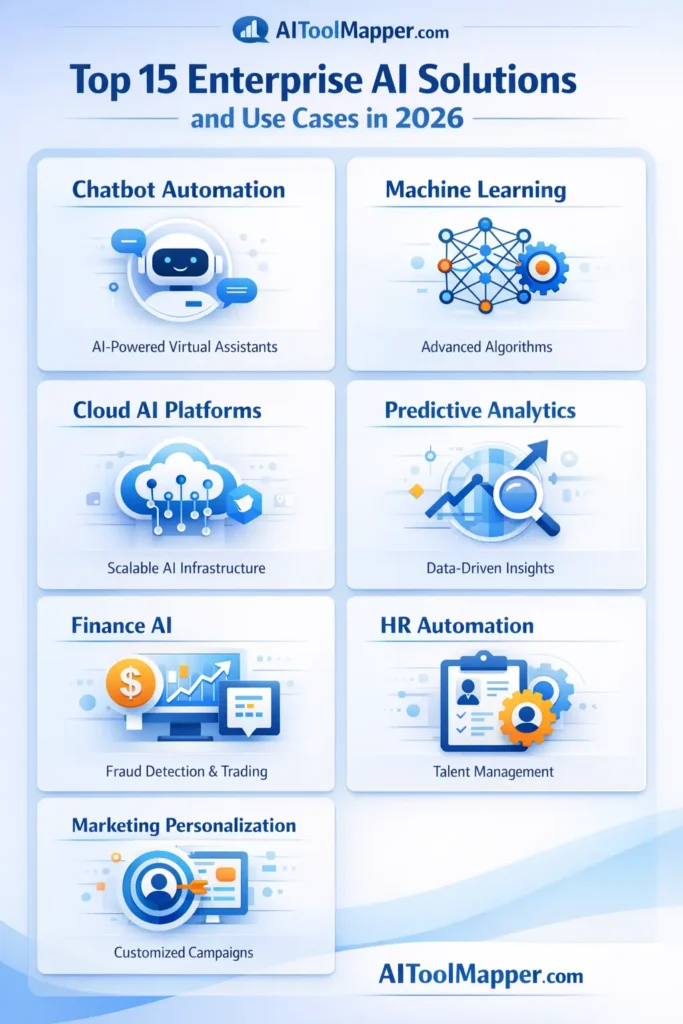
🤖 AI in Customer Support
- Chatbots handle queries 24/7
- Virtual assistants improve response time
📢 AI in Marketing & Sales
- Personalized campaigns
- Lead scoring systems
🧑💼 AI in HR & Recruitment
- Resume screening
- Candidate matching
💰 AI in Finance
- Fraud detection
- Risk assessment
🚚 AI in Operations & Supply Chain
- Demand forecasting
- Inventory optimization
📊 Enterprise AI Solutions Comparison Table
| Platform | Best For | Key Features | Pricing |
| Azure AI | Enterprises | ML, NLP | Pay-as-you-go |
| Google AI | Analytics | Vision, NLP | Subscription |
| AWS AI | Scalability | Automation | Usage-based |
| IBM Watson | Healthcare | NLP | Custom |
| Salesforce | CRM | Sales AI | Subscription |
⚙️ How to Choose the Right Enterprise AI Solution
✔️ Key Factors
- Business goals
- Budget
- Integration capabilities
- Scalability
❌ Common Mistakes
- No clear AI strategy
- Poor data quality
- Overcomplicating implementation
👉 Explore curated tools on AI Tool Mapper to find the best fit for your business needs.
🔮 Future of Enterprise AI Solutions
- AI agents handling complex workflows
- Hyper-personalized user experiences
- Ethical AI governance
- Automation at scale
FAQs
1. What are enterprise AI solutions?
Enterprise AI solutions are advanced software systems that use artificial intelligence to automate workflows, analyze large datasets, and support smarter decision-making across organizations. These tools help businesses scale efficiently, reduce manual effort, and improve productivity by leveraging technologies like machine learning, NLP, and predictive analytics.
2. How do businesses use AI solutions?
Businesses use AI solutions to automate repetitive tasks, enhance customer support with chatbots, personalize marketing campaigns, detect fraud, and predict future trends. By integrating AI into daily operations, companies can streamline workflows, boost efficiency, and deliver more accurate, data-driven experiences to customers.
3. Which is the best enterprise AI platform?
There isn’t a single best enterprise AI platform for every business. Popular options like Microsoft Azure AI, Google Cloud AI, and Amazon Web Services offer powerful features. The right choice depends on your business goals, budget, technical requirements, and integration needs.
4. Are enterprise AI tools expensive?
Enterprise AI tools can be expensive depending on their capabilities and scale. However, many providers offer flexible pricing models such as subscriptions or pay-as-you-go plans. Smaller businesses can start with cost-effective solutions and gradually scale their AI investments as their needs grow.
5. What industries use enterprise AI the most?
Industries like healthcare, finance, retail, manufacturing, and technology are leading adopters of enterprise AI. These sectors use AI for automation, predictive analytics, fraud detection, and customer personalization, helping them improve efficiency, reduce costs, and make more informed strategic decisions.
6. What is the difference between AI tools and enterprise AI?
AI tools are typically standalone or general-purpose applications, while enterprise AI solutions are designed for large-scale business environments. Enterprise AI offers advanced features like system integration, scalability, security, and customization, making it suitable for complex workflows and organizational needs.
7. How to implement AI in a business?
To implement AI in a business, start by identifying key use cases and goals. Then choose the right platform, prepare high-quality data, and run pilot projects. Gradually scale the implementation while monitoring performance to ensure the AI solution delivers measurable business value.
8. Is enterprise AI secure?
Most enterprise AI platforms provide strong security features, including data encryption, compliance standards, and access controls. However, businesses must also implement proper governance, monitoring, and risk management practices to ensure data privacy and maintain secure AI operations.
9. What are examples of enterprise AI use cases?
Common enterprise AI use cases include customer support chatbots, personalized marketing campaigns, fraud detection systems, predictive maintenance in manufacturing, and supply chain optimization. These applications help businesses improve efficiency, reduce risks, and enhance overall performance.
10. What is the future of enterprise AI?
The future of enterprise AI includes advancements in generative AI, autonomous AI agents, and hyper-personalized customer experiences. Businesses will increasingly rely on AI to automate complex tasks, drive innovation, and gain a competitive advantage in a rapidly evolving digital landscape.
🏁 Final Thoughts on Enterprise AI Solutions
Enterprise AI is no longer optional—it’s a necessity. Businesses that embrace AI today are setting themselves up for long-term success.
From automation to predictive intelligence, the right AI tools can transform operations, improve decision-making, and unlock new growth opportunities.
If you’re serious about scaling your business in 2026 and beyond, now is the time to invest in the right AI strategy.