
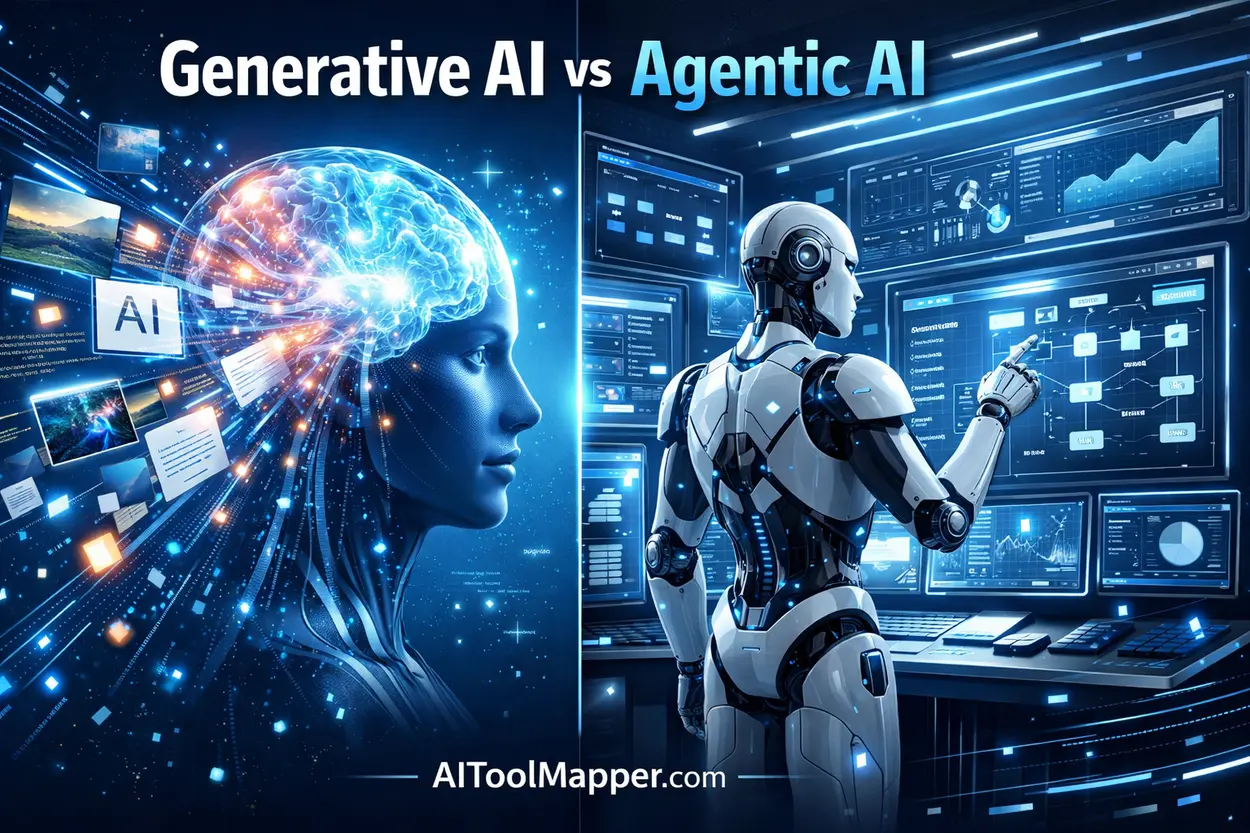
- Generative AI creates content like text, images, and code based on prompts. It is reactive and depends on user input.
- Agentic AI goes beyond creation—it can make decisions, take actions, and complete tasks autonomously to achieve goals.
- The key difference in generative AI vs agentic AI lies in creation vs execution.
- Businesses are rapidly shifting from passive AI tools to goal-driven AI agents that automate workflows and decision-making.
Why Everyone Is Talking About Generative AI vs Agentic AI
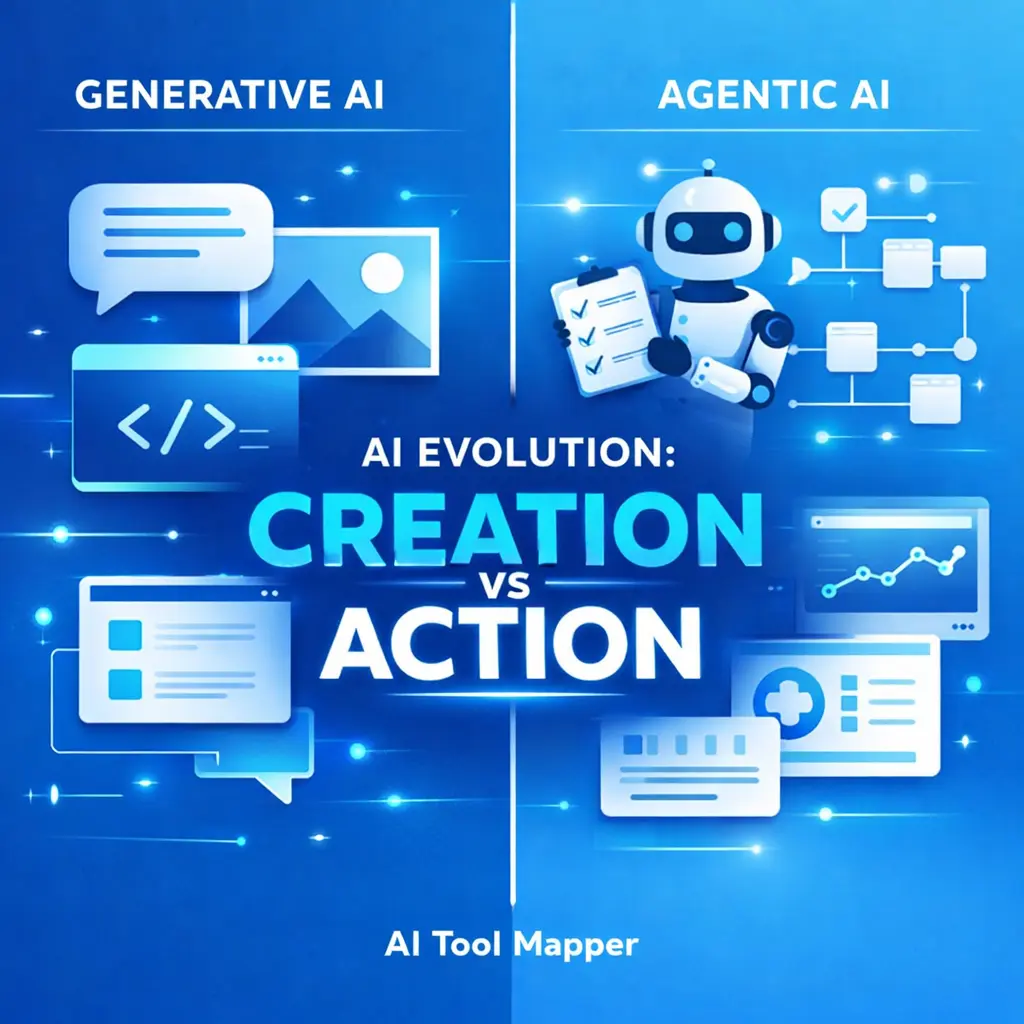
Artificial Intelligence is no longer just a buzzword—it’s reshaping how we work, create, and even think. From tools like ChatGPT writing emails to AI agents managing workflows, the technology is evolving at lightning speed.
But here’s where things get confusing:
What exactly is the difference between generative AI vs agentic AI?
At a glance, they might seem similar. Both rely on advanced machine learning. Both feel “intelligent.” But under the hood, they serve very different purposes.
- Generative AI focuses on creating content.
- Agentic AI focuses on taking action and achieving goals.
Understanding this distinction isn’t just technical—it’s practical. It impacts how businesses automate processes, how developers build systems, and how future jobs will evolve.
So let’s break it down in the simplest way possible.
Key Takeaways
- Generative AI creates content; agentic AI executes tasks
- Agentic AI introduces autonomy and decision-making
- Both technologies complement each other
- Businesses are shifting toward AI-driven automation
- The future lies in hybrid AI systems
What is Generative AI?
Generative AI is a type of artificial intelligence that creates new content—such as text, images, videos, or code—based on patterns it has learned from data.
Think of it like a creative assistant that responds to your instructions.
How Generative AI Works
At its core, generative AI uses:
- Large Language Models (LLMs)
- Deep learning algorithms
- Massive datasets
These systems analyze patterns in data and predict the most likely output based on your prompt.
For example:
You type → “Write a blog intro about AI”
The AI predicts → The best possible response based on training.
It doesn’t “think” or “decide”—it generates.
👉 Learn more about LLMs from this Google AI Blog.
Popular Examples of Generative AI
Some widely used tools include:
- ChatGPT (text generation)
- Midjourney (image generation)
- DALL·E (visual creativity)
- GitHub Copilot (code generation)
These are classic generative AI examples used daily by creators and developers.
Key Features
- Content creation (text, images, code)
- Prompt-based responses
- Pattern recognition
- Reactive behavior
- No independent decision-making
👉 This is where the generative AI vs decision making AI debate begins.
What is Agentic AI?
Agentic AI refers to AI systems that can independently make decisions and take actions to achieve specific goals.
In simple terms, it’s not just answering—it’s doing.
How Agentic AI Works
Agentic AI combines multiple components:
- LLMs (for understanding)
- Memory (to retain context)
- Planning systems
- External tools (APIs, apps)
This allows it to:
- Understand a goal
- Break it into steps
- Execute tasks
- Adjust based on results
It behaves more like a digital employee than a tool.
Examples of Agentic AI
- AutoGPT
- AI workflow automation bots
- Autonomous assistants
- Multi-step task agents
These fall under autonomous AI agents vs generative models.
Key Features
- Goal-oriented execution
- Autonomous decision-making
- Multi-step reasoning
- Continuous learning loops
- Tool integration
👉 This is what separates agentic AI vs traditional AI.
Generative AI vs Agentic AI (Core Differences)
| Feature | Generative AI | Agentic AI |
| Function | Content creation | Task execution |
| Behavior | Reactive | Autonomous |
| Input | Prompts | Goals |
| Decision Making | Limited | Advanced |
| Examples | ChatGPT | AutoGPT |
👉 This table clearly shows the generative AI vs agentic AI difference.
Key Differences Explained in Detail
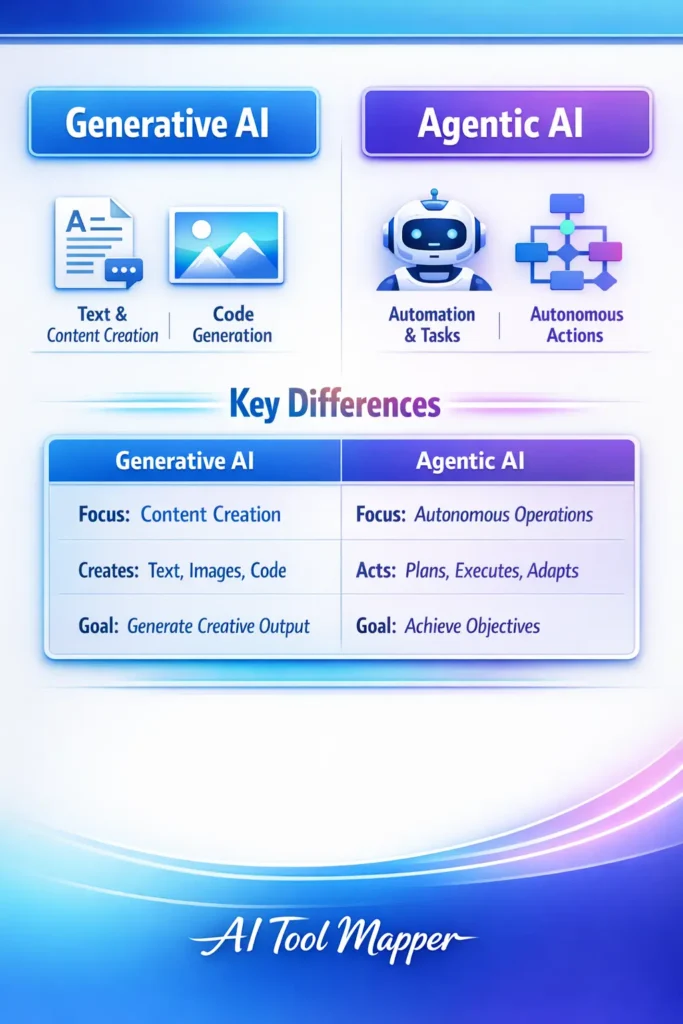
1. Purpose: Creation vs Action
Generative AI is like a writer.
Agentic AI is like a worker.
One creates outputs. The other completes tasks.
2. Autonomy Level
Generative AI:
- Needs constant prompts
- Stops after output
Agentic AI:
- Works independently
- Continues until the goal is achieved
3. Decision-Making Ability
Generative AI:
- Predicts outputs
- No real reasoning
Agentic AI:
- Makes decisions
- Adapts strategies
4. Use Cases
Generative AI:
- Writing blogs
- Designing images
- Generating code
Agentic AI:
- Managing workflows
- Automating business processes
- Running customer service systems
Real-World Use Cases
Generative AI Use Cases
- Content writing for blogs and ads
- Image and video generation
- Code assistance
- Chat-based support
👉 These are classic generative AI examples.
Agentic AI Use Cases
- Automated marketing campaigns
- Personal AI assistants
- Workflow automation
- Business analytics execution
👉 These represent real agentic AI applications in real world.
Advantages and Limitations
Generative AI Pros & Cons
Pros:
- Fast content creation
- Easy to use
- Scalable
Cons:
- No decision-making
- Can produce inaccurate outputs
- Requires human input
Agentic AI Pros & Cons
Pros:
- Automates complex tasks
- Reduces manual effort
- Smart decision-making
Cons:
- Higher complexity
- Risk of incorrect actions
- Requires monitoring
👉 This comparison highlights generative AI limitations vs agentic AI strengths.
Future of Generative AI vs Agentic AI
The future is not about choosing one—it’s about combining both.
We’re moving from:
➡️ Content generation → Autonomous execution
Soon, systems will:
- Generate ideas (Generative AI)
- Execute them (Agentic AI)
Businesses are already adopting autonomous AI agents vs generative models to stay competitive.
👉 According to McKinsey & Company, AI-driven automation could significantly boost productivity across industries.
FAQs
1. Is agentic AI better than generative AI?
Agentic AI is not inherently better than generative AI—it simply serves a different purpose. Generative AI focuses on creating content like text or images, while agentic AI is designed to execute tasks and make decisions. In many real-world scenarios, combining both technologies delivers the most effective results.
2. Can generative AI become agentic AI?
Generative AI can evolve into agentic AI when enhanced with capabilities like memory, planning, and tool integration. By adding these components, it transitions from generating responses to executing tasks autonomously, forming the backbone of intelligent systems that can achieve goals with minimal human intervention.
3. What are AI agents?
AI agents are autonomous systems designed to perform tasks independently. They can understand objectives, make decisions, and take actions without continuous human input. These systems are a core part of agentic AI and are widely used in automation, customer support, and complex workflow management.
4. Is ChatGPT generative AI or agentic AI?
ChatGPT is primarily a generative AI system because it generates responses based on user prompts. However, when combined with external tools, memory, and automation workflows, it can function as part of an agentic AI system, enabling it to perform actions beyond simple content generation.
5. What is the main difference between AI agents and LLMs?
The main difference is that LLMs generate content, while AI agents take action. LLMs rely on patterns in data to produce outputs, whereas AI agents use LLMs along with memory, planning, and tools to execute tasks, making them more dynamic and capable of real-world problem-solving.
6. How does agentic AI work compared to generative AI?
Agentic AI works by combining language models with memory, planning, and external tools to complete tasks autonomously. In contrast, generative AI focuses on producing outputs based on prompts. While generative AI reacts to input, agentic AI actively plans and executes multi-step processes to achieve defined goals.
7. What are some real-world examples of agentic AI?
Real-world examples of agentic AI include automated customer service bots, AI-powered workflow automation tools, and personal AI assistants that manage schedules or tasks. These systems can independently make decisions, interact with software, and complete objectives without constant human supervision.
8. What are the limitations of generative AI compared to agentic AI?
Generative AI is limited by its reliance on prompts and lack of independent decision-making. It cannot execute tasks or adapt dynamically without user input. In contrast, agentic AI can plan actions and operate autonomously, though it may introduce complexity and require careful monitoring to avoid errors.
9. Will agentic AI replace generative AI in the future?
Agentic AI is unlikely to replace generative AI entirely. Instead, both will work together as complementary technologies. Generative AI will continue to create content, while agentic AI will handle execution and automation. This combination is expected to define the next phase of AI innovation.
10. What industries benefit the most from agentic AI?
Industries such as healthcare, finance, e-commerce, and customer service benefit significantly from agentic AI. These sectors use AI agents for automation, decision-making, and workflow optimization, helping improve efficiency, reduce costs, and enhance customer experiences at scale.
The Bottom Line: Understanding the Future of AI
So, what’s the real takeaway?
- Generative AI is about creating.
- Agentic AI is about doing.
If you need content—go generative.
If you need automation—go agentic.
But the real magic happens when both work together.
We’re entering an era where AI doesn’t just assist—it acts.
And understanding the difference between generative AI vs agentic AI is your first step toward staying ahead in this rapidly evolving landscape.