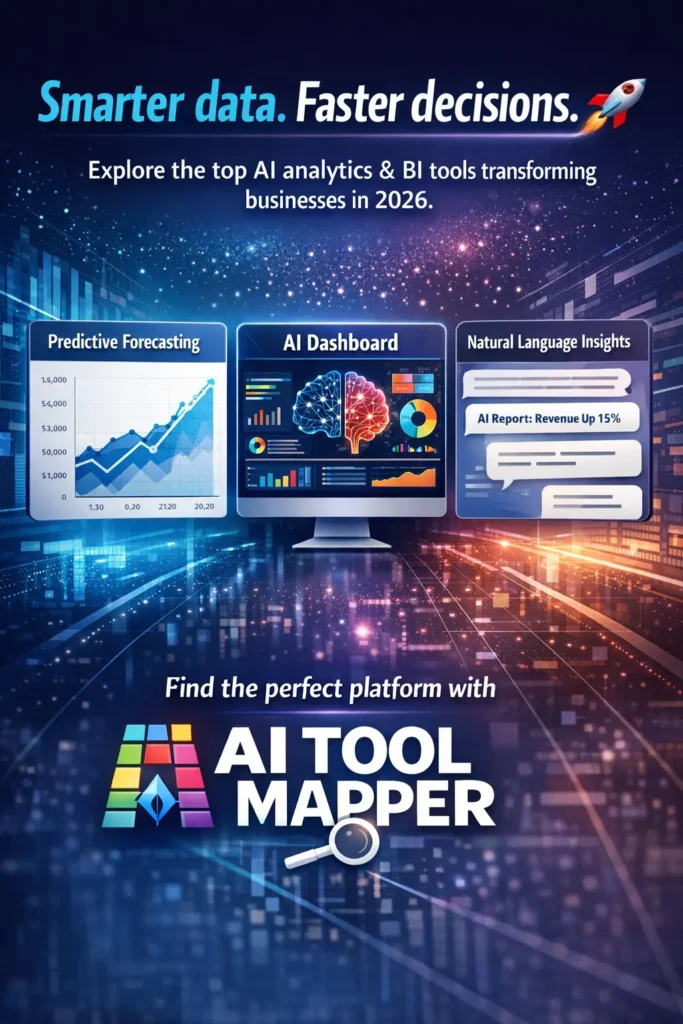

Data is no longer just a byproduct of business operations—it’s the fuel powering modern strategy. In 2026, organizations are no longer asking whether they should use AI in Analytics; they’re asking how fast they can deploy it. From predictive forecasting and automated anomaly detection to AI-powered dashboards that respond to natural language queries, the landscape of Best AI Tools for Analytics & Business Intelligence has evolved dramatically. Companies that once relied on static spreadsheets and manual reporting are now leveraging machine learning models, augmented analytics software, and real-time data analytics tools to make sharper decisions—often in seconds. The result? Faster growth, reduced operational costs, smarter forecasting, and competitive advantage.
This pillar guide breaks down everything you need to know about AI business intelligence tools in 2026—how they work, why they matter, and which platforms truly deliver enterprise-grade value.
What is AI in Analytics & Business Intelligence?
At its core, AI in business intelligence blends artificial intelligence with traditional reporting systems. Instead of simply visualizing past data, AI-powered analytics platforms analyze patterns, predict outcomes, and recommend actions.
Traditional BI answers: What happened?
AI BI answers: Why did it happen—and what will happen next?
Modern AI data analytics platforms use machine learning in business intelligence to automate data modeling, anomaly detection, and automated reporting. They reduce dependency on technical teams and empower decision-makers with real-time insights.
Difference Between Traditional BI and AI-Powered BI
Traditional business intelligence tools relied heavily on structured queries and dashboards. They required analysts to manually interpret trends. AI-powered BI integrates augmented analytics platforms that automatically surface insights, highlight risks, and forecast revenue shifts.
For example, instead of manually comparing quarterly sales reports, an AI analytics software system can detect declining trends in specific geographies and recommend pricing adjustments.
How Machine Learning Improves Data Analytics
Machine learning enables predictive analytics tools to learn from historical patterns. Over time, AI for data analysis improves forecasting accuracy. Retailers can predict inventory demand. Banks can flag fraudulent transactions. SaaS companies can forecast churn.
According to McKinsey & Company, companies leveraging AI-driven analytics outperform competitors in profitability and efficiency. This reinforces the business case for investing in AI-powered analytics.
Role of Predictive & Prescriptive Analytics
Predictive analytics forecasts future outcomes. Prescriptive analytics suggests recommended actions. Together, they power AI decision intelligence tools that help leaders choose optimal strategies with reduced risk.
Why Businesses Are Adopting AI Analytics Tools in 2026
The shift toward AI-powered reporting software isn’t hype—it’s necessity.
Real-Time Decision Making
Modern BI platforms deliver real-time data analytics tools integrated with cloud analytics platforms. Decisions that once took days now take minutes.
Data-Driven Strategy
AI dashboards for business help executives base decisions on predictive insights rather than intuition.
Reduced Manual Reporting
Automated data analysis software eliminates repetitive spreadsheet work, freeing analysts to focus on strategic modeling.
Competitive Advantage
Companies adopting AI business intelligence tools gain operational efficiency and deeper customer insights.
Industry Use Cases
Finance: Fraud detection, risk scoring
Retail: Inventory forecasting
Healthcare: Patient outcome analytics
Manufacturing: Predictive maintenance
SaaS: Customer churn prediction
Key Features to Look for in AI Business Intelligence Tools
When evaluating Business intelligence tools 2026, prioritize these capabilities:
AI-Powered Dashboards
Interactive dashboards that auto-update in real time.
Natural Language Query (NLQ)
Users can ask, “What were Q4 profits?” and receive instant visualized responses.
Automated Insights Generation
AI reporting tools automatically highlight trends and anomalies.
Forecasting & Trend Prediction
AI for business forecasting enhances budgeting and resource planning.
Data Visualization
Modern data visualization tools with AI transform complex datasets into intuitive visuals.
Cloud Integration
Seamless integration with cloud analytics platforms ensures scalability.
Data Governance & Security
Enterprise analytics platforms must ensure compliance and encryption.
Scalability
AI tools for enterprises must scale across departments and global operations.
Top 20 AI Analytics & Business Intelligence Tools in 2026 (Ranked & Reviewed)
Below are the Best AI Tools for Analytics & Business Intelligence, evaluated based on their AI capabilities, scalability, automation features, integrations, and overall value for organizations looking to implement AI-powered analytics and data-driven decision making tools.
1. Microsoft Power BI
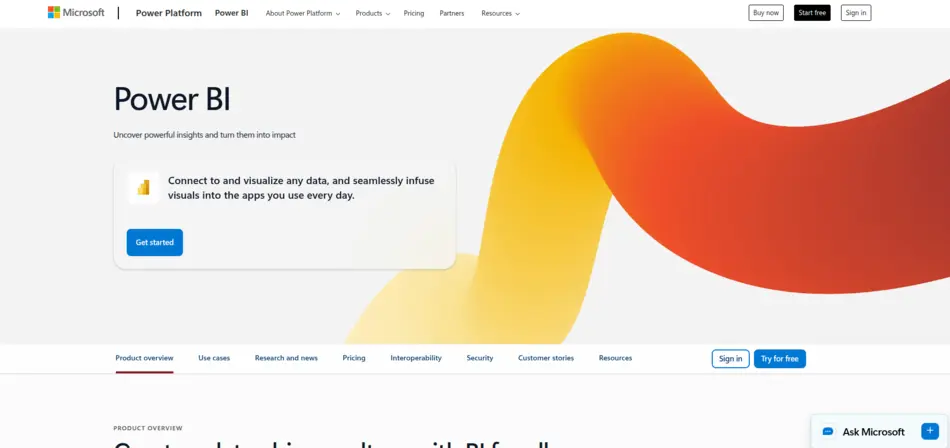
One of the most widely adopted AI business intelligence tools, Microsoft Power BI combines advanced analytics, machine learning integration, and intuitive dashboards. Built within the Microsoft ecosystem, it seamlessly integrates with Azure, Excel, and other enterprise systems, making it a powerful AI data analytics platform for organizations already using Microsoft technologies.
Key AI Features:
AutoML models for predictive analytics
Natural language query (Ask Data)
AI visuals and automated insights
Integration with Azure Machine Learning
Best For:
Enterprises and mid-sized businesses using the Microsoft cloud ecosystem.
Pricing Model:
Subscription-based (Power BI Pro and Premium plans).
Pros:
Deep integration with Microsoft tools
Affordable compared to many enterprise BI platforms
Strong community and ecosystem
Cons:
Can be complex for beginners without BI experience
Premium features may increase cost at scale
2. Tableau
Tableau is widely recognized as one of the most powerful data visualization tools with AI, offering intuitive dashboards and advanced analytics capabilities. Since its acquisition by Salesforce, Tableau has integrated AI-driven insights through Einstein Analytics, allowing businesses to leverage predictive analytics tools and automated trend analysis.
Key AI Features:
Einstein Discovery predictive modeling
Automated insight generation
AI-powered data storytelling
Advanced visualization and interactive dashboards
Best For:
Organizations that prioritize data storytelling and visual analytics.
Pricing Model:
Subscription licensing based on user roles.
Pros:
Best-in-class visualization capabilities
Strong integration with Salesforce ecosystem
Highly customizable dashboards
Cons:
Higher licensing cost compared to other BI tools
Requires training for advanced analytics features
3. Qlik
Qlik is known for its unique associative data engine, which enables users to explore relationships across datasets without predefined queries. This capability makes Qlik one of the most advanced AI analytics software platforms for discovering hidden insights and patterns in large datasets.
Key AI Features:
Associative AI data exploration
Augmented analytics for automated insights
AI-driven recommendations
Natural language analytics interface
Best For:
Organizations seeking self-service BI tools with deep exploratory analytics.
Pricing Model:
Enterprise subscription model.
Pros:
Powerful associative data model
Advanced augmented analytics features
Excellent scalability for large datasets
Cons:
Learning curve for new users
Enterprise pricing may be expensive for startups
4. Looker (Google Cloud)

Looker, part of the Google Cloud ecosystem, is a modern AI BI platform designed for cloud-native analytics and embedded data experiences. It enables organizations to create interactive dashboards and integrate analytics directly into applications.
Key AI Features:
AI-powered data modeling with LookML
Embedded analytics for SaaS products
Integration with BigQuery for large-scale analytics
Automated reporting and data exploration
Best For:
Companies operating within the Google Cloud infrastructure or building embedded analytics solutions.
Pricing Model:
Enterprise-level licensing.
Pros:
Powerful cloud-native architecture
Strong integration with Google data platforms
Excellent for product analytics and embedded BI
Cons:
Pricing transparency can be limited
Requires knowledge of LookML for advanced use
5. IBM Cognos Analytics
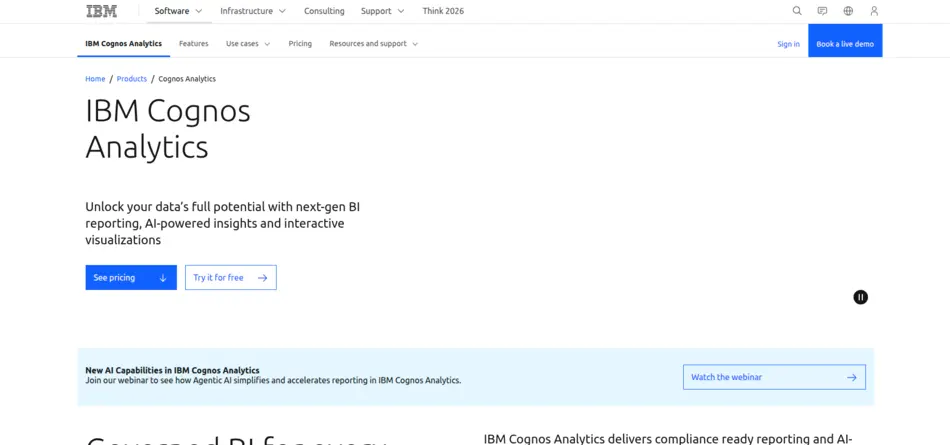
IBM Cognos Analytics is a mature enterprise analytics platform designed for large organizations that require advanced reporting, AI insights, and strong governance controls. It combines AI-driven analytics with enterprise-grade data security and compliance features.
Key AI Features:
AI-assisted dashboard creation
Automated data preparation
Natural language search and insights
Predictive forecasting tools
Best For:
Large enterprises needing secure, scalable BI solutions.
Pricing Model:
Enterprise subscription.
Pros:
Robust enterprise security and governance
Strong reporting capabilities
AI-assisted data modeling
Cons:
Complex setup and implementation
Interface may feel outdated compared to newer tools
6. SAP Analytics Cloud
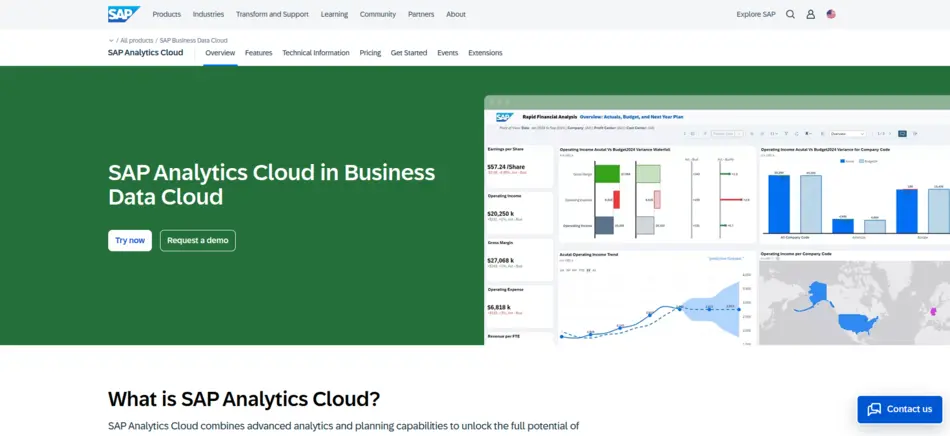
SAP Analytics Cloud is an integrated AI-powered analytics and planning platform that combines BI, predictive analytics, and financial planning in one cloud-based solution. It’s particularly powerful for organizations already using SAP enterprise software.
Key AI Features:
Predictive analytics and forecasting
Automated data insights
AI-driven planning and simulation
Integration with SAP ERP systems
Best For:
Large enterprises operating within SAP ecosystems.
Pricing Model:
Enterprise subscription.
Pros:
Unified analytics and planning platform
Strong enterprise scalability
Advanced forecasting capabilities
Cons:
High implementation cost
Best suited for SAP customers
7. Oracle Analytics Cloud
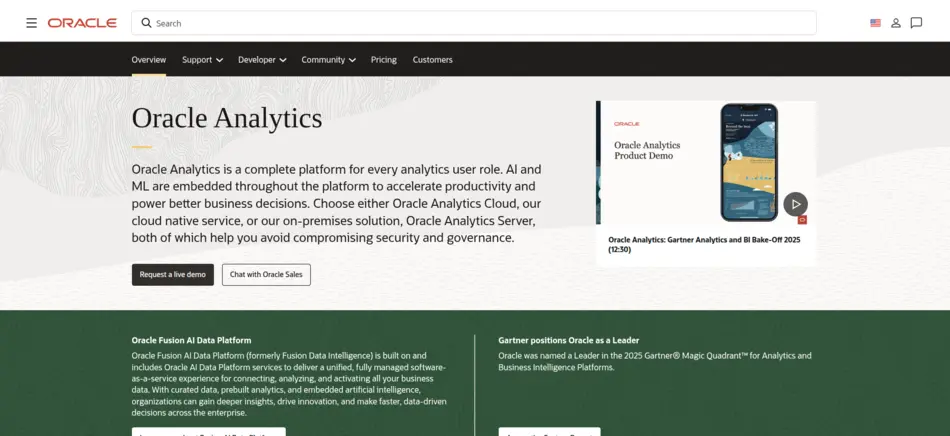
Oracle Analytics Cloud offers a comprehensive AI-powered data analytics platform that combines data preparation, machine learning, and visualization tools. It allows businesses to derive insights from large datasets while maintaining enterprise-grade governance.
Key AI Features:
Machine learning-powered predictions
Automated data discovery
Natural language queries
Real-time analytics dashboards
Best For:
Enterprises requiring advanced analytics integrated with Oracle databases.
Pricing Model:
Cloud subscription.
Pros:
Powerful enterprise analytics capabilities
Seamless integration with Oracle infrastructure
Advanced AI-driven insights
Cons:
Higher complexity for non-Oracle users
Licensing costs can be high
8. Sisense

Sisense is a flexible AI analytics platform designed to embed analytics into applications and products. It allows developers and businesses to create customized analytics experiences for customers or internal teams.
Key AI Features:
Embedded analytics and APIs
AI-powered data modeling
Automated data visualization
Predictive analytics capabilities
Best For:
Developers and product teams embedding analytics into applications.
Pricing Model:
Enterprise licensing.
Pros:
Highly customizable
Excellent for product analytics
Strong API ecosystem
Cons:
Requires technical expertise
Pricing can be high for smaller companies
9. Domo
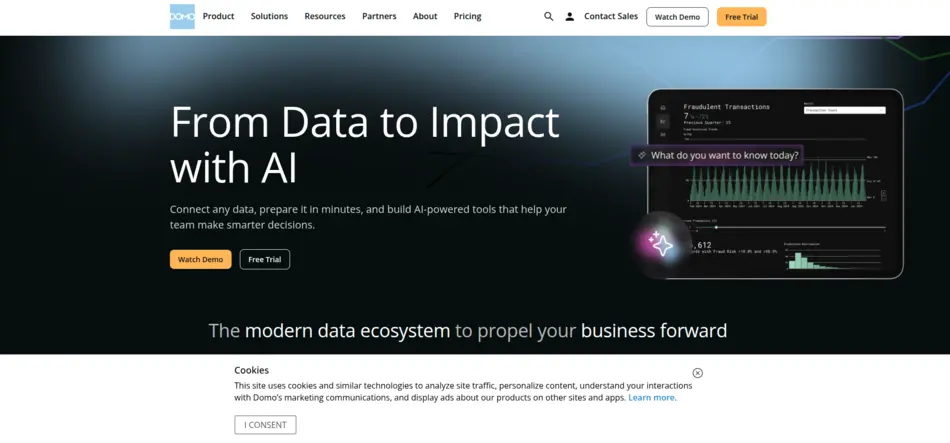
Domo is a cloud-native enterprise analytics solution known for its real-time data integration and mobile-friendly dashboards. It connects hundreds of data sources and delivers insights across teams through interactive visualizations.
Key AI Features:
AI-powered insights engine
Automated data pipelines
Real-time dashboards
Mobile analytics capabilities
Best For:
Organizations needing real-time insights across departments.
Pricing Model:
Subscription-based enterprise platform.
Pros:
Excellent real-time analytics capabilities
Strong mobile BI experience
Large library of integrations
Cons:
Pricing not always transparent
Can become expensive at scale
10. Zoho Analytics
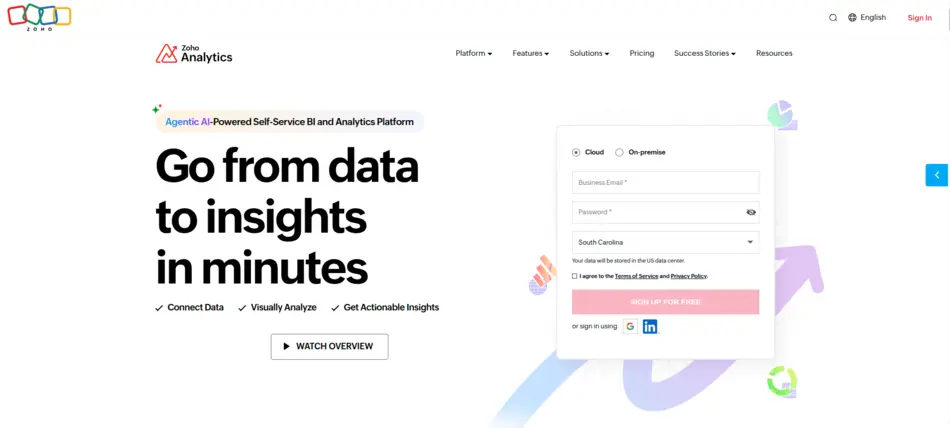
Zoho Analytics is one of the most accessible AI analytics tools for small and mid-sized businesses. It provides powerful dashboards, automated insights, and predictive analytics features at a lower cost compared to many enterprise platforms.
Key AI Features:
AI assistant for natural language queries
Automated insights generation
Smart data visualization
Predictive analytics modules
Best For:
Startups and SMBs looking for affordable AI-powered BI tools.
Pricing Model:
Flexible subscription plans.
Pros:
Cost-effective analytics platform
Easy to use interface
Strong integration with business apps
Cons:
Limited advanced enterprise features
Performance may slow with extremely large datasets
11. Alteryx
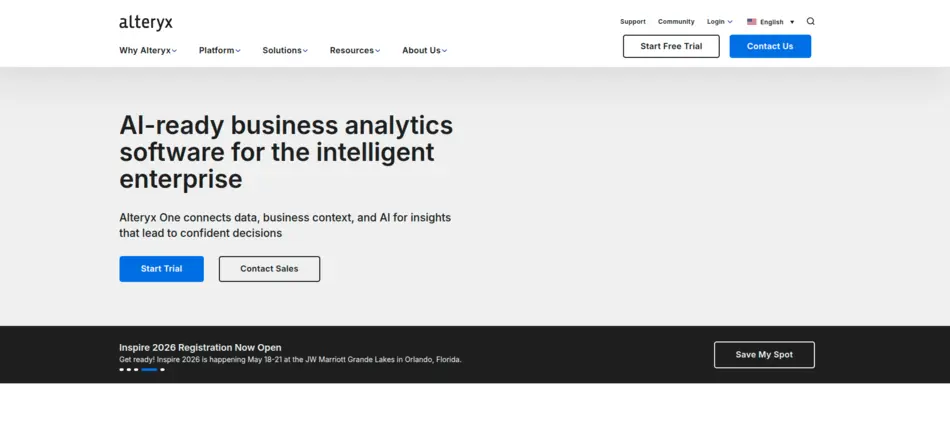
Alteryx is a powerful advanced analytics and data automation platform widely used by data analysts and business intelligence teams to prepare, blend, and analyze data without extensive coding. The platform focuses on simplifying complex data workflows, enabling organizations to automate repetitive analytics tasks and accelerate AI-powered analytics processes. Alteryx combines data preparation, machine learning, and predictive modeling in one unified environment.
Key AI Features:
Automated data preparation and blending
Built-in predictive analytics tools
Machine learning model deployment
Drag-and-drop analytics workflows
Best For:
Data analysts and organizations that need automated data analysis software for complex data pipelines.
Pricing Model:
Enterprise subscription licensing.
Pros:
Powerful automation for data workflows
No-code / low-code analytics environment
Excellent integration with BI platforms like Tableau and Power BI
Cons:
Premium pricing may limit adoption for smaller companies
Requires some analytics expertise to fully utilize advanced features
12. Databricks
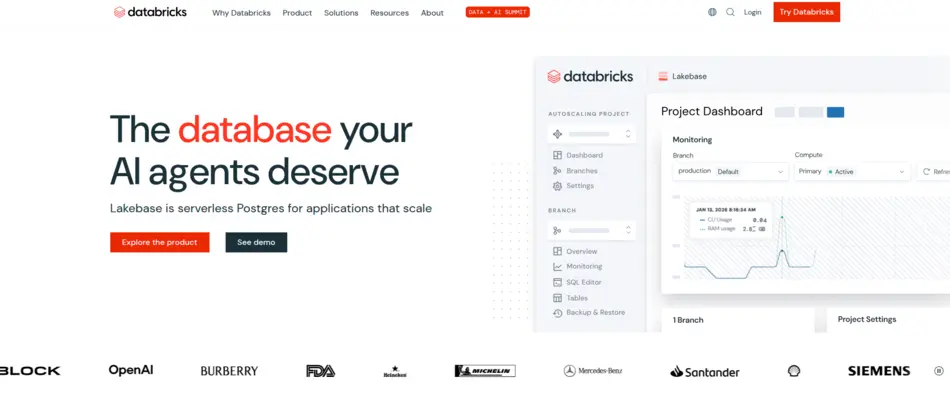
Databricks is a leading AI data analytics platform built around the concept of a “data lakehouse,” which combines the scalability of data lakes with the performance of data warehouses. It enables organizations to process massive datasets while building machine learning models directly within the platform. Databricks is widely used for big data analytics with AI, enabling real-time insights and predictive analytics at scale.
Key AI Features:
Built-in machine learning frameworks
Real-time streaming analytics
Automated model training pipelines
Integration with Apache Spark
Best For:
Large enterprises and data science teams working with big data and advanced AI workloads.
Pricing Model:
Usage-based cloud pricing.
Pros:
Excellent scalability for large datasets
Strong machine learning ecosystem
Unified data engineering and analytics platform
Cons:
Requires technical expertise
Higher infrastructure costs for large-scale deployments
13. Snowflake
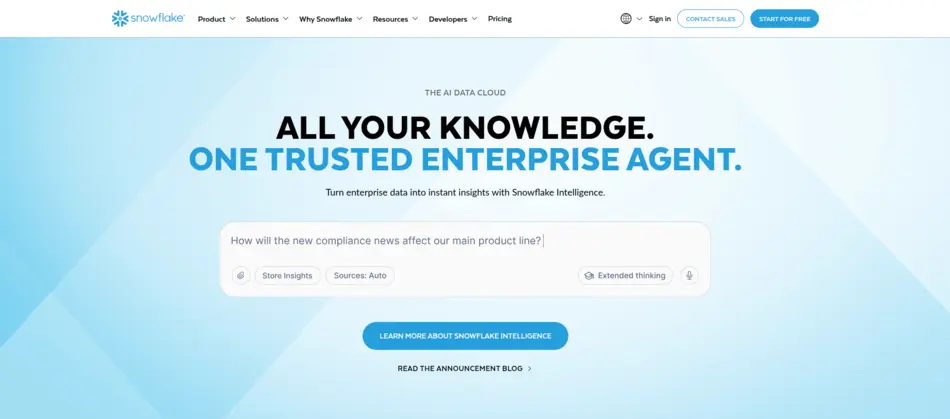
Snowflake is a modern cloud analytics platform that enables organizations to store, process, and analyze massive volumes of data in a highly scalable environment. Its architecture separates compute and storage, allowing businesses to scale analytics workloads independently. Snowflake integrates with many AI-powered analytics tools, making it a key component of enterprise analytics ecosystems.
Key AI Features:
AI-ready data warehouse architecture
Data sharing and collaboration capabilities
Advanced analytics integrations
Real-time data processing
Best For:
Enterprises managing large-scale cloud data infrastructures.
Pricing Model:
Consumption-based cloud pricing.
Pros:
Highly scalable and flexible architecture
Strong integration with data analytics software
Supports large-scale AI data analysis tools
Cons:
Costs can increase rapidly with heavy usage
Requires additional BI tools for visualization
14. ThoughtSpot
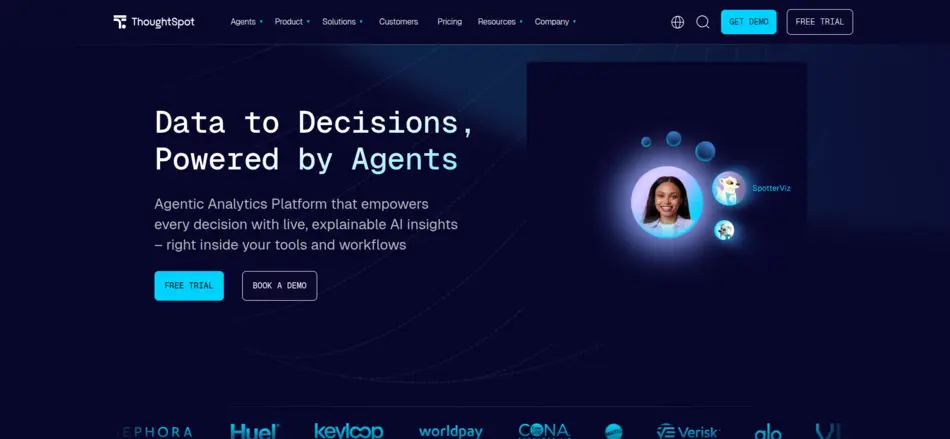
ThoughtSpot is a modern AI-powered business intelligence platform designed around conversational analytics. Instead of traditional dashboards, users can simply ask questions in natural language and receive instant visual insights. This approach makes it one of the most intuitive AI dashboards for business environments.
Key AI Features:
Natural language search analytics
AI-generated insights and recommendations
Automated anomaly detection
Cloud-native analytics architecture
Best For:
Organizations seeking self-service BI tools that allow non-technical users to explore data easily.
Pricing Model:
Subscription-based cloud platform.
Pros:
Extremely user-friendly interface
Powerful search-driven analytics
Fast query performance on large datasets
Cons:
Customization options may be limited compared to traditional BI tools
Advanced analytics features require higher-tier plans
15. TIBCO Spotfire

TIBCO Spotfire is a comprehensive advanced analytics software platform designed for data discovery, predictive analytics, and interactive dashboards. It is widely used in industries such as finance, healthcare, and manufacturing where deep analytical insights are critical. Spotfire provides strong support for statistical modeling and real-time analytics.
Key AI Features:
AI-assisted analytics workflows
Predictive modeling capabilities
Real-time streaming data analysis
Advanced statistical tools
Best For:
Organizations that require deep analytical capabilities and predictive analytics tools.
Pricing Model:
Enterprise licensing and subscription models.
Pros:
Powerful predictive analytics engine
Excellent data visualization features
Strong support for complex analytical models
Cons:
Interface may feel complex for beginners
Implementation may require technical support
16. Amazon QuickSight
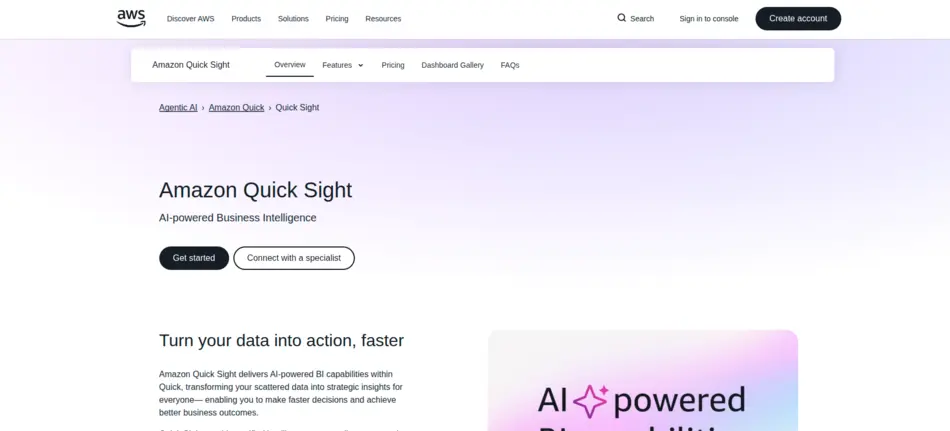
Amazon QuickSight is a cloud-native AI-powered analytics platform built within the AWS ecosystem. It allows businesses to create interactive dashboards and perform advanced analytics on large datasets stored in AWS services. QuickSight uses machine learning to generate automated insights and anomaly detection alerts.
Key AI Features:
Machine learning anomaly detection
Automated narrative insights
Scalable cloud analytics architecture
Natural language queries with Q
Best For:
Organizations using AWS infrastructure for cloud analytics platforms.
Pricing Model:
Pay-per-session and subscription pricing.
Pros:
Fully serverless architecture
Affordable pricing model for scalable analytics
Strong integration with AWS data services
Cons:
Limited customization compared to advanced BI tools
Best performance within AWS ecosystem
17. SAS Visual Analytics
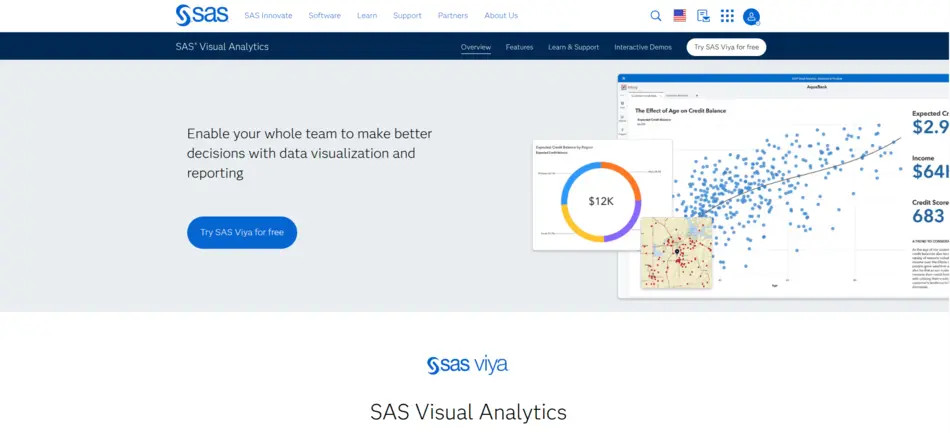
SAS Visual Analytics is an enterprise-grade AI-powered analytics platform designed for advanced statistical analysis and predictive modeling. The platform is widely used in industries requiring high levels of accuracy, such as healthcare, banking, and government analytics.
Key AI Features:
Advanced predictive analytics models
Automated data preparation
Interactive data visualization tools with AI
Real-time analytics capabilities
Best For:
Enterprises and research-driven organizations that require highly accurate predictive analytics tools.
Pricing Model:
Enterprise licensing.
Pros:
Industry-leading statistical capabilities
High-performance analytics engine
Excellent data governance features
Cons:
Higher cost compared to many BI platforms
Requires experienced analysts to fully utilize
18. MicroStrategy
MicroStrategy is a long-standing enterprise analytics platform known for its scalability, governance capabilities, and powerful dashboards. It offers strong support for large organizations that require centralized analytics across multiple departments and data sources.
Key AI Features:
AI-powered data insights
Enterprise-grade governance controls
Embedded analytics capabilities
Advanced mobile BI dashboards
Best For:
Large enterprises managing complex data environments.
Pricing Model:
Enterprise licensing and cloud subscriptions.
Pros:
Excellent scalability for enterprise analytics
Strong governance and security controls
Highly customizable dashboards
Cons:
Complex implementation process
Higher learning curve for new users
19. DataRobot
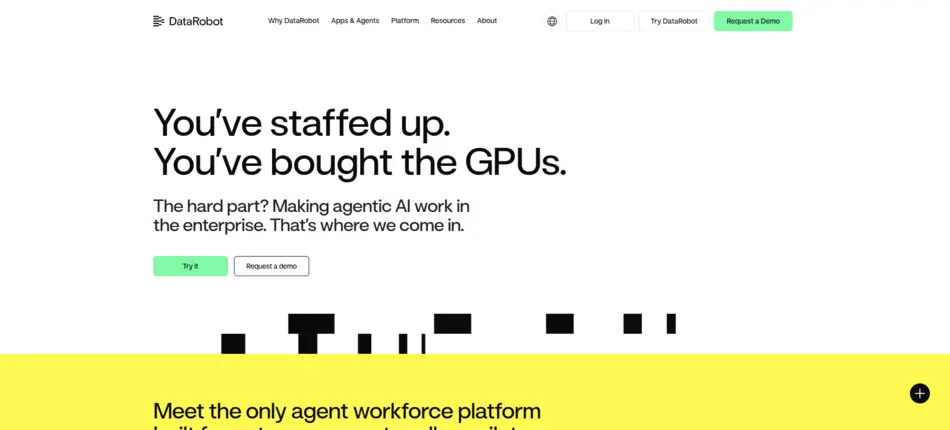
DataRobot is a powerful AI decision intelligence platform that focuses on automated machine learning (AutoML). It allows organizations to build predictive models without deep data science expertise, making advanced analytics more accessible to business teams.
Key AI Features:
Automated model building and deployment
AI-driven predictive analytics
Model monitoring and governance
Automated feature engineering
Best For:
Organizations seeking AI-driven business insights and predictive modeling without heavy coding.
Pricing Model:
Enterprise SaaS subscription.
Pros:
Simplifies machine learning workflows
Strong predictive analytics capabilities
Excellent model management tools
Cons:
Enterprise-focused pricing
Requires integration with BI tools for visualization
20. H2O.ai
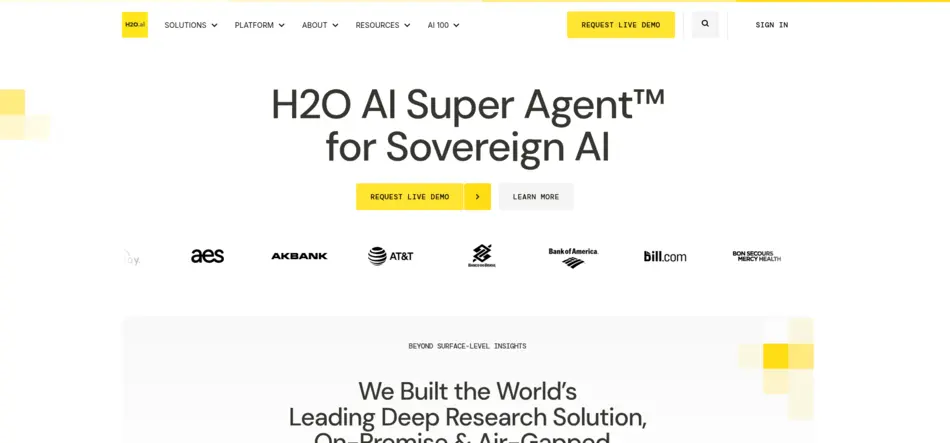
H2O.ai is a well-known open-source AI analytics platform designed for data scientists and enterprises that want flexible machine learning capabilities. The platform offers powerful algorithms, AutoML tools, and scalable deployment options for building advanced predictive analytics models.
Key AI Features:
Open-source machine learning algorithms
AutoML for automated model training
Scalable distributed computing
Integration with big data platforms
Best For:
Data scientists and organizations requiring custom AI data analysis tools.
Pricing Model:
Open-source with enterprise support options.
Pros:
Highly flexible AI development environment
Strong machine learning ecosystem
Cost-effective for advanced analytics projects
Cons:
Requires strong technical expertise
Visualization features require external BI tools
Comparison Table – Best AI BI Tools at a Glance
| Tool | Best For | Key AI Capabilities | Natural Language Query | Deployment Type | Integration Ecosystem | Ease of Use | Scalability | Ideal Business Size | Starting Price |
|---|---|---|---|---|---|---|---|---|---|
| Microsoft Power BI | Enterprise dashboards | AutoML, AI visuals, predictive analytics | Yes | Cloud / Hybrid / On-prem | Microsoft ecosystem (Azure, Excel, Dynamics) | Medium | High | SMBs → Enterprises | $ |
| Tableau | Data visualization | AI-powered analytics, Einstein Discovery | Limited | Cloud / Hybrid | Salesforce ecosystem, databases | Medium | High | Mid-size → Enterprise | $$ |
| Qlik | Self-service analytics | Associative AI engine, automated insights | Yes | Cloud / Hybrid | Enterprise data systems | Medium | High | Mid-size → Enterprise | $$ |
| Looker | Embedded analytics | ML-powered modeling, cloud analytics | Yes | Cloud | Google Cloud, BigQuery | Medium | High | Startups → Enterprise | $$$ |
| IBM Cognos Analytics | Enterprise reporting | Automated insights, predictive forecasting | Yes | Cloud / Hybrid | IBM ecosystem | Medium | High | Enterprise | $$$ |
| SAP Analytics Cloud | Financial planning + BI | Predictive analytics, AI simulations | Yes | Cloud | SAP ERP systems | Medium | Very High | Enterprise | $$$ |
| Oracle Analytics Cloud | Enterprise analytics | ML insights, anomaly detection | Yes | Cloud | Oracle databases & apps | Medium | High | Enterprise | $$$ |
| Sisense | Embedded analytics | AI data modeling, predictive insights | Limited | Cloud / Hybrid | APIs, developer ecosystem | Medium | High | SaaS companies | $$$ |
| Domo | Real-time dashboards | Automated data pipelines, AI insights | Limited | Cloud | 1000+ integrations | Easy | High | Mid-size → Enterprise | $$$ |
| Zoho Analytics | SMB analytics | AI assistant, automated insights | Yes | Cloud | Zoho ecosystem, SaaS tools | Easy | Medium | Startups / SMBs | $ |
| Alteryx | Data preparation | Predictive modeling, workflow automation | No | Hybrid | BI & data platforms | Medium | High | Mid-size → Enterprise | $$$ |
| Databricks | Big data analytics | Machine learning pipelines, real-time analytics | No | Cloud | Spark ecosystem | Advanced | Very High | Enterprises | $$$ |
| Snowflake | Data warehousing | AI-ready data infrastructure | No | Cloud | Multi-cloud integrations | Medium | Very High | Enterprise | $$$ |
| ThoughtSpot | Conversational analytics | Search-driven BI, automated insights | Yes | Cloud | Modern data stack | Easy | High | Mid-size → Enterprise | $$ |
| TIBCO Spotfire | Predictive analytics | AI modeling, real-time analytics | Limited | Cloud / On-prem | Enterprise systems | Medium | High | Enterprise | $$$ |
| Amazon QuickSight | AWS analytics | ML anomaly detection, narrative insights | Yes | Cloud | AWS ecosystem | Easy | High | Startups → Enterprise | $ |
| SAS Visual Analytics | Statistical analytics | Advanced predictive modeling | Limited | Cloud / Hybrid | SAS ecosystem | Advanced | High | Enterprise | $$$ |
| MicroStrategy | Enterprise governance | AI insights, embedded analytics | Limited | Cloud / Hybrid | Enterprise systems | Medium | Very High | Enterprise | $$$ |
| DataRobot | Automated ML | AutoML, predictive analytics | No | Cloud | Data science ecosystem | Medium | High | Enterprise | $$$ |
| H2O.ai | AI model development | AutoML, machine learning algorithms | No | Cloud / On-prem | Open-source ecosystem | Advanced | High | Data science teams | Free / Enterprise |
AI Analytics Tools by Business Size
Best for Startups
Zoho Analytics and Amazon QuickSight offer cost-effective AI dashboards with minimal infrastructure.
Best for Mid-Sized Businesses
Power BI and Qlik balance affordability with advanced AI capabilities.
Best for Enterprises
SAP Analytics Cloud, Oracle Analytics Cloud, and IBM Cognos provide enterprise analytics solutions.
Best for Data Scientists
Databricks, DataRobot, and H2O.ai enable advanced modeling and AI-powered analytics.
AI in Business Intelligence – Industry Use Cases
AI-powered analytics transforms industries by automating insights and enabling predictive analytics.
Finance: Risk modeling
Retail: Demand forecasting
Healthcare: Patient analytics
Marketing: AI reporting tools
Supply Chain: Predictive logistics
Benefits of AI-Powered Data Analytics Platforms
Faster reporting
Real-time dashboards
Predictive forecasting
Cost optimization
Automated anomaly detection
Challenges & Limitations of AI in BI
Data privacy concerns
High implementation costs
Skill shortages
Data quality issues
Organizations must prioritize governance frameworks and training programs.
How to Choose the Right AI Analytics Tool
Consider budget, scalability, AI maturity, integration capability, and usability. Evaluate vendor support and deployment flexibility.
Future Trends in AI Analytics & Business Intelligence (2026–2030)
Generative AI in BI
Conversational analytics
Autonomous decision intelligence
Embedded AI dashboards
Real-time forecasting
Gartner-style forecasts indicate AI-driven decision intelligence tools will dominate enterprise reporting.
FAQs
1. What is AI in business intelligence?
AI in business intelligence combines machine learning, predictive analytics, and automation within BI platforms to analyze data more efficiently. It helps businesses uncover patterns, generate forecasts, and automate reporting. This allows decision-makers to move beyond basic dashboards and gain deeper, real-time insights for smarter strategies.
2. Which is the best AI analytics tool in 2026?
Leading AI analytics tools in 2026 include Microsoft Power BI and Tableau, known for strong AI capabilities and enterprise adoption. Other notable platforms like Looker and Qlik Sense also offer advanced data modeling, automation, and visualization features.
3. Are AI BI tools suitable for small businesses?
Yes, AI-powered BI tools are highly suitable for small businesses. Many cloud-based platforms provide affordable, scalable pricing and easy setup. They help small teams automate reporting, understand customer behavior, and make data-driven decisions without needing a full data science team or heavy infrastructure investment.
4. How does AI improve data analytics in BI tools?
AI enhances data analytics by automating data processing, detecting hidden patterns, and generating predictive insights. It reduces manual effort and speeds up analysis. With features like natural language queries and anomaly detection, users can quickly understand complex datasets and make informed decisions without deep technical expertise.
5. What are the key features of AI-powered BI tools?
AI BI tools offer features like predictive analytics, automated dashboards, natural language processing (NLP), data visualization, and anomaly detection. These capabilities help businesses interpret data faster, forecast trends, and automate repetitive tasks, making analytics more accessible and actionable across departments.
6. Can AI BI tools handle real-time data analysis?
Yes, many modern AI BI platforms support real-time or near real-time data processing. This allows businesses to monitor performance instantly, respond to market changes, and make timely decisions. Real-time insights are especially useful in industries like e-commerce, finance, and digital marketing.
7. Is coding required to use AI BI tools?
Most AI BI tools are designed for non-technical users and require little to no coding. They offer drag-and-drop interfaces, pre-built templates, and natural language queries. However, advanced users can still use coding for customization, deeper analysis, and integration with other data systems.
8. What industries benefit the most from AI in BI?
Industries like finance, healthcare, retail, and marketing benefit significantly from AI in BI. These sectors rely heavily on data-driven decisions, customer insights, and forecasting. AI helps improve operational efficiency, personalize customer experiences, and identify trends that drive growth and innovation.
9. Are AI BI tools secure for handling sensitive data?
Most AI BI tools follow strict security standards, including data encryption, role-based access, and compliance with regulations like GDPR. Cloud providers invest heavily in security infrastructure. However, businesses should still implement internal data governance policies to ensure safe and responsible data usage.
Final Verdict – Which AI BI Tool Should You Choose?
If you need enterprise scalability: SAP or Oracle.
For affordability: Zoho Analytics.
For data science depth: Databricks or H2O.ai.
At AI Tool Mapper, we recommend mapping tools based on business maturity, not hype. Start small, scale strategically.
Key Takeaways
AI in Analytics is reshaping decision-making in 2026.
Predictive analytics tools enhance forecasting accuracy.
AI dashboards automate insights and reduce manual reporting.
Enterprises benefit from scalable AI BI platforms.
Choosing the right tool depends on business size and goals.
Found this helpful? Save it to your Pinterest board!