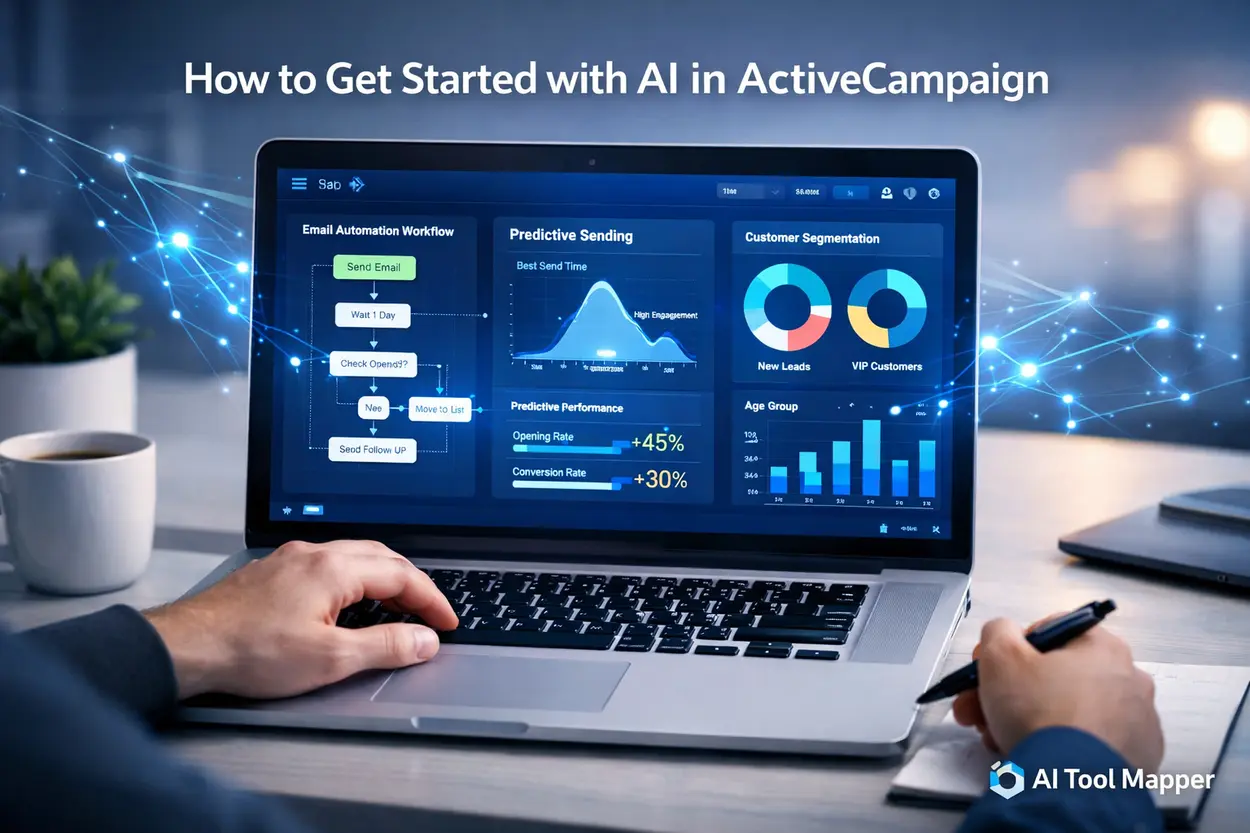
ActiveCampaign AI helps businesses automate marketing tasks using machine learning and predictive analytics. Features such as predictive sending, AI email writing, smart segmentation, and automation optimization allow marketers to deliver personalized messages and improve campaign performance. By analyzing customer behavior and engagement patterns, ActiveCampaign artificial intelligence helps businesses send better emails, automate customer journeys, and increase marketing efficiency.
Key Takeaways
- ActiveCampaign AI enables smarter marketing automation through predictive analytics and machine learning.
- Predictive sending determines the best time to send emails to each subscriber.
- AI segmentation helps marketers target audiences based on behavior and engagement patterns.
- AI email writing tools speed up content creation and improve personalization.
- ActiveCampaign AI automation workflows reduce manual marketing work and improve campaign performance.
How to Get Started with AI in ActiveCampaign
Marketing has changed dramatically over the past few years. Businesses are no longer relying only on manual campaigns, generic email newsletters, or simple automation sequences. Instead, marketing teams now depend heavily on artificial intelligence to analyze customer behavior, personalize messages, and automate decision-making in real time. One platform leading this shift toward smarter automation is ActiveCampaign AI.
Imagine running an email marketing campaign where every message reaches each subscriber at the exact moment they are most likely to open it. Or picture an automation workflow that adapts itself depending on how a customer interacts with your website, emails, or purchase history. That’s exactly what ActiveCampaign artificial intelligence makes possible.
ActiveCampaign has evolved from a traditional email marketing tool into a powerful AI-driven marketing automation platform. Its AI features help marketers generate personalized email content, segment audiences intelligently, and predict the best time to send campaigns. These capabilities allow businesses to create data-driven marketing strategies without needing advanced technical expertise.
For modern digital marketers, using ActiveCampaign AI marketing automation can mean the difference between sending generic messages and delivering highly personalized customer experiences. With tools like predictive sending, AI segmentation, automation optimization, and AI email writing, businesses can dramatically improve engagement and conversions.
This guide will walk you through how to use AI in ActiveCampaign, step by step. We will explore its most important AI features, discuss real marketing benefits, and explain how businesses can build AI-powered campaigns that drive measurable results.
Whether you run an online store, manage a SaaS company, or operate a content platform, learning how to leverage ActiveCampaign automation AI can transform your marketing workflow and help you reach the right customers at the right time.
What is ActiveCampaign AI?
At its core, ActiveCampaign artificial intelligence combines machine learning, predictive analytics, and behavioral data analysis to optimize marketing campaigns. Instead of relying solely on predefined rules, the system continuously learns from customer interactions and uses that information to improve campaign performance.
Traditional marketing automation platforms typically operate with static triggers. For example, a user signs up, receives a welcome email, and enters a fixed automation sequence. While this approach works, it lacks flexibility. AI-powered systems, on the other hand, adapt based on real-time behavior.
ActiveCampaign integrates AI across several core features, including predictive email delivery, intelligent segmentation, and automated campaign optimization. These tools allow marketers to create campaigns that automatically adjust to audience behavior.
For example, ActiveCampaign predictive email sending analyzes historical engagement data to determine when each contact is most likely to open emails. Similarly, AI segmentation in ActiveCampaign groups customers according to behavioral patterns, making personalization much more effective.
By combining these technologies, the platform transforms standard marketing workflows into adaptive, intelligent systems that learn from customer behavior.
How Active Campaign AI Improves Marketing Automation
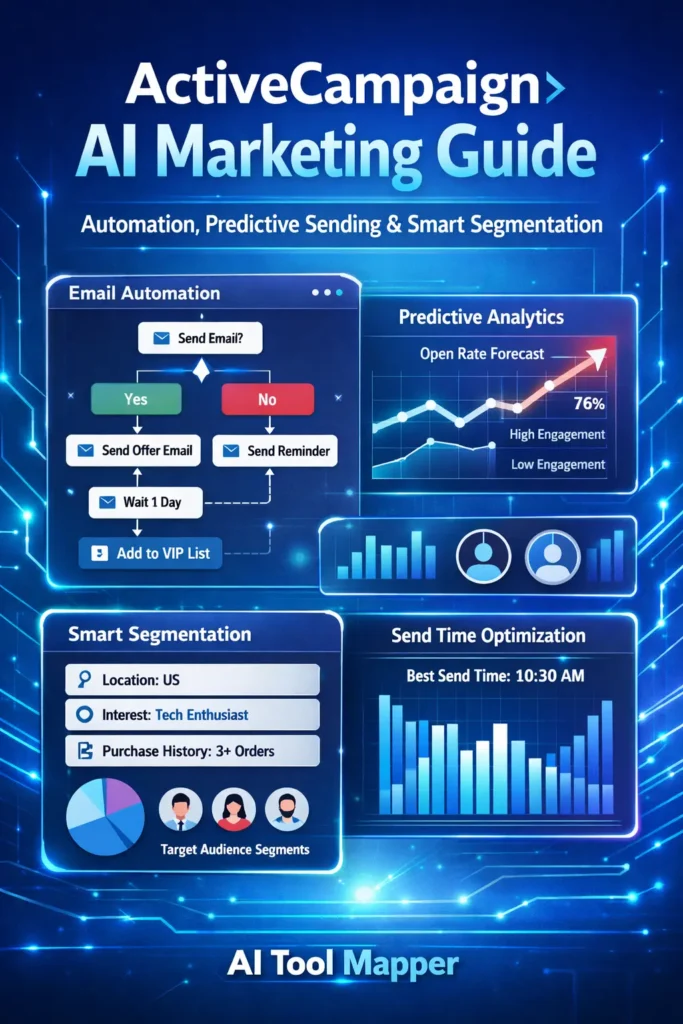
Marketing automation is powerful, but without intelligence it can become repetitive or inefficient. This is where ActiveCampaign AI marketing automation adds real value.
AI improves automation in several ways:
First, it analyzes large datasets quickly. Instead of manually analyzing email open rates, customer journeys, or engagement metrics, AI tools process this data automatically.
Second, it identifies patterns humans might miss. For instance, machine learning algorithms can detect subtle behavioral signals that indicate when a user is ready to purchase.
Third, AI enables real-time personalization. Messages can be tailored to each subscriber based on browsing behavior, previous purchases, or engagement history.
These capabilities transform automation workflows from simple rule-based systems into smart marketing engines.
For marketers looking to explore more tools that use artificial intelligence in marketing, platforms listed on AI Tool Mapper’s AI marketing tools directory can provide additional insights into the rapidly evolving AI marketing ecosystem.
Key Benefits of AI-Powered Marketing
Using ActiveCampaign AI tools offers several benefits that traditional marketing automation cannot easily match.
One of the most important advantages is efficiency. AI reduces manual tasks like segmentation, campaign testing, and content optimization.
Another benefit is improved personalization. Customers today expect relevant and timely messages. AI helps businesses deliver personalized experiences without manually analyzing customer data.
Additionally, AI improves campaign performance. Studies from organizations such as the Gartner marketing research reports show that AI-driven marketing campaigns often achieve significantly higher engagement rates than traditional campaigns.
Finally, AI helps marketers make smarter decisions. Instead of guessing which campaigns will perform best, businesses can rely on data-driven insights generated by machine learning systems.
Key AI Features in ActiveCampaign
Predictive Sending
Predictive sending is one of the most widely used ActiveCampaign AI features. This tool analyzes engagement patterns across a contact’s previous interactions and determines the optimal time to send emails.
Rather than sending emails to everyone at the same time, predictive sending delivers messages individually when each contact is most likely to open them.
For example, one subscriber may typically check email early in the morning, while another prefers evening hours. The AI system detects these habits and adjusts delivery accordingly.
The result is higher open rates and improved engagement.
Predictive Content
Another powerful feature within ActiveCampaign AI marketing tools is predictive content. This capability dynamically selects content variations based on subscriber preferences and engagement behavior.
Imagine sending an email newsletter with multiple product recommendations. Instead of displaying the same products to every reader, AI chooses the most relevant items for each subscriber.
This personalized experience increases click-through rates and improves customer satisfaction.
AI Email Writing
Creating compelling marketing emails can be time-consuming. To address this challenge, ActiveCampaign AI email writing tools help generate high-quality marketing content quickly.
Using AI prompts, marketers can generate subject lines, email introductions, product descriptions, and call-to-action messages. The system analyzes previous campaign performance and suggests content variations designed to maximize engagement.
These tools are particularly useful for businesses managing large email lists or running multiple campaigns simultaneously.
Smart Segmentation
Audience segmentation has always been important in email marketing. However, traditional segmentation often relies on static lists or manual filtering.
With AI segmentation in ActiveCampaign, the system automatically groups contacts based on behavior, engagement, and purchase history.
For example, AI may identify segments such as:
- Highly engaged subscribers
- Customers likely to make repeat purchases
- Contacts who have stopped opening emails
These segments allow marketers to create more targeted campaigns that resonate with each audience group.
Automation Optimization
One of the most advanced ActiveCampaign smart automation features involves automation optimization. AI analyzes the performance of automation workflows and suggests improvements.
For instance, the system may recommend changing email timing, adjusting message content, or modifying triggers to increase conversions.
Over time, these improvements make marketing automation workflows significantly more effective.
Benefits of Using AI in ActiveCampaign
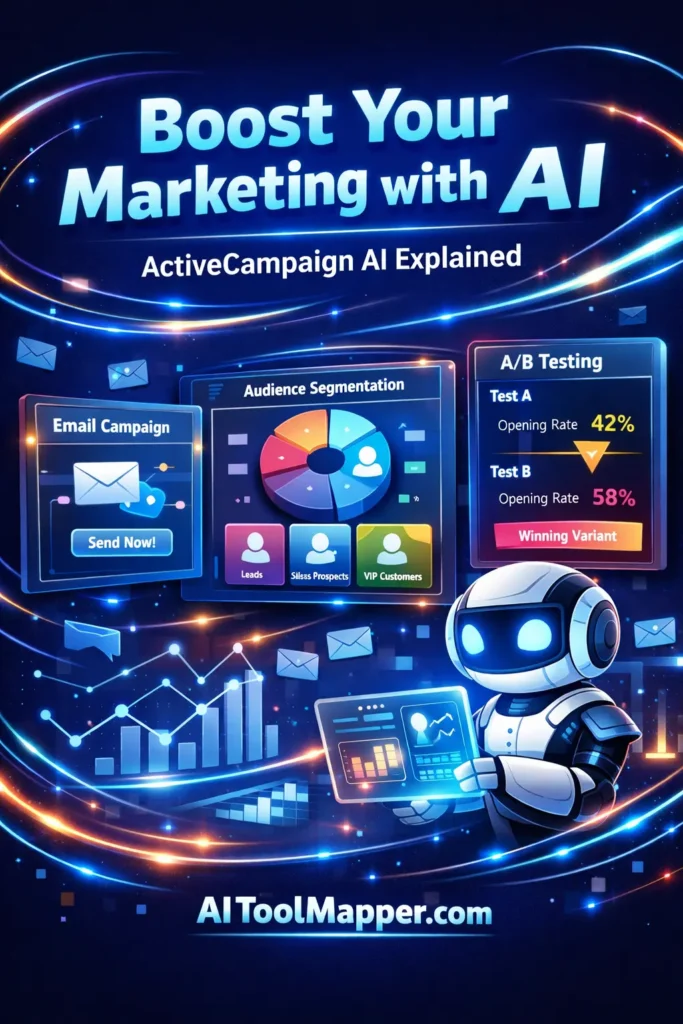
Higher Email Open Rates
One of the most noticeable advantages of using AI email marketing with ActiveCampaign is improved open rates.
Predictive sending ensures emails arrive when subscribers are most likely to engage. This dramatically increases the chances that messages will be seen and opened.
Higher open rates ultimately translate into more clicks, more conversions, and stronger customer relationships.
Better Customer Personalization
Modern consumers expect personalized experiences. Generic marketing messages often feel irrelevant or intrusive.
By using ActiveCampaign machine learning marketing tools, businesses can tailor emails to each subscriber’s preferences and behavior.
For example, product recommendations, promotional offers, and content suggestions can all be customized automatically.
Automated Marketing Workflows
Marketing teams often spend hours managing repetitive tasks such as list segmentation, campaign scheduling, and follow-up emails.
With ActiveCampaign AI automation workflows, many of these processes become fully automated.
Once a workflow is configured, AI continuously monitors performance and adjusts campaigns to improve results.
Improved Customer Engagement
AI doesn’t just automate marketing; it improves how businesses interact with customers.
By analyzing engagement data, AI can determine what types of content resonate with different audiences. This allows businesses to refine messaging strategies and build stronger relationships with customers.
Step-by-Step Guide to Getting Started with AI in ActiveCampaign
Step 1: Create an ActiveCampaign Account
The first step in using ActiveCampaign AI marketing platform features is creating an account. Once registered, users can access the platform’s marketing automation tools, email builder, and AI features.
Businesses should also integrate their website and CRM data to maximize AI insights.
Step 2: Set Up Your Contact List
AI works best when it has access to high-quality data. Therefore, importing or building a detailed contact list is essential.
Marketers should include data points such as:
- Email engagement history
- Purchase behavior
- Website activity
- Demographic information
The more data the system has, the more accurate ActiveCampaign AI segmentation will become.
Step 3: Enable AI Automation Features
Next, marketers should enable the platform’s AI features within automation workflows.
This may include predictive sending, AI content suggestions, and automated segmentation.
These features transform standard campaigns into AI-powered email automation systems.
Step 4: Create Your First AI-Powered Campaign
Once AI features are enabled, businesses can begin building campaigns.
For example:
- Create a welcome email sequence
- Use predictive sending for delivery timing
- Add AI-generated subject lines
- Implement smart segmentation
This approach ensures campaigns are personalized and optimized from the start.
Step 5: Analyze Campaign Performance Using AI Insights
After launching campaigns, marketers should monitor performance metrics using AI analytics.
These insights may reveal patterns such as:
- Which subject lines generate the most engagement
- Which segments convert most frequently
- Which email timing strategies work best
By continuously analyzing these insights, businesses can refine their ActiveCampaign AI marketing strategies.
How to Use AI Automation Workflows
Creating AI-Powered Marketing Funnels
AI automation workflows allow businesses to design complete customer journeys.
For example, a new subscriber may receive a welcome email, followed by personalized content recommendations and product offers based on engagement behavior.
This type of funnel adapts automatically as customer behavior changes.
Using Triggers and Behavioral Data
Triggers play a crucial role in ActiveCampaign AI automation workflow design.
Common triggers include:
- Email opens
- Website visits
- Product purchases
- Form submissions
By analyzing these triggers, AI can determine the best follow-up actions.
Automating Follow-Ups and Email Sequences
Follow-up campaigns are essential for nurturing leads.
Using AI powered email automation, marketers can automatically send personalized follow-ups based on user behavior.
For example, if a subscriber clicks on a product link but does not purchase, the system can trigger a reminder email with additional information or a special offer.
Best AI Use Cases in ActiveCampaign
AI Email Marketing
One of the most common applications of ActiveCampaign AI marketing tools is email marketing.
AI helps marketers generate subject lines, personalize content, and optimize send times.
AI Lead Scoring
Lead scoring helps businesses identify prospects most likely to convert.
AI analyzes customer behavior and engagement patterns to assign dynamic lead scores.
AI Customer Journey Automation
Customer journeys often involve multiple touchpoints across email, website visits, and product interactions.
AI ensures each interaction is relevant and personalized.
AI Campaign Optimization
AI continuously analyzes campaign performance and recommends improvements.
These insights allow marketers to refine strategies and achieve better results over time.
ActiveCampaign AI vs Traditional Marketing Automation
| Feature | Traditional Automation | AI Automation |
|---|---|---|
| Email Timing | Manual scheduling | Predictive sending |
| Segmentation | Static lists | AI segmentation |
| Campaign optimization | Manual testing | AI insights |
Tips to Maximize AI Results in ActiveCampaign
Use Behavioral Data
Behavioral data provides valuable insights into customer preferences. AI systems rely on this data to improve segmentation and personalization.
Test AI Automation Workflows
Even though AI optimizes campaigns automatically, testing different workflows can reveal new opportunities for improvement.
Personalize Campaigns Using AI Insights
Marketers should regularly analyze AI insights and adjust campaigns to deliver more relevant experiences.
Monitor AI Analytics Regularly
Tracking analytics ensures campaigns continue improving over time.
Common Mistakes to Avoid When Using AI in ActiveCampaign
Over-Automation
Automation is powerful, but excessive automation can feel impersonal.
Businesses should balance automation with authentic communication.
Poor Data Quality
AI relies heavily on accurate data. Poor data quality can lead to ineffective segmentation and personalization.
Ignoring Analytics Insights
Failing to analyze campaign data can prevent businesses from identifying improvement opportunities.
Not Testing AI Workflows
Testing different automation strategies ensures campaigns remain optimized.
Future of AI in ActiveCampaign Marketing
AI-Driven Customer Journeys
Future marketing systems will create dynamic customer journeys that adapt in real time.
Predictive Marketing Automation
Predictive analytics will help marketers anticipate customer needs before they arise.
Hyper-Personalized Email Marketing
AI will continue improving personalization, allowing businesses to deliver highly relevant experiences.
Conclusion
Artificial intelligence is rapidly transforming digital marketing. Platforms like ActiveCampaign AI demonstrate how machine learning and predictive analytics can simplify complex marketing tasks while delivering better results.
By using tools such as predictive sending, smart segmentation, AI email writing, and automation optimization, businesses can build smarter campaigns that adapt to customer behavior in real time.
For marketers who want to stay competitive, learning how to use ActiveCampaign AI marketing automation is no longer optional. It is becoming a core skill in modern digital marketing.
With the right strategy, data, and experimentation, businesses can leverage AI to create marketing campaigns that are more efficient, more personalized, and significantly more effective.
FAQs
1. What AI features does ActiveCampaign offer?
ActiveCampaign offers a powerful suite of AI features, including predictive sending, AI email writing, smart segmentation, predictive content, and automation optimization. These tools use machine learning to analyze user behavior, personalize messaging, and improve campaign performance automatically, helping marketers deliver more relevant and timely experiences to their audience.
2. Is ActiveCampaign AI good for small businesses?
Yes, ActiveCampaign AI is highly suitable for small businesses. It simplifies marketing by automating repetitive tasks like email campaigns, segmentation, and follow-ups. With built-in intelligence, even non-technical users can create personalized campaigns, improve engagement, and scale their marketing efforts without needing a large team or advanced expertise.
3. How does predictive sending work in ActiveCampaign?
Predictive sending uses machine learning to study each contact’s past behavior, such as when they open emails or click links. Based on this data, ActiveCampaign schedules email delivery at the optimal time for each individual, increasing the likelihood of engagement and improving overall campaign performance.
4. Can AI improve email marketing results?
Yes, AI can significantly enhance email marketing results by optimizing send times, generating personalized content, and segmenting audiences more effectively. It also analyzes campaign performance in real time, allowing marketers to make data-driven improvements that boost open rates, click-through rates, and conversions.
5. What is AI email writing in ActiveCampaign?
AI email writing in ActiveCampaign helps marketers generate high-quality email content quickly. It can suggest subject lines, create engaging copy, and personalize messages based on customer data. This reduces content creation time while improving the effectiveness and relevance of email campaigns.
6. How does AI segmentation work in ActiveCampaign?
AI segmentation automatically groups contacts based on behavior, engagement patterns, and customer data. Instead of manually creating lists, the system identifies meaningful segments such as active users, potential buyers, or disengaged subscribers, allowing marketers to target each group with more relevant and personalized campaigns.
7. What is automation optimization in ActiveCampaign AI?
Automation optimization uses AI to analyze the performance of marketing workflows and suggest improvements. It identifies weak points in campaigns, recommends better timing or messaging, and helps refine automation sequences, ensuring that marketing efforts continuously improve without constant manual adjustments.
8. Does ActiveCampaign AI require technical skills?
No, ActiveCampaign AI is designed for ease of use. Its intuitive interface and built-in automation tools allow users to implement AI-driven marketing strategies without coding or advanced technical knowledge. This makes it accessible for beginners while still powerful enough for experienced marketers.
9. How does AI help with customer journey automation?
AI enhances customer journey automation by tracking user behavior across multiple touchpoints. It adjusts messaging, timing, and offers based on how customers interact with emails and websites, ensuring each user receives a personalized experience that guides them smoothly through the sales funnel.
10. Is ActiveCampaign AI useful for eCommerce businesses?
Yes, ActiveCampaign AI is especially valuable for eCommerce businesses. It can recommend products, automate abandoned cart emails, segment customers based on purchase behavior, and optimize campaigns for higher conversions. These features help online stores increase sales while improving customer engagement and retention.