
An enterprise AI solution is a business-focused artificial intelligence system designed to automate tasks, analyze large-scale data, and enhance decision-making. These solutions integrate with existing enterprise systems like CRM and ERP platforms, enabling organizations to improve efficiency, reduce costs, and deliver personalized customer experiences.
📌 Key Takeaways
- Enterprise AI solutions enable automation, data analysis, and decision-making at scale
- They integrate with business systems like CRM and ERP
- Key benefits include efficiency, cost savings, and improved customer experience
- Common use cases include chatbots, predictive analytics, and fraud detection
- Implementation requires strategy, clean data, and continuous optimization
- The future lies in generative AI, AI agents, and hyper-personalization
What Is an Enterprise AI Solution?
An enterprise AI solution is a system that uses artificial intelligence to automate processes, analyze large volumes of data, and support smarter decision-making across an organization.
In simple terms, it’s AI built specifically for businesses—helping companies streamline operations, improve customer experiences, and make data-driven decisions at scale.
👉 Think of it as the “brain” behind modern digital businesses, quietly working in the background to optimize everything from marketing campaigns to supply chains.
What Does Enterprise AI Mean?
At its core, enterprise artificial intelligence refers to AI technologies designed for large organizations handling complex workflows and massive datasets.
But how is it different from basic AI?
Regular AI might power a chatbot or recommendation engine.
Enterprise AI, on the other hand, operates across departments—finance, HR, marketing, operations—working as a unified intelligence layer.
Key Characteristics of Enterprise AI
- Handles large-scale data processing
- Integrates with enterprise systems (CRM, ERP, cloud)
- Supports AI solutions for business growth
- Enables real-time decision-making
- Operates across multiple departments
👉 In short, enterprise AI solutions are not tools—they are ecosystems.
How Does an Enterprise AI Solution Work?
Understanding how enterprise AI works doesn’t require a data science degree. Let’s break it down step by step.
🔹 Data Collection & Processing
Every enterprise AI system begins with data.
Businesses generate two main types of data:
- Structured data: Databases, spreadsheets
- Unstructured data: Emails, videos, social media
AI systems gather and process this data to extract meaningful insights.
👉 This is the foundation of data-driven decision making.
🔹 Machine Learning Models
Once data is processed, machine learning models step in.
These models:
- Identify patterns
- Predict outcomes
- Automate decisions
For example:
- Predict customer churn
- Forecast sales trends
- Detect anomalies in transactions
🔹 AI Integration with Business Systems
Enterprise AI doesn’t work in isolation.
It integrates with:
- CRM systems (customer data)
- ERP systems (operations)
- Cloud platforms (scalability)
This ensures AI insights are applied directly to business workflows.
🔹 Continuous Learning & Optimization
Unlike traditional software, AI systems improve over time.
- Learn from new data
- Adapt to changing conditions
- Optimize performance automatically
👉 This is what makes AI automation so powerful—it evolves with your business.
🚀 Key Benefits of Enterprise AI Solutions
Why are businesses investing heavily in enterprise AI solutions?
Because the impact is massive.
🔥 Top Benefits
- Improved Efficiency
Automates repetitive tasks like data entry, customer support, and reporting. - Cost Reduction
Reduces manual labor and operational inefficiencies. - Better Decision-Making
Uses predictive analytics to guide strategy. - Scalable Automation
Handles thousands of tasks simultaneously without human intervention. - Enhanced Customer Experience
Personalizes interactions based on user behavior.
💡 Real-World Example
Imagine an eCommerce company using AI to recommend products.
Instead of generic suggestions, AI analyzes browsing history and predicts what each customer is likely to buy.
Result?
Higher conversions and happier customers.
🧩 Top Enterprise AI Use Cases
Let’s explore how companies actually use enterprise AI today.
🤖 Customer Support Automation
AI-powered chatbots and virtual assistants handle:
- FAQs
- Order tracking
- Customer queries
👉 Example: A telecom company reduces support tickets by 40% using AI chatbots.
📈 Predictive Analytics in Business
AI predicts future outcomes using historical data.
- Sales forecasting
- Demand prediction
- Risk analysis
👉 Example: Retail chains optimize inventory using AI forecasts.
🔐 Fraud Detection & Security
Banks use AI to detect suspicious transactions in real time.
- Pattern recognition
- Anomaly detection
👉 Example: AI flags unusual credit card activity instantly.
🚚 Supply Chain Optimization
AI improves logistics by:
- Predicting demand
- Optimizing routes
- Reducing delays
👉 Example: Logistics companies cut delivery times using AI insights.
🎯 Marketing Personalization
AI tailors marketing campaigns to individual users.
- Email personalization
- Product recommendations
- Ad targeting
👉 Example: Streaming platforms suggest content based on viewing habits.
🏢 Examples of Enterprise AI Solutions
Instead of focusing on specific brands, let’s look at categories of enterprise AI tools:
- AI-powered CRM systems
Manage customer relationships intelligently - Business intelligence platforms
Analyze and visualize data - Automation platforms
Streamline workflows and repetitive tasks - Enterprise chatbots
Handle customer interactions at scale - AI analytics tools
Provide predictive insights for decision-making
👉 Platforms like those listed on AIToolMapper help businesses explore and compare these solutions effectively.
🔄 Enterprise AI vs Traditional AI
| Feature | Enterprise AI | Traditional AI |
| Scale | Large | Small |
| Data | Big Data | Limited Data |
| Integration | High | Low |
| Use Case | Business-wide | Specific task |
| Complexity | Advanced | Basic |
👉 Enterprise AI is built for scale, integration, and impact.
🧱 Key Components of Enterprise AI Architecture
A strong enterprise AI architecture includes:
- Data Infrastructure
Data lakes, warehouses - AI Models
Machine learning algorithms - APIs & Integrations
Connect AI with business systems - Cloud Computing
Scalable computing power - Security Layers
Data protection and compliance
👉 Think of it as a digital backbone supporting intelligent operations.
🛠️ How to Implement Enterprise AI in Your Business
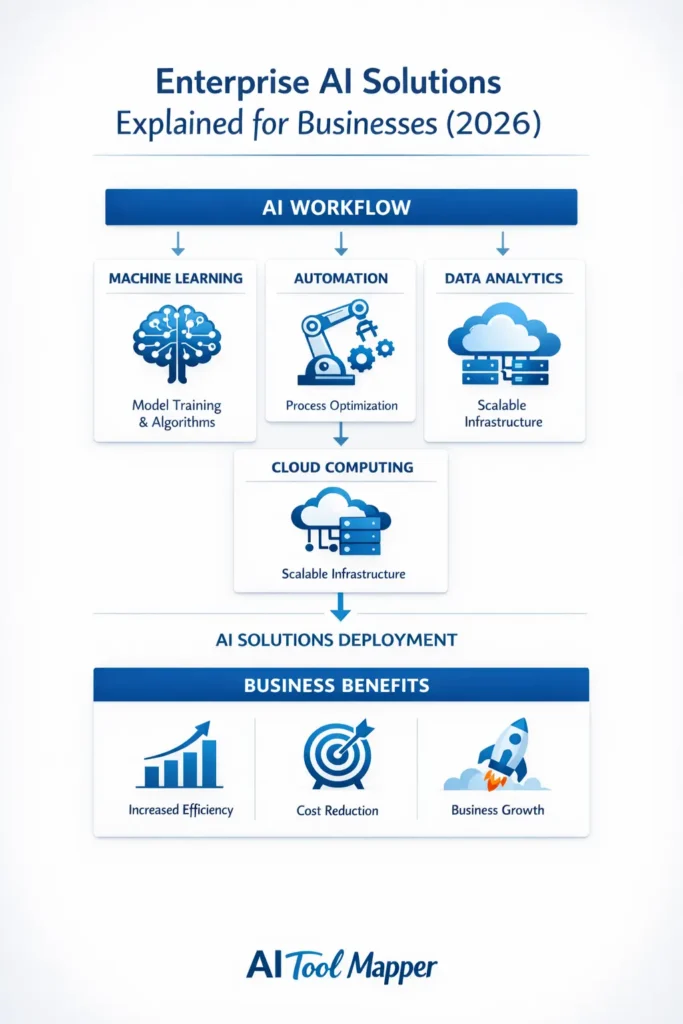
Adopting enterprise AI isn’t just about technology—it’s about strategy.
Step 1: Identify Business Problems
Start with clear goals:
- Reduce costs?
- Improve customer experience?
- Increase revenue?
Step 2: Choose the Right AI Solution
Select tools aligned with your needs.
👉 Avoid chasing trends—focus on real business value.
Step 3: Data Preparation
Clean and organize your data.
Bad data = bad AI results.
Step 4: Integration & Testing
Integrate AI into existing systems and test thoroughly.
Step 5: Monitor & Optimize
Continuously evaluate performance and improve models.
👉 AI is not “set and forget.”
⚠️ Challenges of Enterprise AI Adoption
While powerful, enterprise AI comes with challenges.
Common Issues
- High Implementation Cost
- Data Privacy Concerns
- Skill Gap in AI Talent
- Complex Integration
👉 Being aware of these helps businesses plan better.
🔮 Future Trends in Enterprise AI (2026 & Beyond)
The future of enterprise AI is evolving rapidly.
🚀 Key Trends
- Generative AI in Enterprises
Creating content, code, and designs automatically - AI Agents & Automation
Autonomous systems handling complex workflows - Hyper-Personalization
Tailored experiences for every user - AI + Cloud Synergy
Faster, scalable AI deployment
👉 The next wave of AI solutions for companies will be smarter, faster, and more autonomous.
FAQs (People Also Ask)
1. What is an enterprise AI solution?
An enterprise AI solution is a business-oriented artificial intelligence system designed to automate workflows, analyze large-scale data, and enhance decision-making. It integrates seamlessly with enterprise tools like CRM and ERP systems, helping organizations improve efficiency, reduce manual work, and operate more intelligently at scale.
2. How do enterprise AI solutions work?
Enterprise AI solutions collect and process large volumes of structured and unstructured data, then use machine learning models to identify patterns and generate insights. These insights are integrated into business systems, enabling automation and smarter decisions. Over time, the system continuously learns and improves its accuracy and performance.
3. What are examples of enterprise AI?
Common examples of enterprise AI include AI-powered CRM systems, predictive analytics platforms, fraud detection tools, workflow automation software, and enterprise chatbots. These solutions are widely used to optimize operations, enhance customer experiences, and improve productivity across departments like marketing, finance, and customer support.
4. What are the benefits of enterprise AI?
Enterprise AI provides several benefits, including improved operational efficiency, reduced costs, better decision-making, and scalable automation. It also enhances customer experiences through personalization and real-time insights. By leveraging data-driven strategies, businesses can gain a competitive advantage and respond faster to market changes.
5. Is enterprise AI expensive?
Enterprise AI can require a significant upfront investment in infrastructure, integration, and skilled talent. However, its long-term benefits—such as cost savings, increased productivity, and improved efficiency—often outweigh the initial expenses. Many businesses also adopt cloud-based AI solutions to reduce costs and scale gradually.
6. How is enterprise AI different from regular AI?
Enterprise AI is built for large-scale operations, handling vast datasets and integrating across multiple business systems. In contrast, regular AI typically focuses on narrow tasks with limited data and minimal integration. Enterprise AI is more complex, scalable, and designed to deliver organization-wide impact.
7. Can small businesses use enterprise AI?
Yes, small businesses can use enterprise AI through cloud-based and subscription-based solutions. Many AI platforms offer scalable features that fit smaller budgets, allowing businesses to automate tasks, analyze data, and improve decision-making without heavy infrastructure investments.
8. What industries use enterprise AI the most?
Enterprise AI is widely used in industries such as finance, healthcare, retail, manufacturing, and logistics. These sectors rely on AI for tasks like predictive analytics, fraud detection, supply chain optimization, and customer personalization to improve efficiency and stay competitive.
9. What is enterprise AI architecture?
Enterprise AI architecture refers to the structured framework that supports AI systems within an organization. It includes data infrastructure, machine learning models, APIs, cloud platforms, and security layers. This architecture ensures seamless integration, scalability, and efficient performance across various business operations.
10. How to choose the best enterprise AI solution?
To choose the best enterprise AI solution, businesses should identify their goals, evaluate features, ensure scalability, and check integration capabilities with existing systems. Cost, ease of use, and vendor support are also important factors. The ideal solution should align with long-term business strategy and deliver measurable results.
🏁 Final Thoughts on Enterprise AI Solutions
Enterprise AI is no longer a futuristic concept—it’s a present-day necessity.
Businesses that embrace AI today are setting themselves up for long-term success. Those that delay risk falling behind in an increasingly competitive, data-driven world.
So, the real question isn’t:
“Should you adopt enterprise AI?”
It’s:
“How fast can you implement it?”